
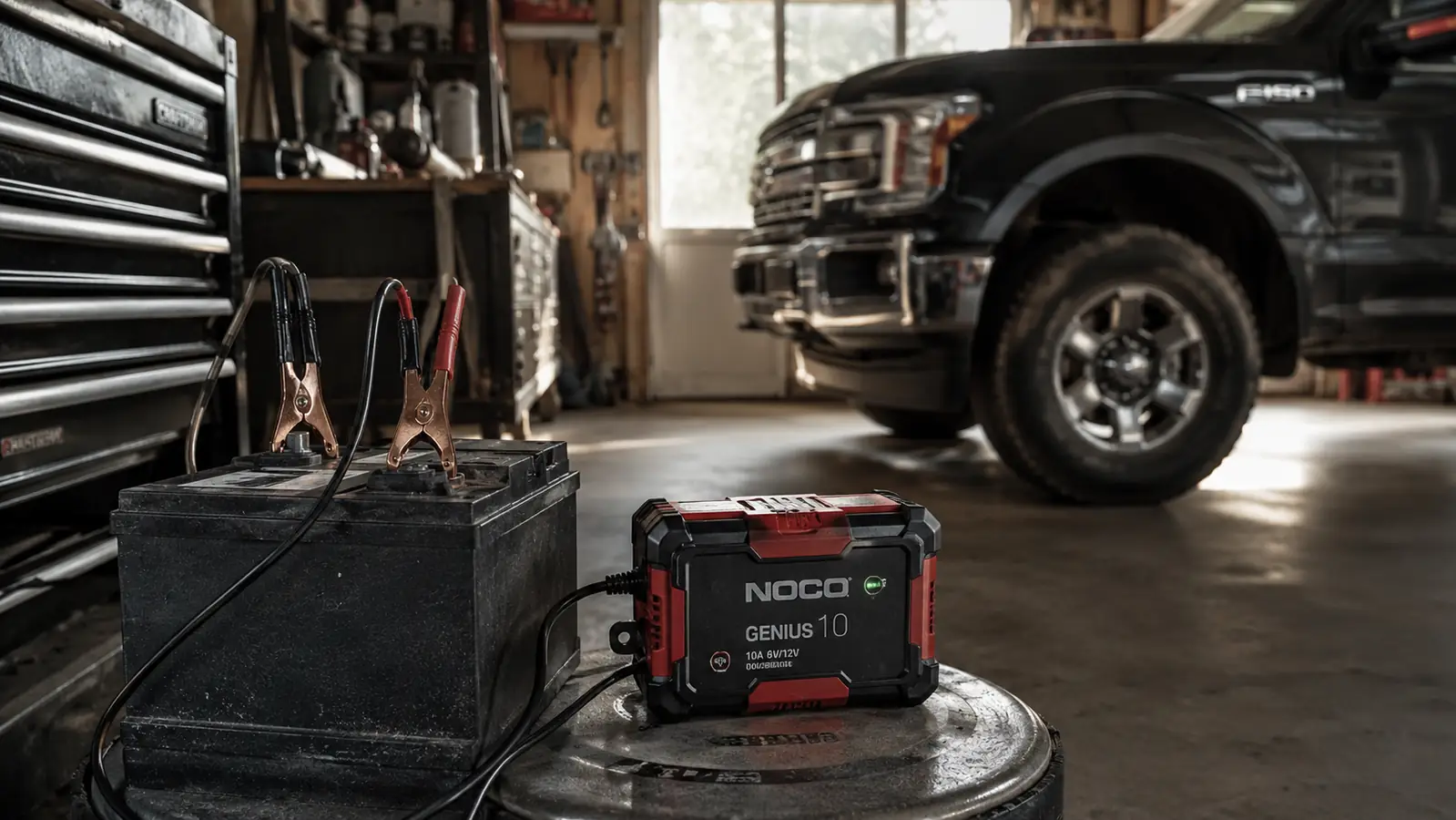
Come January in Ohio, I expect to walk out to the driveway and hear that slow, tired crank from the F-150. It has 190,000 miles on it and a battery that was already three years old when I started paying attention to it. I have jumped that truck more times than I want to admit, usually in a coat I was not dressed for. So this winter I finally did what I should have done years ago: I put a maintainer on it. The one I kept reaching for was the NOCO GENIUS1, and after six months of real use on two vehicles, I have opinions.
The Quick Verdict
The NOCO GENIUS1 is the first maintainer I have owned that I actually trust to leave hooked up all winter. It is slow, so do not buy it to rescue a dead battery. Buy it to keep a good battery from dying.
Amazon Check Today's Price →Keep your battery from dying in the cold
The NOCO GENIUS1 is the maintainer I leave on my F-150 all winter. It charges, maintains, and desulfates automatically, and it is small enough to hang anywhere in the garage.
Amazon Check Today's Price on Amazon →How I've Used It
I ran the NOCO GENIUS1 on my 2014 F-150 through January, February, and most of March. The truck sits for days at a time when I am not driving it, and that is exactly the situation that kills a battery. I hooked the clamps up, plugged the charger into a garage outlet, and let it do its thing. The GENIUS1 is a 1-amp charger, which sounds small, and it is. That is the point. It is not built to charge a dead battery fast. It is built to sit there and hold a battery at the right voltage for months.
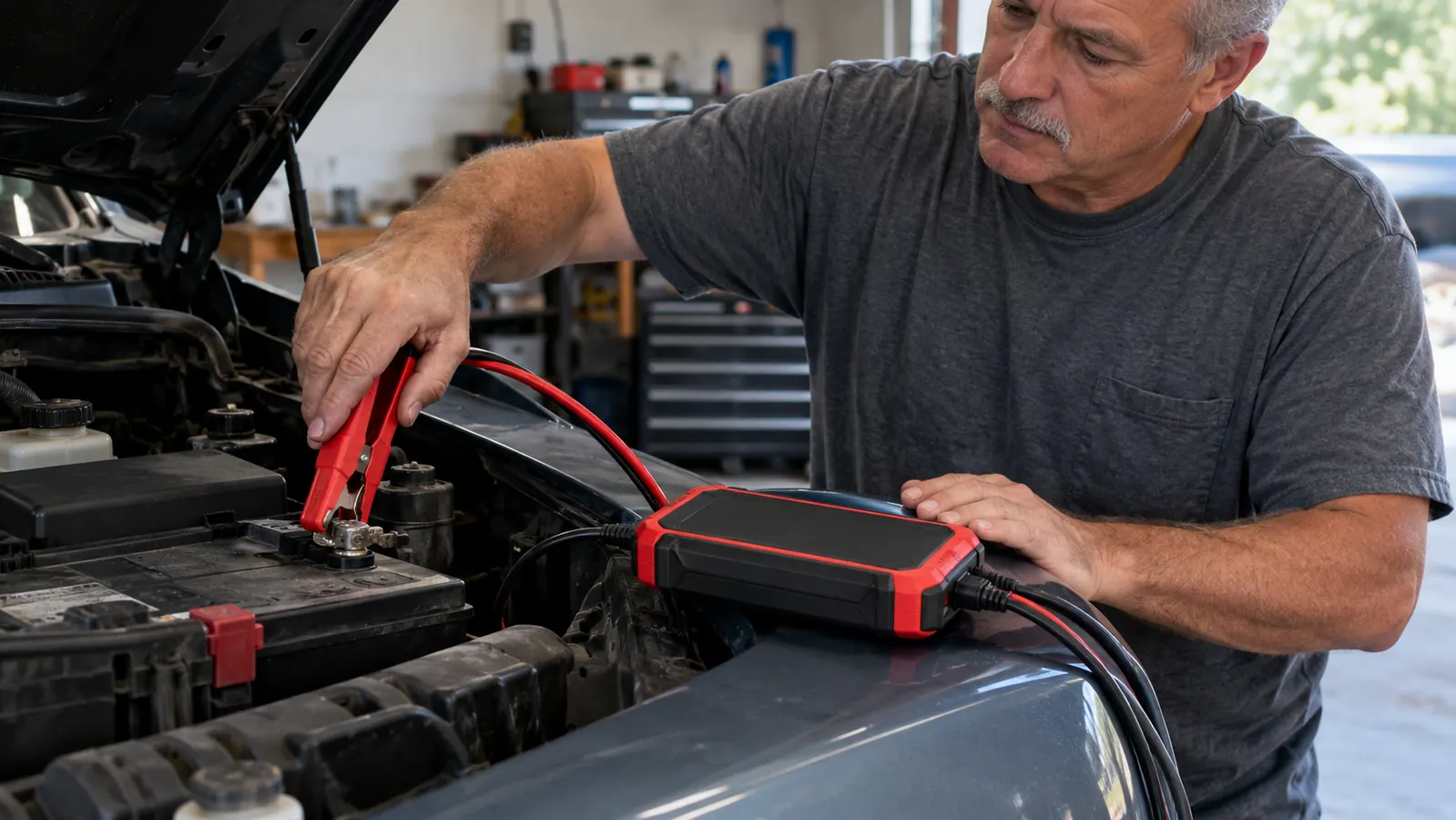
The first hookup took me longer than it should have, because I did something dumb. I clamped the red lead to the positive terminal and the black lead to the negative, which is right, but I had the charger sitting on the fender and the clamps kept sliding off the posts. The posts on this truck are side terminals, not top posts, and the angle is awkward. I finally figured out that the trick is to hook the clamps on from underneath, where the jaw bites the terminal flat, then give the cable a little slack so it does not pull the clamp loose. Once I did that, it stayed put for the whole winter. I mention this because the reviews that complain about the clamps falling off are usually about the angle, not the clamp. The clamp is fine. The angle is the problem, and the angle is fixable.
After the F-150 was sorted, I moved the unit over to Carol's 2017 CR-V for a stretch. That SUV does not sit as long, but it does sit, and her battery was starting to show its age. Same story: clamp on, plug in, walk away. The GENIUS1 has a mode for 6-volt batteries and a mode for 12-volt, and it picks the right one automatically. I did not have to think about it, which is exactly what I want from a tool I am leaving unattended.
One thing I will say plainly: this is not a jump starter and it is not a fast charger. If you walk out to a completely dead battery, the GENIUS1 will not get you going in ten minutes. It took the better part of a day to bring a badly drained battery back to a usable state. That is not a flaw in the product. It is a misunderstanding of what the product is for. I use it to prevent the dead battery, not to recover from one.
What I wanted from it was simple: plug it in, forget about it, and have a truck that starts on the coldest morning of the year. Over three months the NOCO GENIUS1 did that, and the more I used it the more I appreciated how little it asked of me. I ran the cord out through the grille so I could clip it on and off in a few seconds, and after the first week the whole routine took less time than scraping the windshield.
What the GENIUS1 Actually Does
The NOCO GENIUS1 is a smart charger, which means it does not just dump current into a battery and hope for the best. It measures the battery's state, charges it in stages, and then switches to a maintenance mode that keeps it topped off without cooking it. That staged approach is the difference between a maintainer you can trust and a trickle charger that slowly overcharges your battery over the winter.
Here is the part that sold me. The charger starts in a bulk charge stage, where it pushes its full 1 amp into the battery until the voltage climbs. Then it drops to an absorption stage, holding the voltage steady while the current tapers off. Then it goes to float, which is a maintenance voltage that keeps the battery full without boiling off the electrolyte. A dumb trickle charger just keeps pushing current forever. The NOCO GENIUS1 stops pushing when the battery is full. That is the difference between a battery that lasts six years and a battery that gets cooked in two.
It also has a desulfation mode. Sulfation is the buildup of lead sulfate crystals on the battery plates, and it is the main reason a battery that sits for months comes back weaker. The GENIUS1 detects sulfation and runs a pulse cycle to break it down. I cannot measure that directly, but I can tell you the F-150 battery that used to struggle after a week of sitting started the truck without hesitation all winter.
The unit is weather-resistant and rated for outdoor use, which matters if you do not have a garage outlet near the car. I have mine in the garage, but I have read the manual and it is designed to handle the elements. The clamps are solid, the cable is long enough to reach from the battery to the ground, and the whole thing is small enough to hang on the battery tray or a hook on the wall.
I also like that it does not need babysitting. With some older chargers I owned, I used to set a kitchen timer so I would remember to unhook the battery before it boiled. The NOCO GENIUS1 watches the battery itself and drops into maintenance mode on its own, so I could leave it connected for weeks at a time while the truck sat without worrying about overcharging.
Performance Over a Full Winter
The real test was the stretch in February when we had a week of single-digit nights. The F-150 sat for five days straight. Every morning I expected the slow crank. Every morning it fired up like it was June. That is the first winter in years I have not had to jump that truck, and I give the NOCO GENIUS1 the credit.
I also paid attention to the battery voltage. Before I hooked up the maintainer, the truck's battery would sit around 12.2 volts after a few days of rest, which is getting into the danger zone. With the GENIUS1 connected, it held at 12.7 volts, which is a fully charged battery. That is the whole job, and it did it without me touching it for weeks at a time.
Let me give you the actual numbers from that cold snap. On the morning of February 12, the thermometer outside my garage read 4 degrees. The truck had not moved since the previous Saturday. I walked out with a cup of coffee, half expecting to need the jumper cables, and the starter cranked maybe three revolutions before the engine caught. I checked the voltage with my multimeter before I unhooked the charger: 12.68 volts. A week later, after another four days of sitting, it read 12.71. That is a battery that is not just surviving the winter, it is sitting at a full charge the whole time. The old battery, before the NOCO GENIUS1, would read 12.2 after two days and I would start mentally preparing for a jump.
The one annoyance: the status lights. They are bright, and the GENIUS1 sits in the garage where I can see it from the kitchen window. At night it glows like a little beacon. That is not a real complaint, but if you are the kind of person who is bothered by a glowing light in your garage, you should know it is there.
If you are buying a maintainer for a vehicle that sits through the winter, that week of single-digit nights is the scenario that matters, and it is the one the NOCO GENIUS1 handled best. The truck started every morning, the battery voltage stayed where it should, and I never once had to drag out the jump pack. That is not exciting to write about, and that is exactly the point.

Who This Is For
The NOCO GENIUS1 is for anyone who has a vehicle that sits. A daily driver that you use every day does not need a maintainer. A truck that sits for a week at a time, a classic car, a motorcycle, a lawn tractor, a boat, that is what this thing is for. If you have ever come out to a dead battery and thought, I should have done something about this, this is the something.
It is also for the person who does not want to think about batteries at all. That is the quiet strength of the NOCO GENIUS1. You clamp it on, plug it in, and it manages the whole job. It decides the voltage, it decides the charge stage, it decides when to switch to maintenance, and it decides when to run a desulfation cycle. There is no switch to set wrong, no timer to forget, no dial to misread. For a guy like me who has killed a battery or two by leaving a dumb charger on it too long, that hands-off behavior is worth the price of the unit by itself.
Who Should Skip It
Skip the NOCO GENIUS1 if you need to bring a dead battery back to life in a hurry. It is a 1-amp charger, and 1 amp is slow. If your battery is completely drained, you will be waiting most of a day. For that job, you want a larger charger or a jump starter. Also skip it if you only have one vehicle and you drive it every day. You do not need a maintainer, and you would be buying a tool that does not fit your situation.
And be honest with yourself about what kind of battery you are dealing with. If the battery is already on its last legs, if it is swollen, if it will not hold a charge even after a full day on the charger, the NOCO GENIUS1 is not going to resurrect it. I learned that lesson the hard way on a lawn tractor battery a few years back. A maintainer keeps a good battery good. It does not make a dead battery new. If your battery is truly done, replace it first, then put the maintainer on the new one.
If you are somewhere in between, a vehicle that sits for a few weeks at a time, a battery that is a few years old but still healthy, and a garage or driveway where you can run a cord, the NOCO GENIUS1 is the right size of tool. It is small enough to hang on a hook, simple enough that Carol has hooked it up herself, and gentle enough to leave on all season.
Pros and Cons
What I Liked
- Holds a battery at full charge all winter without overcharging
- Desulfation mode can extend the life of a battery that sits
- Automatic 6V and 12V detection, no settings to get wrong
- Weather-resistant housing, safe to use outside
- Small and light, easy to hang or store
- Spark-proof clamps and reverse polarity protection
Where It Falls Short
- 1-amp output is too slow to recover a dead battery quickly
- Status light is bright enough to notice in a dark garage
- Cable is long enough but not generous for large trucks
The F-150 sat for five days in single-digit weather and fired up like it was June. That is the first winter in years I have not had to jump that truck.
The maintainer I trust on my own truck
After a full winter on my F-150 and Carol's CR-V, the NOCO GENIUS1 is the tool I leave hooked up and forget about. If you have a vehicle that sits, this is the one I would buy again.
Amazon Check Today's Price on Amazon →