

The check engine light came on in my 2014 F-150 on a Tuesday morning in March, right as I was pulling out of the driveway. I did what I used to do: I swore, guessed, and drove forty minutes to a shop that charged me a diagnostic fee to tell me the gas cap was loose. That was the last time I paid for a diagnosis. A year later, the ANCEL AD310 has paid for itself several times over, and I have a much better idea of what it can and cannot do.
I am Walt Kessler, 58, a retired factory maintenance tech who does all his own vehicle work in a two-car garage outside Dayton, Ohio. My daily driver is a 2014 F-150 with a little over 190,000 miles on it, and I also keep my wife Carol's 2017 Honda CR-V running. This review is about the ANCEL AD310 after a full year of real use, not a weekend of playing with a new toy.
The Quick Verdict
The ANCEL AD310 is the best cheap code reader I have used in thirty years of turning wrenches. It reads and clears codes on both of my vehicles, the buttons are simple enough for a beginner, and it has saved me more in avoided shop visits than it cost. It will not do live data, and that is the only reason it is not a perfect score.
Amazon Check Today's Price →Stop paying a shop for a gas cap diagnosis
The ANCEL AD310 reads and clears engine codes on any 1996 or newer OBD2 vehicle. I have used it on my F-150 and my wife's CR-V for a year, and it has paid for itself many times over.
Amazon Check Today's Price on Amazon →How I've Used It
In the past twelve months, the check engine light has come on in one of our two vehicles nine times. That sounds like a lot, but it is what 190,000 miles looks like. The ANCEL AD310 has been plugged into the diagnostic port under the dash for every one of those events, plus a few times when I was just curious about what the computer was seeing.
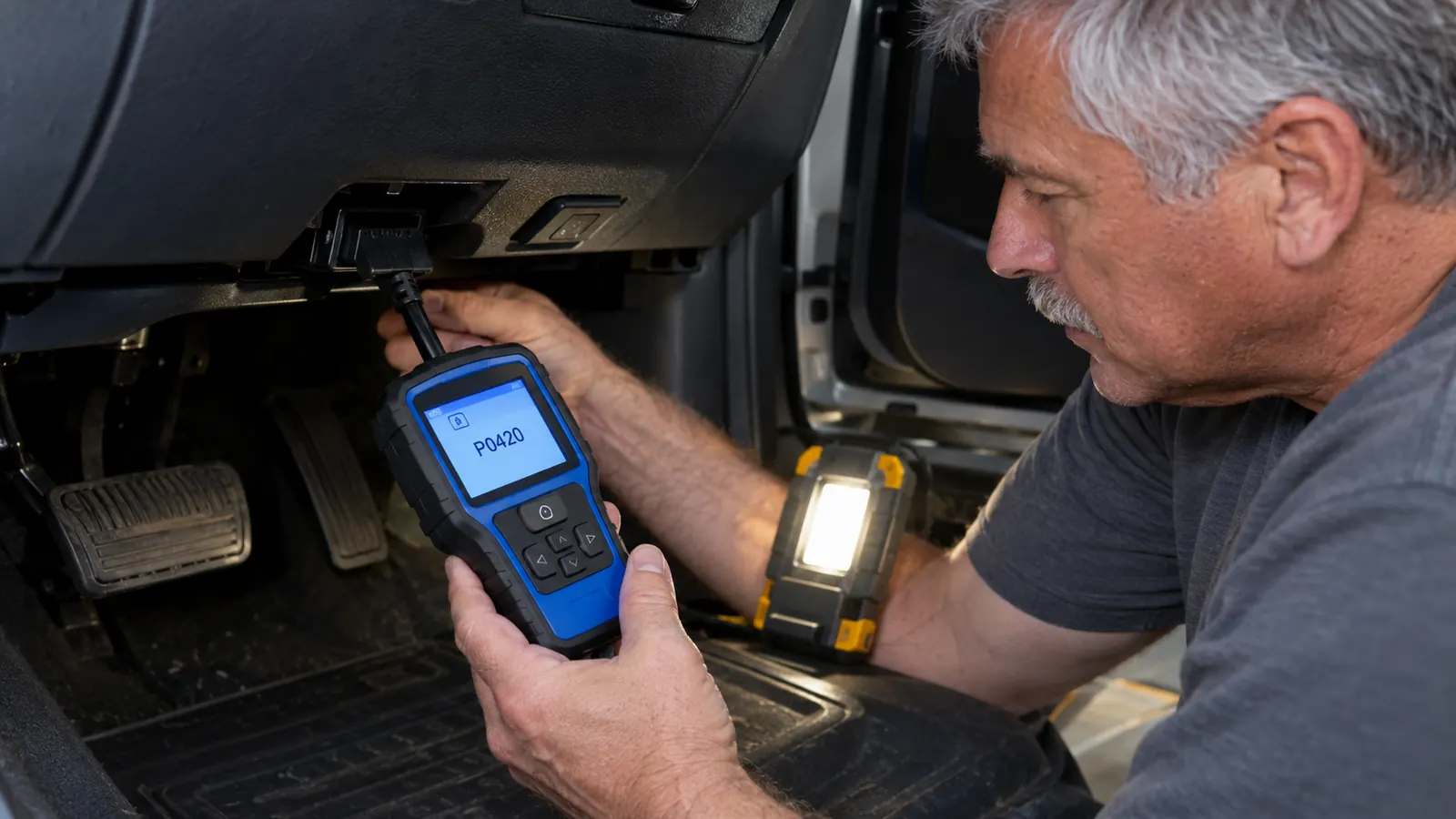
The routine is always the same. I park on the concrete floor of the garage, set the parking brake, and kneel down by the driver's side. On the F-150 the port sits just left of the steering column under the dash. On the CR-V it is in almost the same spot, easy to reach without any contortion. I plug the scanner in, turn the key to the on position without starting the engine, and wait a few seconds. The screen lights up, the scanner talks to the computer, and the code appears. No phone, no app, no pairing. Just a cable and a screen. I keep a spiral notebook on the workbench, and every code goes into it with the date and the mileage. That notebook has been worth more than the tool itself, because it lets me see patterns. A code that comes back every six weeks is a different problem than a code that shows up once and never again.
The first event was the one that sold me on this tool. That Tuesday in March, the P0455 on the F-150 pointed to a loose gas cap. I had already paid a shop for that exact diagnosis the year before, so this time I just got out, tightened the cap, cleared the code with the AD310, and went on with my day. The light has not come back for that reason since.
The June P0420 on the CR-V took more work. That code means the catalytic converter is not cleaning the exhaust as well as it should. The honest answer is that the converter itself could be going, and that is an expensive job. But I did not want to throw a converter at the car without checking the cheaper causes first. I cleared the code with the AD310 and drove the car for a week. When the light came back, I pulled the rear oxygen sensor and looked at it. The tip was fouled, so I replaced it. That fix cost me about an hour in the garage and a fraction of what a converter would have cost. I cleared the code again, and it has stayed off for four months now.
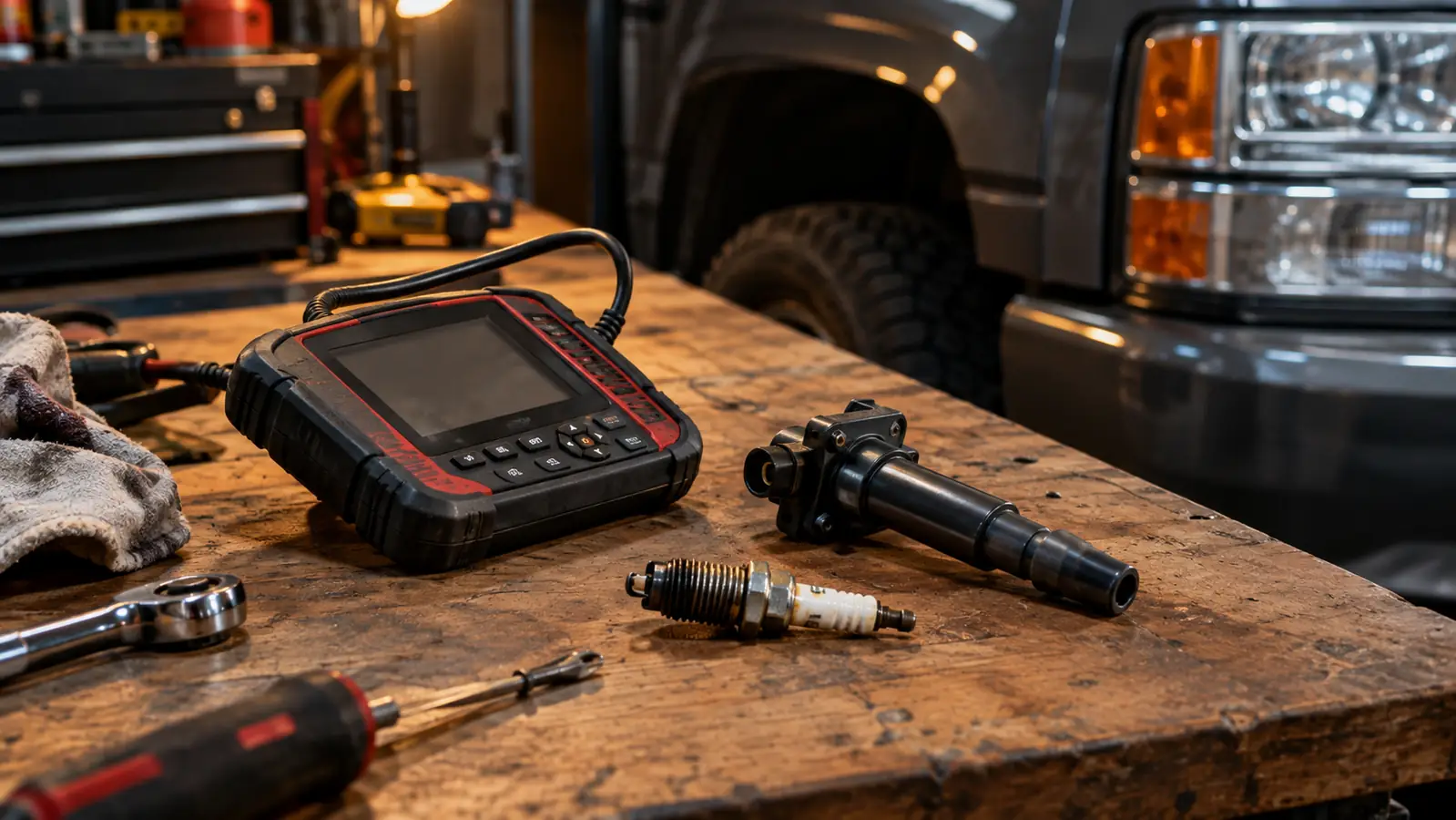
The October P0301 was the misfire in cylinder one. I used the scanner to confirm the code, then replaced the spark plugs and the ignition coil on that cylinder. The old plug had a cracked insulator, which I would have found eventually, but the scanner told me which cylinder to start with instead of pulling all eight plugs to look. That is the real value of a code reader. It does not fix the car. It points you at the corner of the engine where the problem lives.
What the ANCEL AD310 Actually Does
The AD310 is a code reader, not a full diagnostic scanner, and understanding that difference is the whole game. It reads and clears generic powertrain codes, which are the P codes that cover engine, transmission, and emissions. It will not read manufacturer-specific codes, it will not show live data, and it will not do bidirectional tests. What it does, it does well.
The menu is about as simple as it gets. When you plug it in and turn the key, the first screen asks what you want to do. You scroll to read codes, clear codes, or check the I/M readiness status. That I/M screen is the one most people never find, and it is genuinely useful if you live in a state with emissions testing. It shows whether the engine's monitors have finished their test cycles after a battery disconnect or a cleared code. If you take a car for an emissions check before those monitors are ready, it fails for nothing. I have checked the readiness screen on the CR-V after clearing codes, just to know when it would be legal to drive it to a test station.
The AD310 also shows a freeze frame for many codes. That is a snapshot of what the engine was doing the moment the code was set, things like engine speed and coolant temperature. It is not live data, but it is a record of the exact instant the computer got angry. The day I chased the misfire on the F-150, the freeze frame told me the engine was at operating temperature and at highway speed when the code set. That ruled out a cold-start problem and pointed me at something that only showed up under load. I would not have gotten that from a plain code list.
The screen is small but readable, and the five buttons are laid out in a way that makes sense. I have used scanners with menus that required a manual the size of a shop repair book. The AD310 has one button to read codes, one to clear them, and a scroll button to move through the list. My neighbor, who has never touched a code reader in his life, had it working in under a minute.
One thing I appreciate is that the AD310 does not ask me to download an app or create an account. I am not against apps in general, but I have seen too many cheap tools that become useless when the company stops updating the software. The AD310 is a standalone device. It does not depend on a phone, a subscription, or a server somewhere. Ten years from now, it will still work the same way it works today.
Performance Over a Year of Real Use
The most important test for any code reader is whether it gives you the same answer as a professional scanner. I have compared the AD310 against the Snap-on scanner at a friend's shop on three separate occasions. The first was the gas cap code in March, the second was the oxygen sensor code on the CR-V in June, and the third was the misfire on the F-150 in October. Every time, the AD310 read the same code my friend's scanner read, and every time, the fix I made based on that code solved the problem. That is the only proof that matters to me.
The build quality has held up better than I expected for a tool in this price range. The housing is solid, the cable is long enough to reach the port without contorting my body, and the screen has not scratched despite a year of being tossed into the glove box and onto the workbench. The buttons still click cleanly, and the connector still fits snugly into the port on both vehicles. In December I used it on a morning when the garage was barely above freezing. The screen was a little slow to wake up in the cold, but it read the code and cleared it without any drama.
The one thing that annoys me is the lack of live data. When I was chasing the P0301 misfire on the F-150, I wanted to see the misfire counts in real time to confirm which cylinder was the problem. The AD310 cannot do that. Here is exactly how that played out. I cleared the code on a Saturday morning, drove the truck about ten miles into town, and the light came back the following Tuesday. Same code. That told me the misfire was real and consistent, not a one-time glitch. I replaced the coil on cylinder one, cleared the code again, and it has not come back since. It worked, but it took longer than it would have with a scanner that shows live data.
I also learned when not to trust the tool. A code reader tells you what is wrong, not how urgently it needs fixing. When the P0420 popped up on the CR-V, the scanner could not tell me whether I had a bad sensor or a dying converter. I had to do the rest of the diagnostics myself. That is not a flaw in the AD310. It is the difference between a code reader and a mechanic. The tool gets you to the right neighborhood. You still have to knock on the door.
The AD310 has paid for itself at least five times over this year, and I have not paid a single shop visit since I bought it.
Who This Is For
The ANCEL AD310 is for the person who wants to know what the check engine light means before they decide whether to call a shop. It is for the driveway mechanic who wants to confirm a diagnosis before buying a part. It is for the beginner who has never touched a code reader and wants something that works without a manual. If you have a vehicle from 1996 or newer, this scanner will read its engine codes.
It is also for the person who is tired of paying for diagnoses. A single shop visit in my area comes with a diagnostic fee just to read the code. The AD310 costs less than that, and you can use it as many times as you want, on as many vehicles as you want. My neighbor has used mine on his daughter's car, and my brother-in-law borrowed it for his truck. It is the kind of tool that makes the rounds.
Here is a use case I did not expect when I bought it: checking out a used vehicle before you hand over money. Last fall my brother-in-law was looking at a used truck at a lot down the road. He borrowed the AD310, plugged it in, and found no stored codes. But the I/M readiness screen showed the battery had been disconnected recently, which is how a seller hides a code that has not come back yet. He walked away from that truck. That one afternoon made the tool worth every cent.
And it is for the person who, like me, keeps more than one vehicle running. My F-150 is past 190,000 miles and my wife's CR-V is not far behind. Something is going to fail on one of them eventually. When it does, I would rather spend ten minutes in the garage with the AD310 than spend a morning at a shop. The tool does not make the repairs for me. It makes the decision about whether I can do the repair myself.
Who Should Skip It
If you are a professional mechanic, or if you do serious diagnostic work like tracking down intermittent electrical problems, the AD310 is not enough. You need live data, manufacturer-specific codes, and bidirectional controls. Those tools cost more, and they are worth it for someone who makes a living with them.
If you have a vehicle that is newer than 1996 but uses a non-standard protocol, the AD310 may not work. That is rare, but it happens. And if you are the kind of person who will never turn a wrench, who would rather pay a shop than get your hands dirty, this scanner will not change your mind. It is a tool for people who want to do the work themselves.
What I Liked
- Reads and clears engine codes on any 1996 or newer OBD2 vehicle
- Simple five-button interface that a beginner can use without a manual
- No app, no account, no subscription, no phone required
- Paid for itself after a single avoided shop visit
- Solid build quality that has survived a year in my garage
Where It Falls Short
- No live data, so you cannot watch sensor readings in real time
- Only reads generic powertrain codes, not manufacturer-specific codes
- Small screen that washes out in direct sunlight
- No Bluetooth, so you cannot share codes with a mechanic remotely
The Bottom Line
The ANCEL AD310 is not the most powerful code reader you can buy, and it does not pretend to be. It is a simple, reliable, affordable tool that tells you what the check engine light means. For a driveway mechanic like me, that is exactly what I need. It has saved me money, it has saved me time, and it has kept me from guessing.
If you are on the fence, think about the last time the check engine light came on in your vehicle. Did you know what it meant? Did you know whether you could fix it yourself? The AD310 answers both questions in under a minute. That is worth more than the price of the tool.
Know what the light means before you pay someone to tell you
The ANCEL AD310 has been in my garage for a year, and it has paid for itself many times over. If you do your own maintenance, this is the tool to start with.
Amazon Check Today's Price on Amazon →