
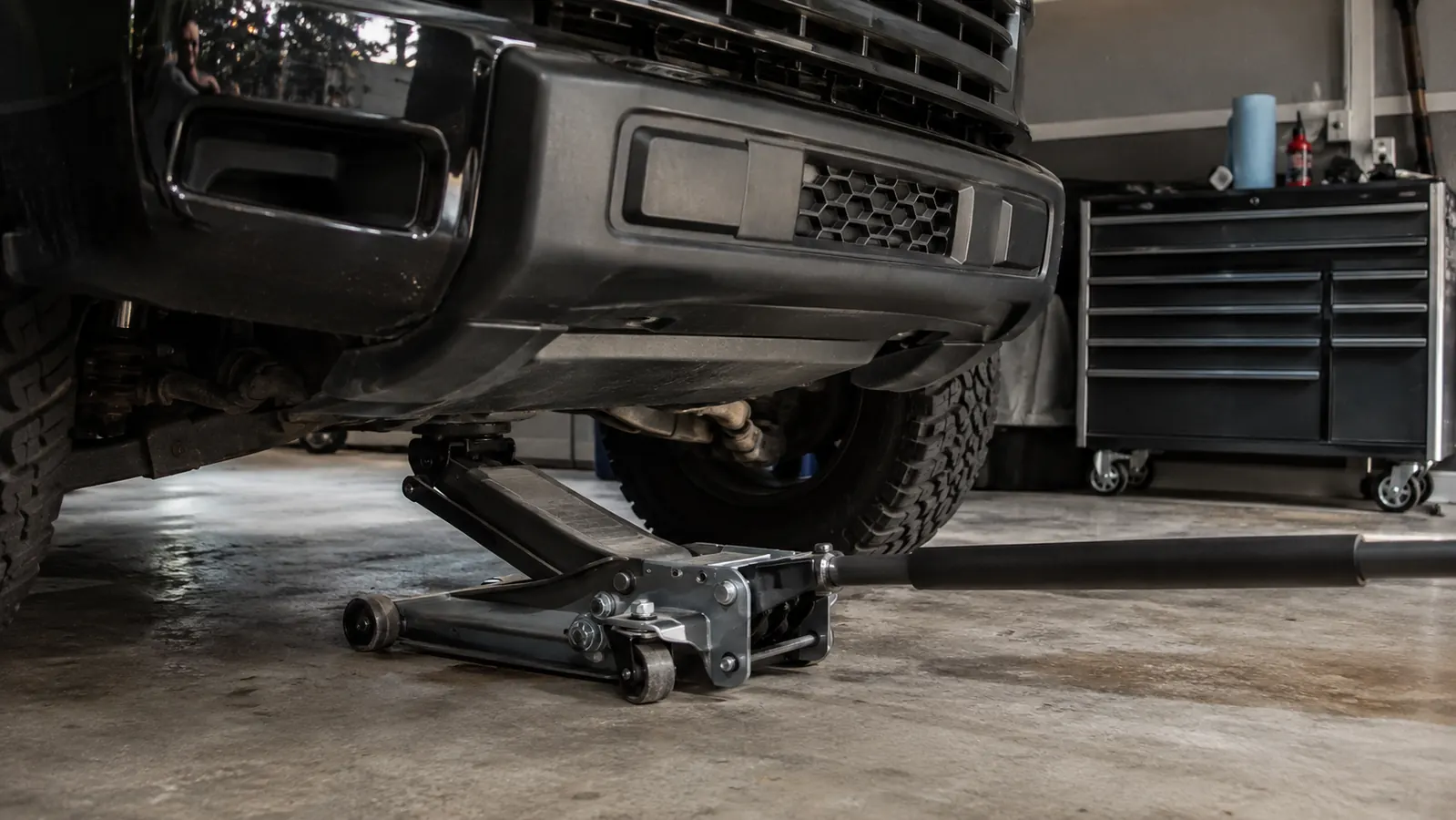
My 2014 F-150 has a little over 190,000 miles on it, and at this point it spends about as much time on jack stands as it does on the road. I do the brakes, the oil, the front end work, the transfer case fluid, all of it, in my two-car garage outside Dayton. For years I made do with a scissor jack and a stack of blocks, and I told myself that was good enough. It wasn't. It was slow, it was tippy, and every time I crawled under the truck I was thinking about the math instead of the job. So last winter I finally bought a real floor jack, the Jack Boss 3 Ton Low Profile, and I've been using it steadily ever since. This is the long-term review I wish I'd had before I spent my money.
I'm not going to tell you it's the last floor jack you'll ever buy, because I don't believe that about any tool. But after months of weekend work, oil changes, brake jobs, and one very cold February afternoon replacing a starter, I can tell you exactly what this jack does well, what it does poorly, and who should buy it.
The Quick Verdict
The Jack Boss 3 Ton is a fast, stable, low profile floor jack that makes driveway work genuinely safer and easier. It has a couple of annoyances, but for the money it's the best jack I've owned in thirty years of turning wrenches.
Amazon Check Today's Price →Stop Crouching Under a Scissor Jack
If you're still using a scissor jack and blocks, you're making every brake job harder and riskier than it needs to be. The Jack Boss 3 Ton lifts my F-150 in about three pumps and holds it steady while I work.
Amazon Check Today's Price on Amazon →How I've Used It
I bought the Jack Boss in early winter, and the first job was a front brake job on the F-150. That's the job that made me throw the scissor jack in the corner of the garage for good. The truck sits high enough that a standard jack fits, but the low profile frame means I don't have to drive up on a board to get the saddle under the front crossmember. The dual piston quick lift pump is not a gimmick. The saddle reaches the frame in two or three pumps, and then the real lifting starts. I had the front end off the ground in under a minute.
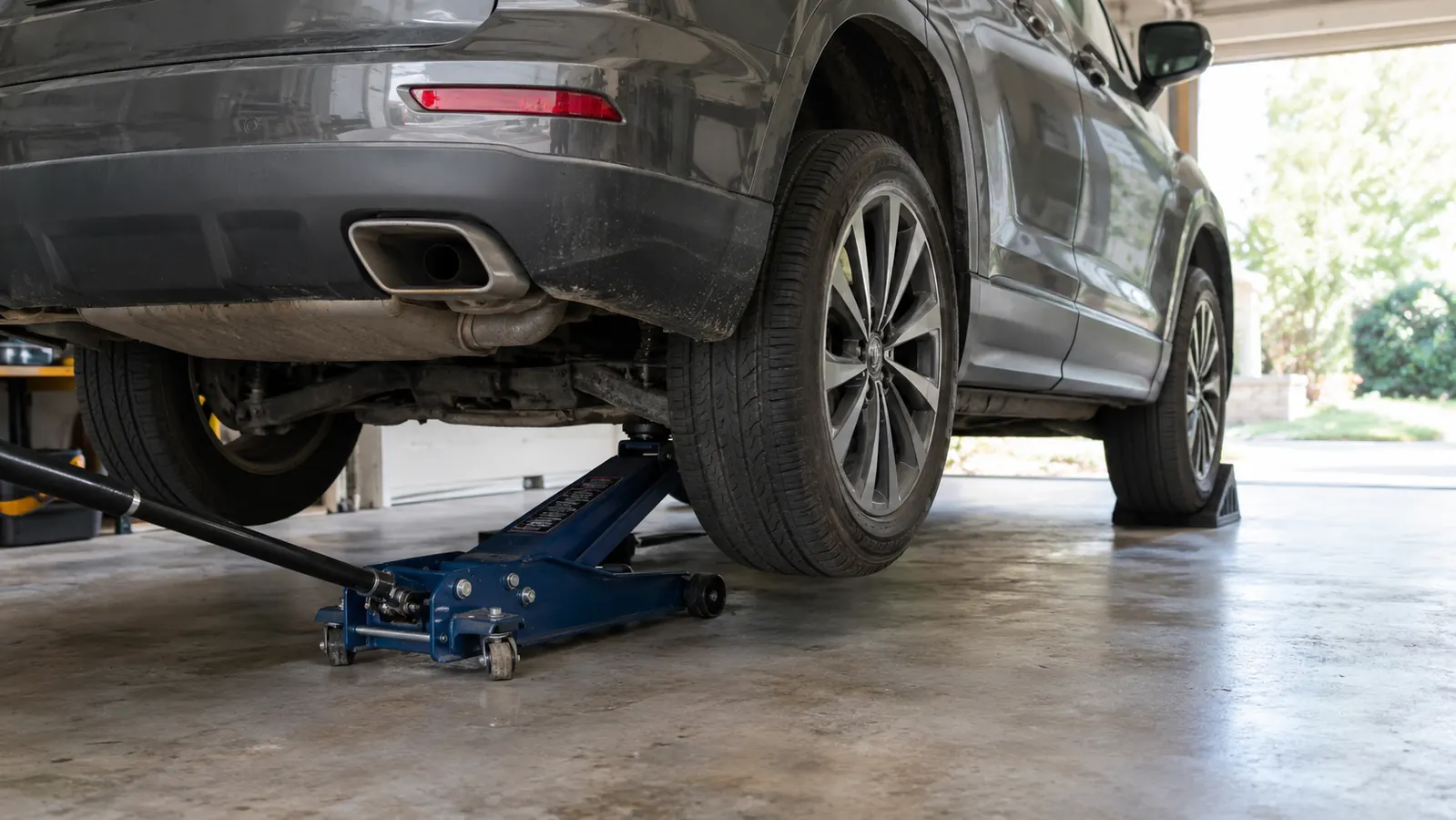
Since then I've used it for oil changes on both the F-150 and Carol's CR-V, rear brakes, a transfer case fluid change, a starter replacement, and a handful of tire rotations. The CR-V is lower to the ground, and the 3-15/16 inch minimum height is the reason this jack works on it. A standard height jack won't slide under that car without driving it up on ramps first. The Jack Boss slides right under.
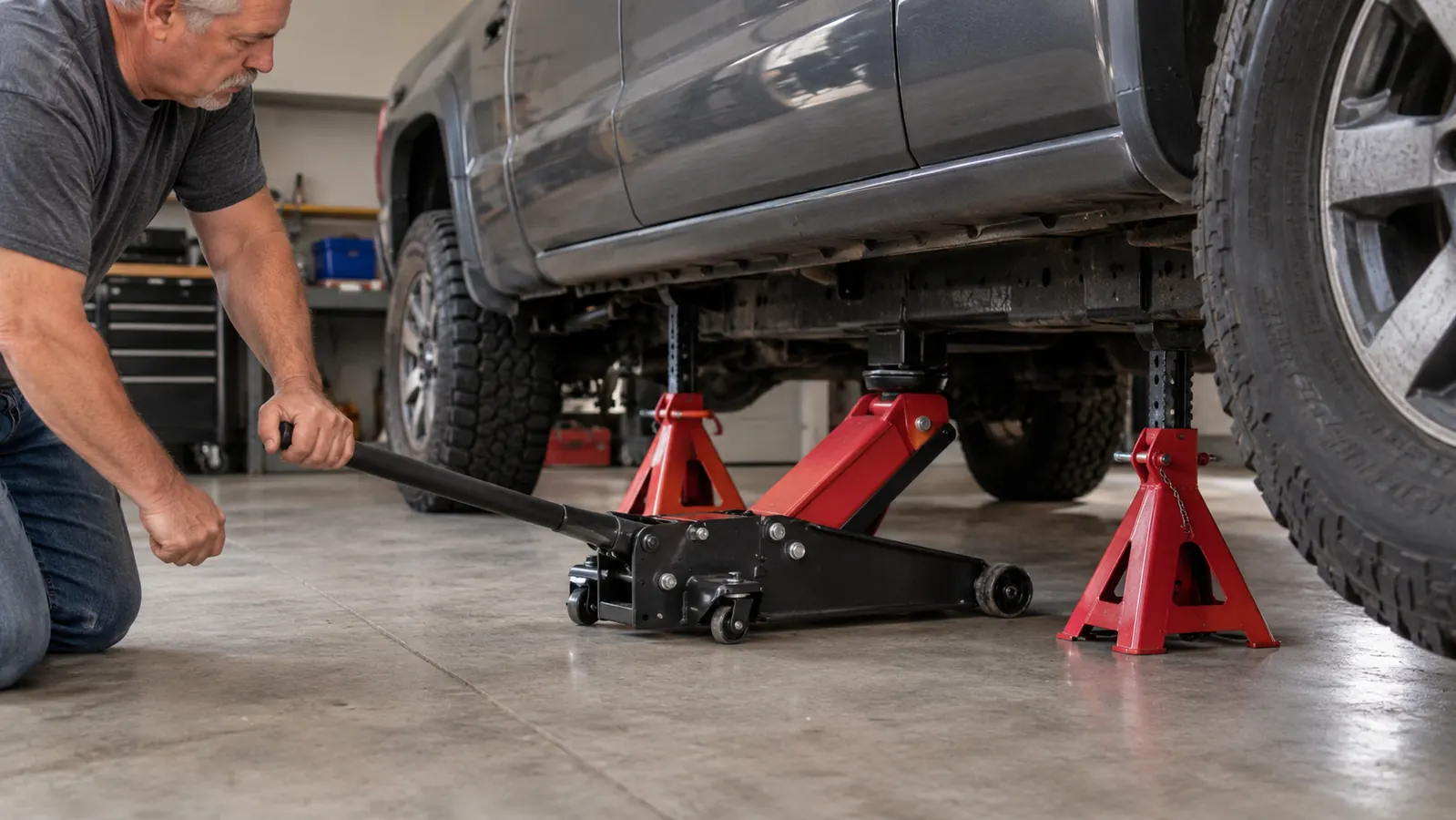
I also want to be honest about how I use it, because the safety talk matters. I never get under a vehicle supported only by a floor jack. The Jack Boss gets the truck up, and then jack stands go under the frame before I crawl underneath. That's not a knock on the jack. That's just how you don't die in a garage. The jack's job is to lift. The stands' job is to hold.
Here is my routine, because I think it is the part most reviews skip. I roll the truck in, set the parking brake, and chock the rear wheels when I am lifting the front. I slide the Jack Boss under the front frame lift point, pump until the tire just clears the floor, then set a jack stand under each side at the points the manual shows. Then I lower the jack until the truck is resting on the stands, leave the jack snug underneath as a backup, and give the truck a firm shake before I put any part of my body under it. It adds maybe two minutes to a job, and I have never once regretted them.
What the Jack Boss Gets Right
The first thing you notice is the speed. The dual piston quick lift pump brings the saddle up to the load fast, and then the main pistons take over. On the F-150, I can go from jack on the floor to front wheels off the ground in maybe twenty seconds. When you're doing a job in a cold garage in January, twenty seconds matters. You spend less time bent over and more time actually working.
The second thing is stability. The Jack Boss has a wide stance and a steel frame, and the aluminum makes it light enough that I can move it around the garage with one hand. I've had the truck up on it for an hour at a time while I fought a rusted bolt, and the jack didn't settle, didn't creep, didn't do anything scary. The 1.5X overload test is the kind of spec I actually trust, because it's a number, not a slogan.
The third thing is the low profile. The 3-15/16 inch minimum height is the whole reason I can use this jack on Carol's CR-V without driving the car up on boards. If you own a car that sits low, this is the feature that makes the jack worth owning. A floor jack that won't fit under your car is just a heavy paperweight.
To put that low profile in real terms: Carol's CR-V sits low enough that my old jack needed a board under it and a lot of fiddling to reach the lift point. The Jack Boss slides straight under with room to spare. On the F-150 I can roll it under the front without first driving up on anything, and the lift range is enough to get the tires well clear for a brake job. One jack covering both vehicles in our garage was the main thing I was after, and it delivered on that from the first week.
The casters deserve a mention too. They roll smoothly on my concrete floor and swivel without binding, which makes lining the saddle up under the lift point easy even when I am lying on a creeper looking at it sideways. Cheap jacks often skimp here, and you end up dragging them into place.
Where It Falls Short
I said I'd be honest, so here's the honest part. The handle is long, and in a two-car garage that's mostly full of a pickup truck, a tool chest, and thirty years of stuff I should have thrown away, the handle gets in the way. I've tripped over it more than once. It's not a design flaw, it's a space problem, but it's worth knowing before you buy.
The release valve is also a little touchy. Lowering the truck smoothly takes a light hand. If you crack the valve too far, the load drops faster than you expect. I've never had it slam down, but I've had it come down quicker than I wanted, and that's on me as much as it is on the jack. You learn the feel after a few uses.
And the saddle is on the smaller side. For a full size pickup it's fine, but for the CR-V I have to position it carefully so the saddle sits flat under the pinch weld. It works, but it's not as forgiving as a wider saddle would be.
None of those complaints changed how I feel about the jack, but they are the kind of thing you only notice after you have used it a few dozen times, so I would rather you hear them from me. If your garage is tight, measure the space behind your vehicle before you buy and plan on working with the handle angled.
What I Liked
- Low profile slides under cars a standard jack can't reach
- Quick lift pump gets the saddle to the frame in two or three pumps
- Stable and steady, even with a heavy pickup on it for an hour
- Aluminum and steel build is light enough to move with one hand
- 1.5X overload tested, which is a spec I can actually trust
Where It Falls Short
- Long handle is awkward in a crowded garage
- Release valve takes a light touch to lower smoothly
- Saddle is on the small side for some pinch welds
The low profile is the whole reason I can use this jack on Carol's CR-V without driving the car up on boards. A floor jack that won't fit under your car is just a heavy paperweight.
How It Holds Up Over Time
I've had the Jack Boss for months now, and it's been through a cold Ohio winter, a wet spring, and a summer of garage use. The paint has a few scuffs from sliding under the truck, but there's no rust on the frame or the pistons. I wipe it down when I think about it and I don't baby it, and it still works like it did the day I unboxed it.
The hydraulic fluid hasn't needed a top up, and the lift height hasn't dropped. I check the piston rods for scoring every few months, and they're clean. The one thing I do is keep it stored with the saddle down and the handle upright, which keeps the seals from sitting under pressure. That's the kind of maintenance that keeps a jack alive for years.
I've also used it in the driveway a few times when the garage was too full to pull the truck in. The Jack Boss rolls fine on concrete and on asphalt, though the wheels pick up gravel if you drag it sideways. On a smooth driveway it's no problem at all.
On maintenance, I keep it simple. Every couple of months I wipe the jack down, put a drop of oil on the pivot points and wheels, and look for any weeping around the seals. I store it with the saddle fully lowered so the piston is not sitting exposed, and I keep it off the floor drain where water collects. That is the same care I gave my old jack for fifteen years, and it is the reason I expect this one to keep working for a long time.
A fair question is whether I would buy the Jack Boss again knowing what I know now. I would. It is not the cheapest jack on the shelf, but it lifts both of our vehicles quickly, it sits steady on the floor, and it has not given me a single surprise. For a tool you trust with the weight of a pickup truck, that is what I care about most.
Who This Is For
The Jack Boss 3 Ton is for the person who does their own work and is tired of fighting their equipment. If you have a car that sits low, or a truck that's heavy, or a garage where space is tight, this jack solves the problems that make you dread a brake job. It's also for the beginner who's ready to stop using a scissor jack and a block of wood. A good floor jack is the difference between a job you put off and a job you just do.
It is especially worth it if you are working on more than one vehicle, if one of them sits low, or if you are coming from a scissor jack and you are tired of cranking for five minutes to get a wheel off the ground. Pair it with a good set of jack stands and you have the foundation for nearly every job you will ever do in a home garage.
Who Should Skip It
If you only change a tire once a year and your car never goes up on stands, you don't need a 3 ton floor jack. The scissor jack that came with your car is fine for a roadside flat. And if you work in a shop with a lift, you already have something better. The Jack Boss is for the driveway mechanic, not the professional. If that's not you, save your money.
And if you have never lifted a vehicle before, spend an evening with your owner's manual before the first job. Find the lift points on the frame, figure out where the jack stands go, and practice raising and lowering the vehicle a couple of inches with nothing else going on. The Jack Boss makes the lifting part easy, but knowing exactly where to put it is still on you, and that is the habit that keeps a simple tire rotation from turning into a bad day.
Months Later, I'd Buy It Again
After a winter of brake jobs and oil changes, the Jack Boss 3 Ton is the tool I reach for every time. If you're still working under a scissor jack, this is the upgrade that pays for itself in saved time and saved frustration.
Amazon Check Today's Price on Amazon →