
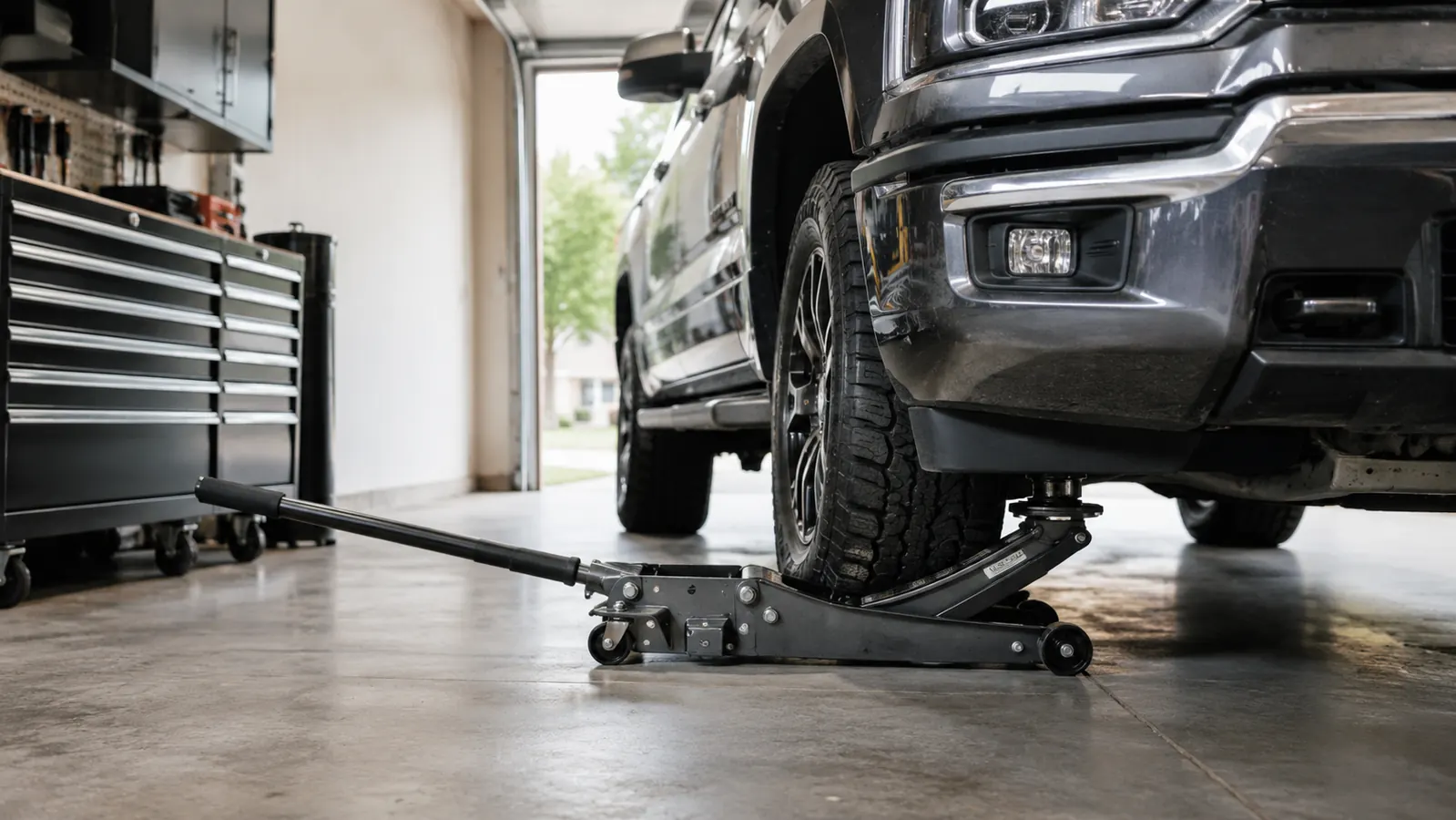
If you do your own work in a home garage, the floor jack is the one tool you will use on almost every job. I have owned a heavy steel floor jack for years, and it has lifted my 2014 F-150 more times than I can count. But when I got the Jack Boss 3 Ton Low Profile floor jack in my garage, I found myself reaching for it more and more. So I ran them side by side for a few weeks to see which one actually earns its spot on the concrete.
The short answer: the Jack Boss wins for most home garage work because it is lighter, lifts faster, and slides under a low car without a second jack. The heavy steel jack still wins when you want a rock-solid platform under a big truck and you do not mind the weight. Here is the full breakdown.
| Jack Boss 3 Ton Low Profile | Heavy Steel Floor Jack | |
|---|---|---|
| Weight | Aluminum frame, easy to carry to the driveway | Steel frame, heavy to drag around the garage |
| Lifting speed | Dual piston quick lift pump, reaches height in a few pumps | Single piston, slower to raise the same load |
| Low profile | 3-15/16 inch minimum height, slides under low cars | Higher minimum height, struggles with low bumpers |
| Stability under load | Solid and stable on concrete, rated for 3 tons | Heavier steel base feels planted under a full-size truck |
| Price | More upfront, but you get aluminum and a faster pump | Usually the cheaper upfront option |
| Best for | Home garage work, low cars, quick oil changes | Heavy trucks and shop use where weight is not an issue |
Where the Jack Boss Wins
The first thing I noticed was the weight. My steel jack is a workout to move from the corner of the garage to the front of the pickup. The Jack Boss is noticeably lighter, so I actually use it more. When a job only takes ten minutes, I do not want to wrestle a heavy jack out of the way first. That alone changed how often I bother to lift the truck for a quick check.
The low profile is the bigger deal, and it is the reason I stopped reaching for the steel jack. My wife Carol's 2017 Honda CR-V sits low enough that the steel jack barely fits under the front bumper, and I mean barely. The first time I tried to change her oil with the steel jack, the saddle caught the plastic undertray and pushed it up hard enough that I heard it crack. That was the moment I started keeping a couple of 2x6s in the corner of the garage, just so I could drive the CR-V up on them and give the jack enough room. The Jack Boss lists a minimum height of 3-15/16 inches, and it slides under that same front bumper with room to spare, no boards required. The dual piston quick lift pump is the other part of the story. On the F-150, the steel jack takes a good twenty or twenty-five full strokes to get the front wheels off the ground, and each stroke is a solid pull. The Jack Boss gets the same truck up in maybe eight or nine strokes, and the pump strokes are shorter and easier because the aluminum frame is not fighting me. On a concrete floor, it raises the F-150 smoothly and holds it there while I work. I checked the saddle height against the floor with a tape measure the first week I had it, and it matched the spec close enough that I stopped second-guessing the numbers.
Let me give you a concrete example. The first weekend of last month I finally got around to a front brake job on the F-150, new rotors and pads, and I started the way I always have, with the steel jack. I got the truck up, set the jack stands under the frame, and did the passenger side. When I finished that side, I lowered the truck, moved the steel jack to the driver side, and pumped it back up. That whole dance took maybe fifteen minutes, and by the end my back was already complaining. Then the real fun started. The caliper bracket bolts on a truck with 190,000 Ohio miles do not want to come loose, and I spent a good twenty minutes with a breaker bar and a cheater pipe before the first one broke free. By the time I had the new rotor on and the caliper torqued back down, I had been in the garage for close to three hours, and the steel jack had only been part of the work twice. The next weekend I did the same job on Carol's CR-V with the Jack Boss, and the difference was not subtle. The jack slid under the front subframe on the first try, the quick lift pump brought the SUV up in a handful of strokes, and I had both sides in the air before I would have finished wrestling the steel jack across the garage the first time. I still had to fight the same rusted hardware on the Honda, but at least the jack was not adding to the argument. I have done the brake job on the truck twice a year for the last six years, and I can tell you the jack is the part of that job I used to dread most. Now it is the part I do not think about at all.
The lifting range matters more than most people think, and the top end matters just as much as the bottom. The Jack Boss spec sheet lists a maximum height of 18-5/16 inches, and it matches what I see on my own concrete floor. That maximum is what tells you how high the truck will go before the jack runs out of travel, which matters when you are trying to get a jack stand under the frame. With the F-150, I get the front wheels about fourteen inches off the floor, which is plenty to slide a six-ton stand under the frame rail. The steel jack goes a little higher before it tops out, maybe an inch or two more, and on a lifted truck that extra inch can be the difference between the stand fitting and the stand being a quarter inch short. For my two vehicles, though, the Jack Boss range has covered every job I have asked of it, and I have not once found myself wishing it would go higher.
Lift Your Truck Without the Heavy Lifting
The Jack Boss 3 Ton Low Profile floor jack gets under low cars, lifts fast, and does not fight you on the way to the driveway. See today's price on Amazon and check the lifting range against your own vehicle.
Amazon Check Today's Price on Amazon →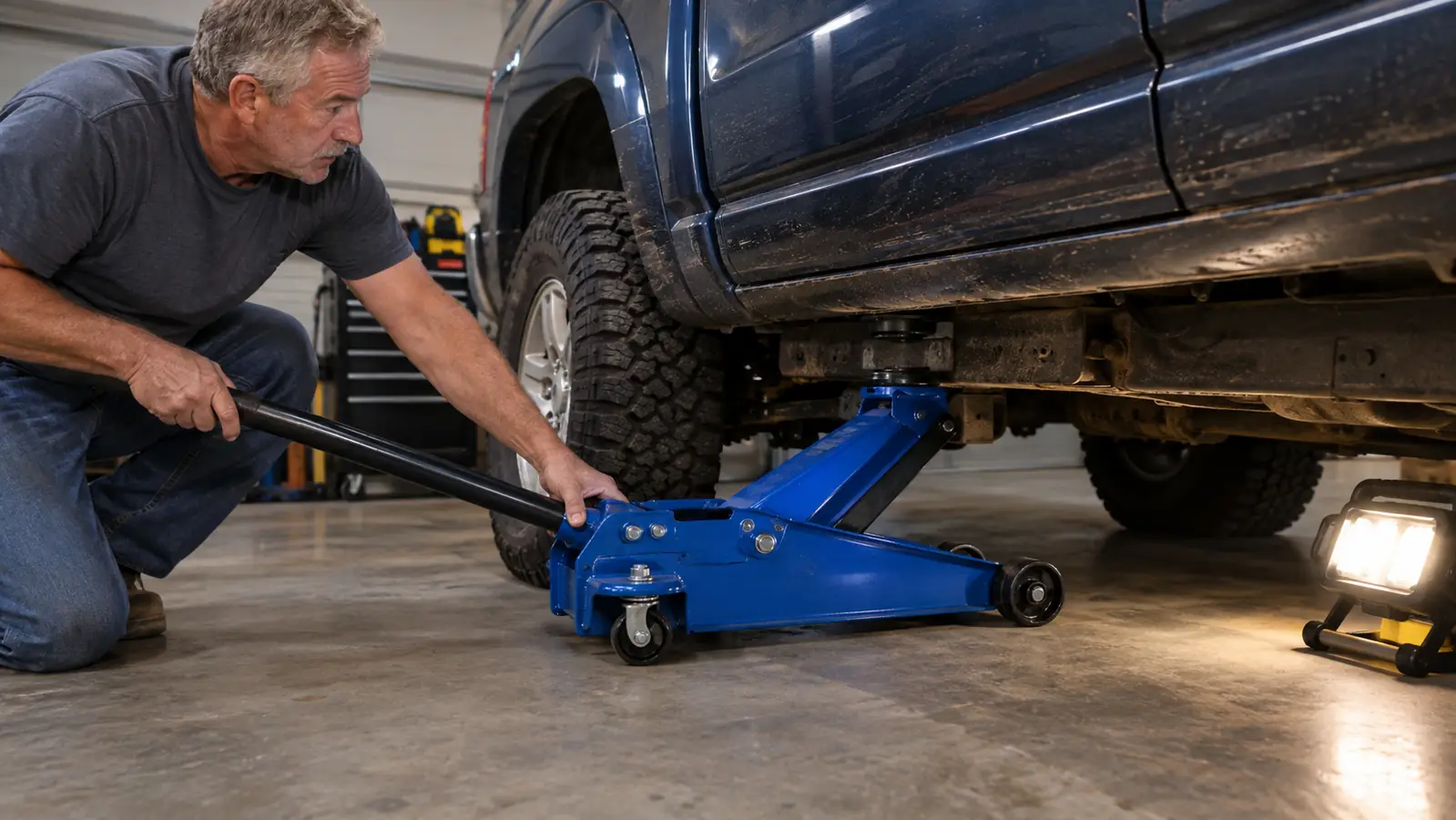
Where the Heavy Steel Jack Wins
I am not going to pretend the steel jack has no place. Under a full-size pickup, the extra weight of a steel base makes the jack feel absolutely planted. When I have the F-150 up on jack stands and I am leaning on a breaker bar, I like knowing the jack underneath is not going to budge. The Jack Boss is stable too, but the steel jack has a heavier, more solid feel that is hard to describe until you have used both. Part of it is the wide base and part of it is just the mass, and mass does not lie.
Price is the one place I have to give the steel jack the win, and I want to be straight about it. A basic heavy steel floor jack from a big box store is usually cheaper than the Jack Boss, sometimes by a fair amount, and for someone who only lifts a car a few times a year, that lower price might be the right call. The Jack Boss is not a budget tool, and I would not pretend otherwise. If you drive a tall truck, never work on low cars, and do not mind the weight, the steel jack is a perfectly good tool and you will not be making a mistake buying it.
There is one more thing the steel jack does that surprised me, and it is the way it behaves when the load is off center. A couple of weeks ago I was rotating tires on the F-150, all five including the spare, and I had the rear end up with the steel jack placed under the differential. The truck was on a slight slope, maybe a degree or two toward the garage door, and I knew it. When I put a breaker bar on a lug nut and really leaned into it, the whole truck rocked a little, and the steel jack just sat there, no creak, no give, no movement at all. I have done the same job with the Jack Boss under the same spot, and it held fine too, but the steel jack feels like it is part of the floor. That planted feeling is real, and if you spend most of your time under a heavy truck, it is worth something. Here is the thing I have learned after thirty years of doing this, though. That rock-solid feel matters most when the load is off center, and off-center loads are the exception in a home garage, not the rule. Most of my work is a wheel off the ground, one corner at a time, with jack stands doing the real holding. The jack is just there to get it up and get out of the way. In that role, the Jack Boss does everything I need, and it does it without me having to plan my route across the garage around it.
The honest tradeoff is that the steel jack's weight is the same thing that makes it feel so solid. Mine has casters that roll okay on smooth concrete, but the moment I need to move it over a floor crack or a dropped tool, I am basically dragging it. The Jack Boss I can pick up with one hand on the handle and walk across the garage. For a retired guy with a bad back, that is not a small thing. It is the difference between doing a job and talking myself out of it. I have caught myself skipping a simple tire pressure check because I did not feel like pulling the steel jack out, and that is a silly reason to skip a five minute job.
The Jack Boss gets under Carol's CR-V without a second jack. That is the moment I stopped reaching for the steel one.
Who Should Buy Which
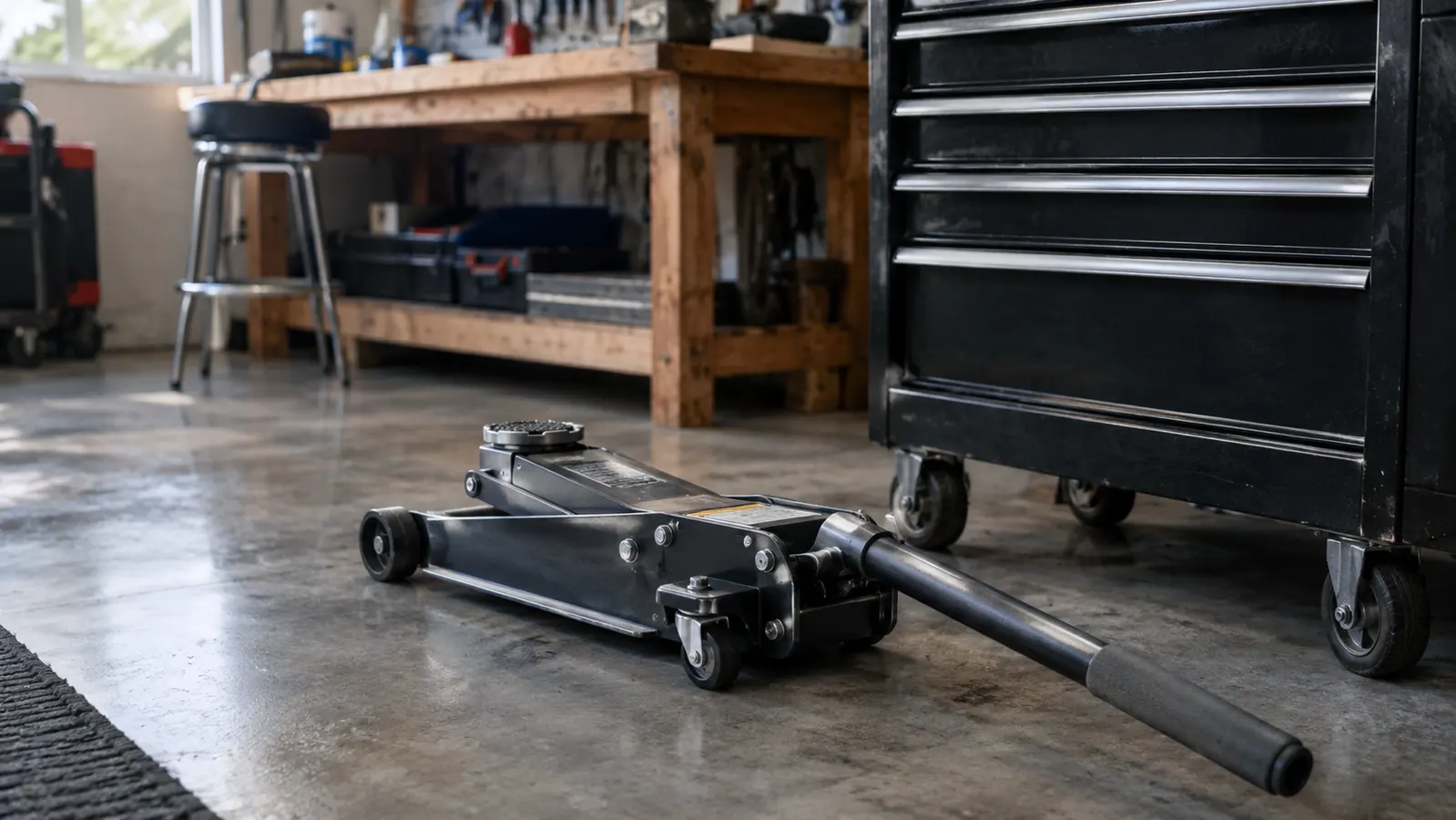
Buy the Jack Boss if you work on a low car or a crossover, if you are tired of dragging a heavy jack around the garage, or if you want to get the truck up in the air fast for an oil change. It is the better all-around choice for a home garage. In the weeks I have had it, it has handled a front brake job on the F-150, an oil change on the CR-V, two tire rotations, and a rear differential fluid change on the truck, and I have not once wished I had the steel jack back in my hand for any of them. The low profile alone is worth the switch for anyone who owns a car built in the last ten years, because those plastic undertrays sit low and the steel jack will find them every time.
Buy the heavy steel jack if you only work on tall trucks, if you want the absolute lowest price, or if you like the planted feel of a heavy base under a full-size vehicle. There is nothing wrong with that choice, and I am not going to tell you to throw your steel jack in the scrap bin. Mine stays in the garage, and it will keep being useful the day I need to lift the F-150 with the weight sitting off center. But for most of what I do in my own garage, the Jack Boss is the one I grab first. It is lighter, it is faster, it gets under both of our vehicles without any tricks, and it has not once let the truck down. That is the best recommendation I can give, and it is the same one I would give you if you were standing in my garage right now.
The Jack Boss Earned Its Spot in My Garage
After weeks of side by side use, the Jack Boss is the jack I reach for first. Check today's price on Amazon and see if the lifting range fits your vehicles.
Amazon Check Today's Price on Amazon →