
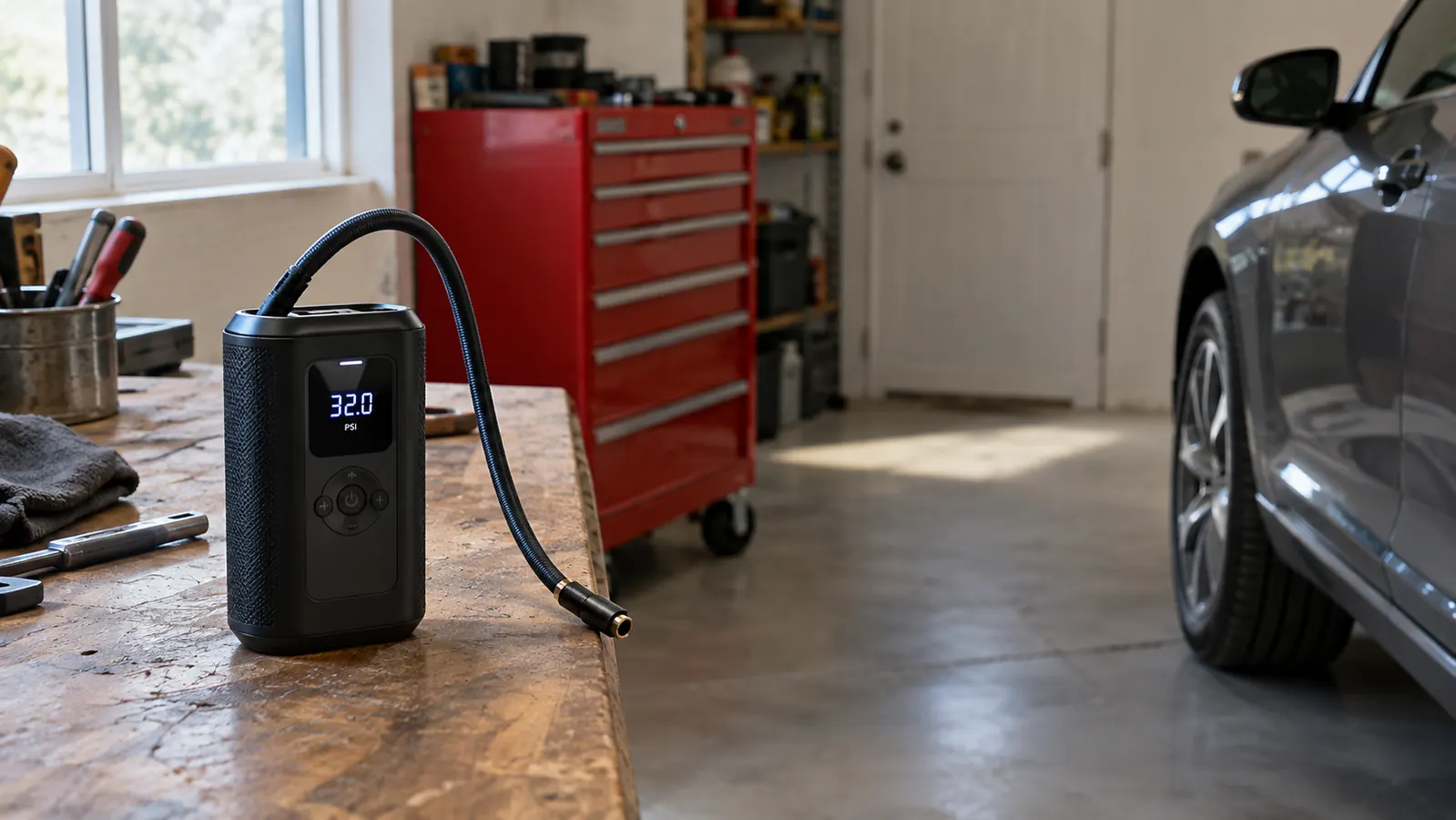
I keep the AstroAI AIRUN H in the trunk of my wife Carol's 2017 Honda CR-V, not in my own truck. That was the test. If a tire inflator can survive a year of Ohio weather, trunk heat, and the occasional drop on a gravel shoulder, it has earned its spot. I am Walt Kessler, and I have done my own vehicle work for thirty years to keep money in my pocket. This is what a year with the AstroAI AIRUN H actually looked like.
The unit we are talking about is the AstroAI AIRUN H, a 12V DC portable air compressor with a digital pressure gauge, auto shut-off, and a 9.8-foot cord. It is not the biggest compressor AstroAI makes, and it is not the smallest. It is the one that sits in the middle and does the job without drama. After a year, I have a clear picture of where it shines and where it falls short.
The Quick Verdict
The AstroAI AIRUN H is the inflator I reach for first: accurate gauge, honest auto shut-off, and a cord long enough to reach all four tires on an SUV. It is not fast enough for a shop, but for a driveway mechanic it is the right tool.
Amazon Check Today's Price →The inflator that has lived in my trunk for a year
If you want a portable 12V inflator that sets the pressure and stops on its own, the AstroAI AIRUN H is the one I trust with my wife's car.
Amazon Check Today's Price on Amazon →How I've Used It
The CR-V sits outside more than it sits in the garage, so the AstroAI AIRUN H has baked in summer heat and frozen in single-digit winter mornings. I have used it to top off all four tires on the CR-V every few weeks, to bring my F-150's tires from 30 back up to 38 psi after a cold snap, and to help a neighbor with a slow leak on a sedan. I have also used it on a bicycle tire and a lawn mower tire, which is not what the box promises, but it handled both.
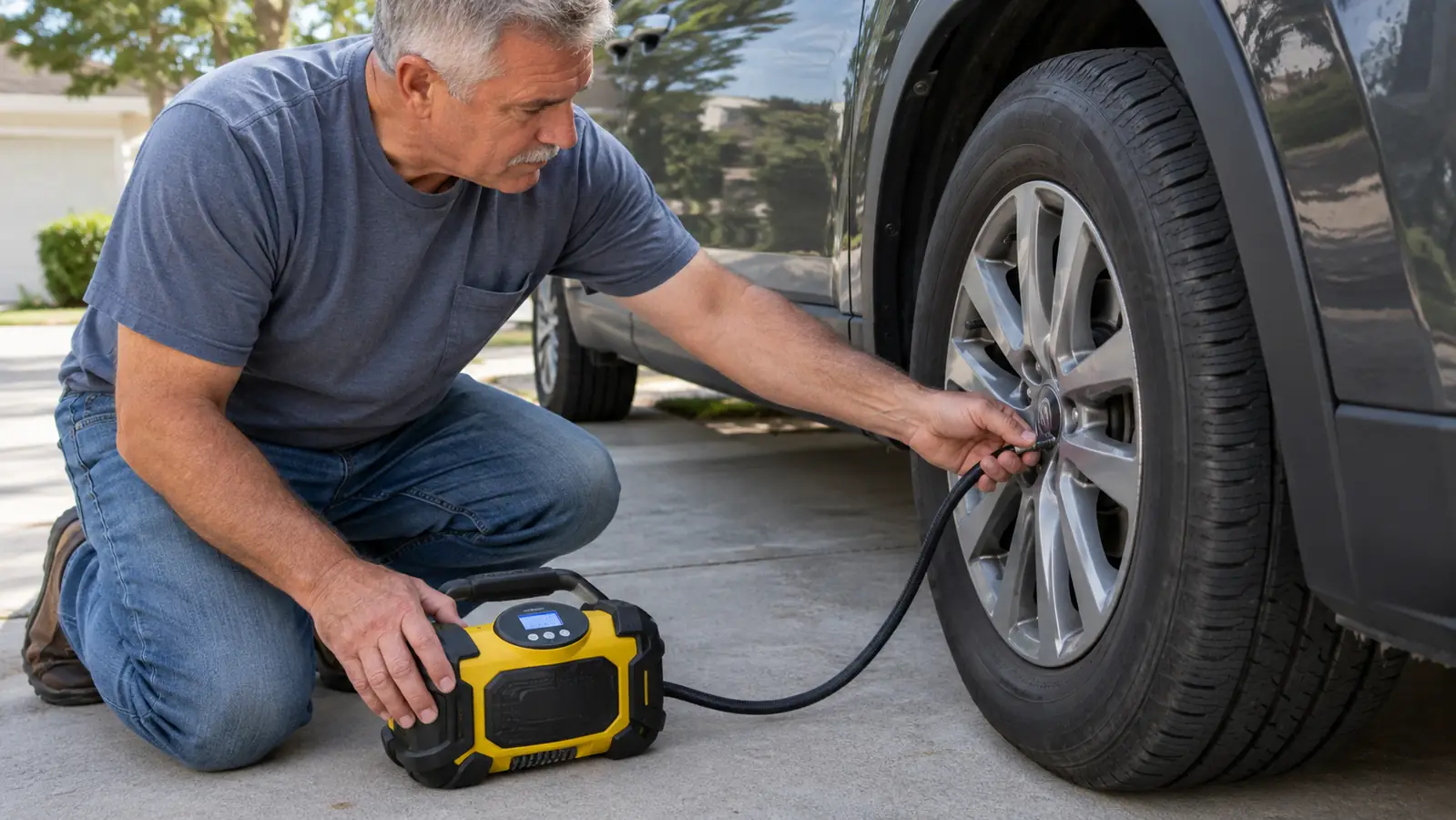
My habit is simple. I check pressures cold, usually on a Sunday morning before the sun heats the driveway. I set the target on the digital gauge, clip the chuck onto the valve stem, and let the AstroAI AIRUN H run until it stops. Then I check with my own analog gauge to confirm. In a year, the auto shut-off has stopped within about one psi of the target every single time. That consistency is the reason I stopped carrying a separate gauge. One Sunday in early March, I went out to top off the CR-V and found the left front at 27 psi, which was odd because I had checked everything two weeks before. I set the AstroAI for 35, and while it ran I walked the other three tires with my own gauge. The left front came up and held for a week, so I figured it was temperature. A month later the same tire read 25, and that time I looked closer and found the nail. The pattern only showed up because the AstroAI made checking so easy that I actually did it.
The 9.8-foot cord is the detail I did not expect to care about. When I first got it, I still moved the unit from tire to tire out of habit, because that is what you do with a short cord. After two or three fill-ups I realized I was carrying it for no reason. On the CR-V, I can start at the front passenger tire, work around the back, and reach the driver side front without unplugging and moving the inflator. On my F-150, the cab outlet sits in the center console, and the cord reaches all four corners from there. That sounds minor until you have owned a unit with a six-foot cord and had to stretch it across a wet driveway.
What the AstroAI AIRUN H Gets Right
The digital gauge is the first thing you notice, and it is the reason I trust this unit. It reads in one-psi increments, which is fine for tire work. I have compared it against two analog gauges and a shop air chuck with a calibrated dial, and the AstroAI reads within a pound of all of them. I wrote the readings down for the first three months, both from the AstroAI and from my old pencil-style gauge, and they never disagreed by more than one psi. The analog gauges drift over time. I have two of them that read differently from each other on the same tire, which is why I stopped trusting them. The digital readout on the AstroAI has been steady all year. For a portable unit, that is good enough. You are not balancing aircraft tires with this thing.
The auto shut-off is not a gimmick. You set the pressure, press the button, and the compressor stops when it hits the number. I have owned inflators where the shut-off was a suggestion, and they would overshoot by three or four psi. The AstroAI AIRUN H has never overshot by more than one. That means I can set 35 psi, walk around to check the other tires, and come back to a finished tire instead of a screaming compressor.
The LED light is brighter than I expected. I have used it twice at night on the shoulder of a county road, once for a neighbor's flat and once for my own slow leak. The first of those was a Tuesday in October, around 8:30, and the shoulder was dark enough that I could not see the valve stem until I turned the light on. The LED threw a clean pool of light on the tire and the gauge, and I finished the job without wishing for a second light. The light also comes on automatically when you plug in the unit, which confused me for a minute the first time, but now I like it. It is not a work light, but it is a real light, not the little glow you get on some budget units.
The build quality has held up. The plastic housing has no cracks, the hose has no leaks, and the chuck still grips the valve stem firmly. I have dropped it on concrete twice and once on gravel. It has a few scuffs, but nothing has broken. For a tool that lives in a trunk and gets used a few times a month, that is the right amount of durability.
Where It Falls Short
It is slow. That is the honest tradeoff. Filling a completely flat car tire from 0 to 35 psi took me about nine minutes. That was the neighbor's sedan, a car that had sat for months with a slow leak. I set the AstroAI to 35 and it ran for nine minutes and change. I checked my watch because I wanted the number. It stopped at 34, and a few seconds of topping off brought it to 35. The unit was warm when I unplugged it, but it never slowed down or stalled. Topping off a tire from 28 to 35 psi takes about two and a half minutes. For a driveway mechanic, that is fine. You set it and walk away. But if you are used to a shop compressor or a high-volume unit, you will notice the difference. The AstroAI AIRUN H is a top-off tool and an emergency tool, not a tire shop in a box.
The unit gets warm on long runs. After filling a completely flat tire, the housing was noticeably warm to the touch. It never shut down or lost power, but I would not run it back to back through four flat tires without letting it cool. That is true of most portable compressors in this class, so I do not count it as a defect. I count it as a limit you should know about.
The hose is a little stiff in cold weather. At 20 degrees or below, it does not coil back as neatly as it does in summer, and you have to coax it into the bag. One morning in January, at 14 degrees, I had to bring the hose inside for ten minutes before it would coil flat. The inflator still worked, and the chuck still sealed on the valve stem, but the plastic was noticeably stiffer. It is not a functional problem, just a nuisance. If you live somewhere that never sees freezing temperatures, you will not care. I live in Ohio, so I notice it every January.
The Numbers That Matter
I tracked the AstroAI AIRUN H for a year because I wanted to know if it was actually saving me time and money. Here is the math. A tire shop charges for air in some places now, and a trip to the station costs gas and twenty minutes. I top off four tires on the CR-V in about ten minutes total, and I do it at home. Over a year, that is maybe two hours saved and a handful of trips I did not make.
The bigger number is the one I did not expect. In late April, on a Sunday morning check, the right rear tire on the CR-V showed 24 psi when I expected 35. The AstroAI caught it on a routine top-off, not because the tire looked low. It did not look low. A CR-V carries a lot of weight on that corner, and 24 psi is not visually obvious. I found a small nail in the tread, plugged it myself with a kit I have had for years, and saved the cost of a new tire. That single event paid for the AstroAI AIRUN H several times over. That is the real value of keeping an inflator in the trunk: it turns a surprise into a routine fix.
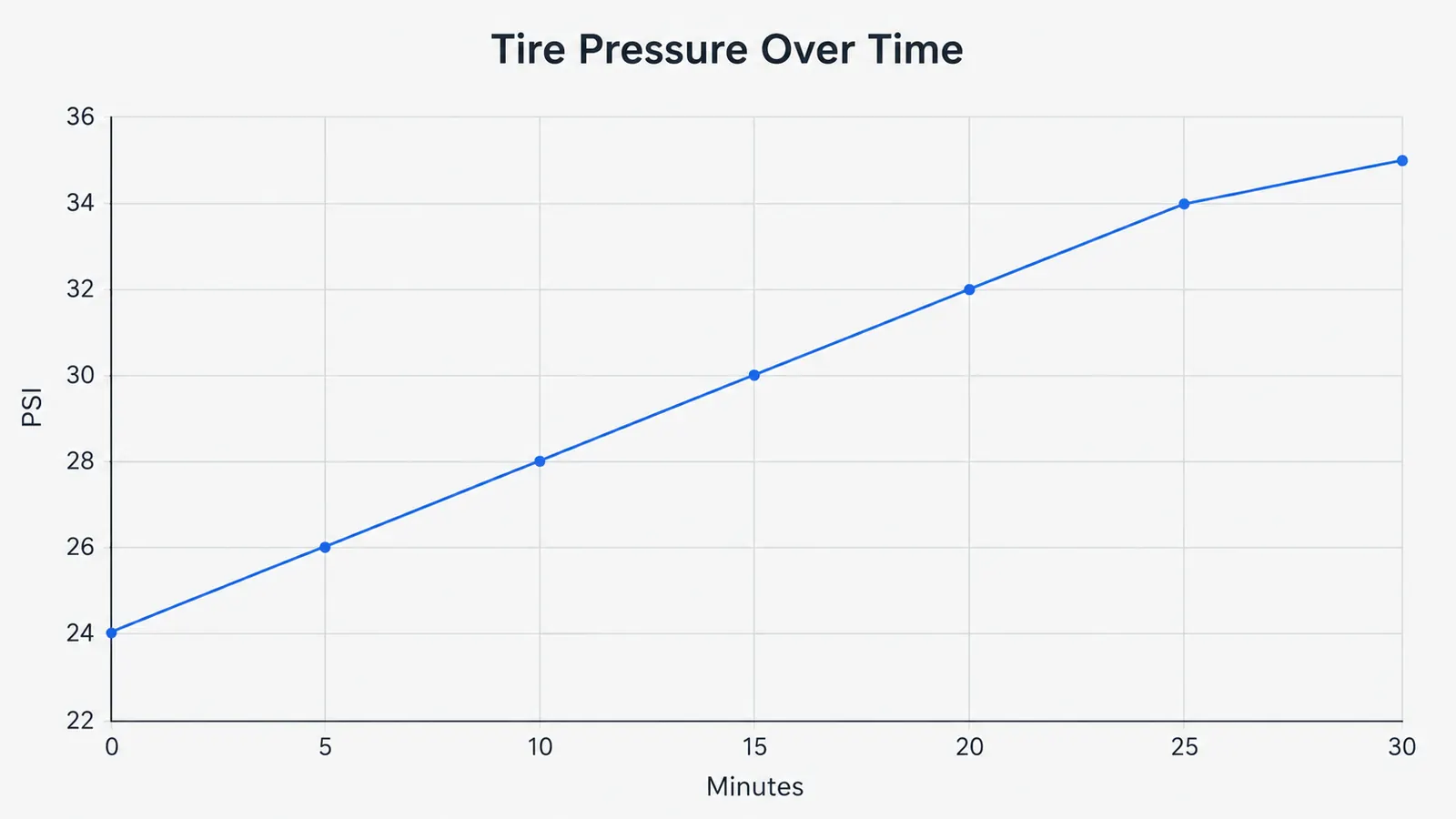
The chart below shows a typical top-off run from my notes. Cold tire at 24 psi, target 35 psi, about four minutes of run time. The line is steady, no stalling, no overheating, no false shut-off. That is the behavior I want from a tool I keep in the trunk.
The auto shut-off has stopped within one psi of the target every single time for a year. That consistency is the reason I stopped carrying a separate gauge.
How It Compares to What I Used Before
Before the AstroAI AIRUN H, I carried a cheap analog inflator that plugged into the cigarette lighter and had a gauge that bounced around like a fish on a line. It worked, but I never trusted the reading, so I always carried a separate gauge. The AstroAI replaced both tools. The digital readout is steady, and the auto shut-off means I do not have to watch it.
I also considered a cordless inflator, because the idea of not running the engine is appealing. But cordless units cost more, the batteries lose charge sitting in a trunk through an Ohio winter, and the AstroAI AIRUN H runs off the car's own battery, which is always charged because the car is driven. For my use, the corded 12V design is the more reliable choice. I do not have to remember to charge a tool that sits in the trunk for weeks at a time.
Who This Is For
The AstroAI AIRUN H is for the person who wants to stop relying on gas station air pumps and wants a tool that works the first time, every time. It is for the driveway mechanic who tops off tires on a regular schedule, the commuter who wants peace of mind in the trunk, and the household with more than one vehicle. If you check your tire pressures once a month and you are tired of the pump at the station being broken or busy, this is the tool.
It is also for the person who wants a simple, honest tool. There is no app, no Bluetooth, no subscription. You set a number, it fills to that number, and it stops. That is the whole job, and the AstroAI AIRUN H does it well. After a year, I trust it enough to keep it in my wife's car, which is the highest compliment I can give a tool.
Who Should Skip It
If you need to fill a fleet of work truck tires every morning, or you regularly air up large RV and trailer tires, the AstroAI AIRUN H is not the tool for you. It will do the job eventually, but it will take a while, and the unit will get warm. A larger compressor or a high-volume inflator is a better fit for that kind of work.
If you want a cordless inflator so you can air up a tire in a field with no car nearby, skip this one. The 12V cord means you need a running vehicle or a battery with enough charge. And if you are the kind of person who will never check a tire pressure unless the tire looks flat, this tool will not change your habits. It only helps if you use it.
What I Liked
- Accurate digital gauge, within one psi of my analog gauges
- Auto shut-off that actually stops at the target pressure
- 9.8-foot cord reaches all four tires on an SUV without moving the unit
- LED light is genuinely useful at night
- Survived a year of trunk heat, Ohio winters, and a few drops
Where It Falls Short
- Slow on completely flat tires, about nine minutes from 0 to 35 psi
- Housing gets warm on long runs
- Hose stiffens in freezing weather
A year later, I still keep it in the trunk
The AstroAI AIRUN H has earned its spot in the CR-V. If you want a portable inflator you can trust to stop at the right pressure, this is the one.
Amazon Check Today's Price on Amazon →