
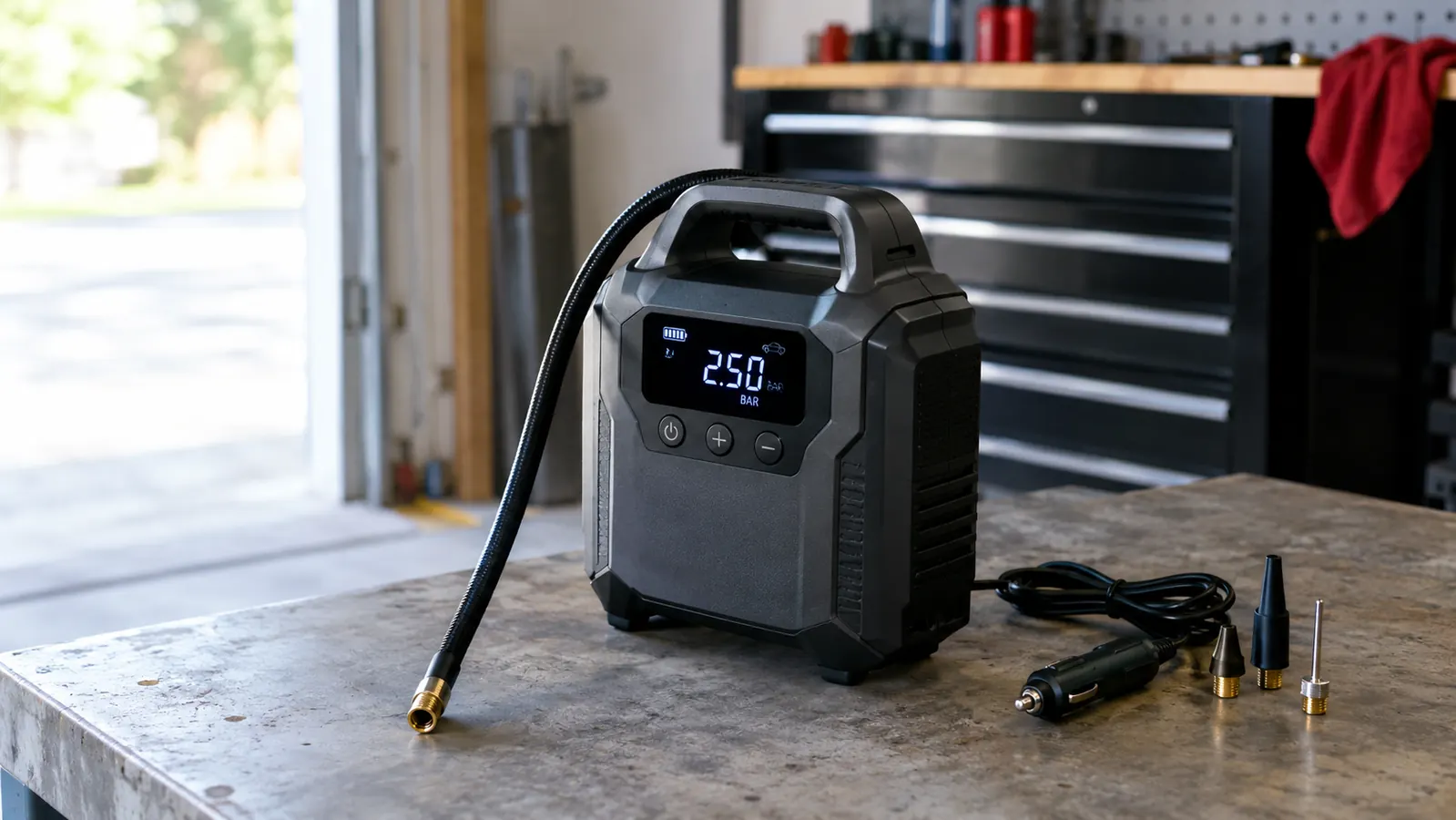
If you are trying to decide between the AstroAI AIRUN H and the VIAIR 88P, you are really asking one question: do you need a heavy-duty compressor that runs like a workhorse, or a compact inflator that lives in your trunk and bails you out? I have spent a month with both of them in my garage, airing up my 2014 F-150, my wife Carol's 2017 CR-V, and a pile of trailer tires for a neighbor. They look similar at a glance. They are not the same tool.
The short answer: the AstroAI AIRUN H is the better everyday companion, and the VIAIR 88P is the better dedicated workhorse. One is a smart, easy inflator that handles 95 percent of what a normal driver faces. The other is a tougher, slower, no-frills compressor that earns its keep if you air down on trails or run a lot of tires in one sitting. I kept the AstroAI in my truck. I also kept the VIAIR in the garage. Here is why.
For context, I tested both inflators over the same months in my own garage outside Dayton. The AstroAI rode around in the back seat of my 2014 F-150 and spent a few weeks in Carol's 2017 CR-V, and the VIAIR sat on a shelf in the garage and came out for the bigger jobs. I checked every reading against the same pencil gauge and a dial gauge I have trusted for years, because an inflator is only as good as the number it shows you.
| AstroAI AIRUN H | VIAIR 88P | |
|---|---|---|
| Best for | Daily drivers who want set-it-and-forget-it inflation | Truck and SUV owners who air down off-road or fill many tires |
| Pressure range | Digital gauge with auto shut-off at your target PSI | Analog gauge, you watch it and stop it yourself |
| Duty cycle | Rated for intermittent use, fine for topping off tires | Built for longer continuous runs, cools better between fills |
| Cord and hose | 9.8-foot power cord, hose reaches all four corners of a pickup | Shorter cord, you may need the truck running and positioned close |
| Noise | Noticeable but tolerable for a few minutes | Louder, sounds like a real shop compressor |
| Ease of use | Set the PSI, press start, walk away until it beeps | Stand there and watch the needle |
| Build toughness | Solid plastic housing, fine for trunk duty | Metal head and heavier case, built for abuse |
| Price | Lower price, easier to replace if it walks off | Higher price, you are paying for the duty cycle |
Where the AstroAI AIRUN H Wins
The AstroAI AIRUN H wins the moment you stop thinking of a tire inflator as a tool and start thinking of it as a convenience. Set the digital gauge to 35 PSI, clip the hose onto the valve stem, hit the button, and walk back into the garage. When it hits 35, it shuts itself off. That is the whole job. I used it to top off all four tires on the F-150 before a trip to Cincinnati, and I did not have to kneel there watching a needle the whole time. For a 58-year-old back, that alone is worth something.
The 9.8-foot cord is the other quiet win. I can reach the front and rear tires on the pickup without moving the truck, and I can reach the far side of Carol's CR-V in the driveway without dragging the unit across the concrete. The built-in LED light also means I am not holding a phone flashlight in my teeth when I find a soft tire at dusk. The AstroAI is the inflator I grab first, because it does the job with the least amount of stooping, squinting, and cussing.
Here is a concrete example from the third week of testing. Carol came home from work on a Tuesday and said the CR-V felt floaty on the highway. I checked the pressures with the AstroAI before I even got the gauge out of the drawer. The right rear was at 26 PSI and the other three were sitting at 31. I set the AstroAI to 33, which is what the door sticker calls for, and let it run. It took about two and a half minutes per tire, and it stopped on its own at 33 every time. I did not have to crouch down and read a gauge in the fading light, and I did not have to worry about overfilling a tire that was already warm from the drive home. That is the kind of job the AstroAI turns into a non-event.
The auto shut-off also saved me from my own carelessness. One Saturday I was airing up the F-150's left front tire and got distracted by a phone call from my brother. With an analog gauge, I would have come back to a tire at 50 PSI and a compressor that had been running the whole time. The AstroAI beeped, shut itself off at 35, and sat there quietly until I got off the phone. That is the difference between a tool that watches the pressure for you and a tool that expects you to watch it.
Accuracy matters more than people think, so I paid attention to it. Over a few dozen fills, the AstroAI's display landed within about one PSI of my dial gauge most of the time, which is about as good as you can ask from a portable unit. The preset feature is where that pays off: I set it to the pressure on the door placard, walk away, and come back to a tire that is where it should be instead of where my patience ran out.
It is also the one I actually reach for. That sounds trivial, but a tool you leave in the garage because it is a hassle to drag out does nothing for your tires. Because the AstroAI is small and runs off the power outlet in the vehicle, I check pressures more often than I used to, especially when the temperature drops in the fall and every tire on both vehicles loses a few pounds overnight.
The inflator that shuts itself off at the right PSI
Set your target pressure, press start, and let the AstroAI AIRUN H handle the rest. It is the one I keep in the truck for everyday tires.
Amazon Check Today's Price on Amazon →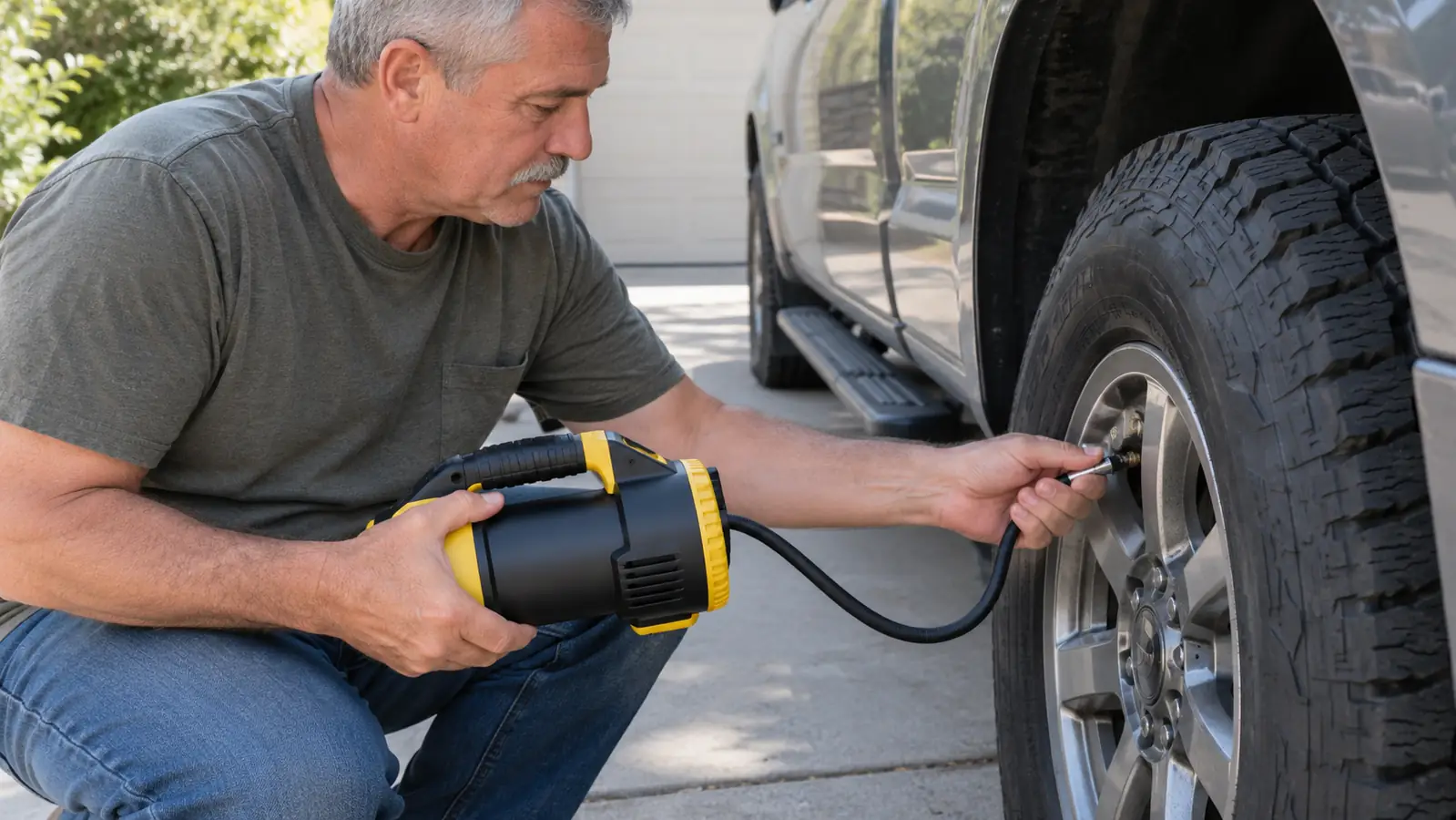
Where the VIAIR 88P Wins
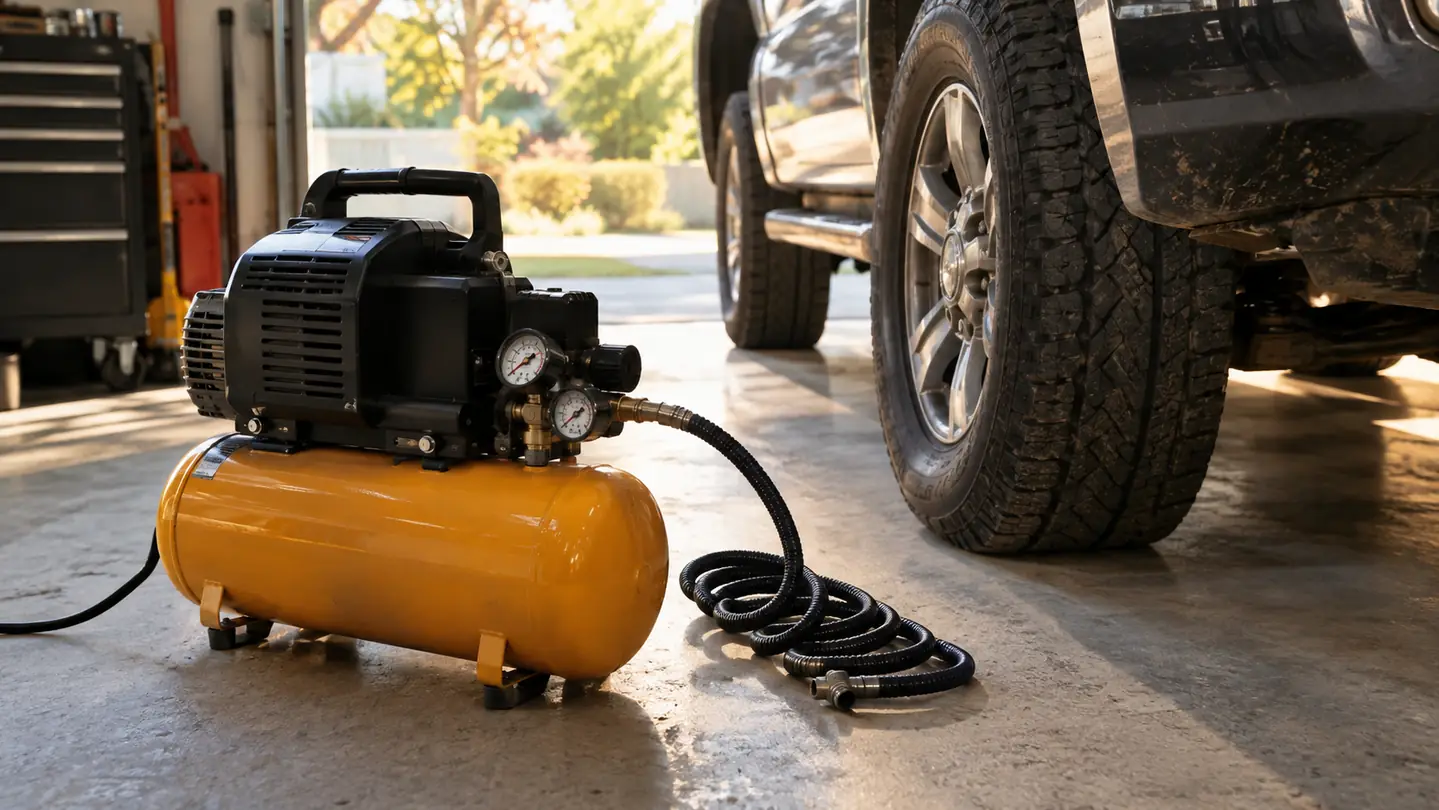
I will be straight with you: the VIAIR 88P is the tougher machine. It has a metal head, a heavier case, and a duty cycle that is built for longer runs. When I aired up a neighbor's trailer tires from 20 PSI to 50 PSI, four tires in a row, the VIAIR kept going without complaint. The AstroAI would have done it, but I would have been watching the clock and giving it a rest between tires. If you air down on forest roads and then have to bring four big tires back up, the VIAIR is the one that will not flinch.
The VIAIR also wins on pure simplicity. There is no digital brain to fail, no auto shut-off to calibrate, just a compressor and an analog gauge. Some people prefer that. If you are the kind of person who likes to feel the tool working and watch the needle climb, the VIAIR gives you that. It is louder, and it sounds like a real compressor instead of a gadget. That noise is the sound of a tool that was built for a job, not for a glovebox.
The trailer job is the one that made me respect the VIAIR. My neighbor Dave has a 6x12 utility trailer that had been sitting all winter, and all four tires were low. The first one read 20 PSI, and the other three were not much better. I hooked the VIAIR to the battery of the F-150, let the truck idle, and started filling. From 20 to 50 PSI, each tire took somewhere around six or seven minutes. That is twenty-five minutes of nearly continuous running, and the VIAIR never tripped, never slowed down, and never felt hot enough to worry me. I checked the case with the back of my hand when I was done and it was warm, not scary. I would not have run the AstroAI that long without a break, and I would not have wanted to.
The VIAIR also handled a job the AstroAI is not built for: reseating a bead on a stubborn trailer tire. Dave had a tire that kept losing air at the bead, and after I cleaned the rim and applied some soapy water, I needed a strong burst of volume to pop it back into place. The VIAIR's continuous output did it. The AstroAI is a precision inflator, not a volume machine, and I would not have asked it to do that job. If your world includes off-road trips where you air down to 15 PSI and then have to bring the tires back up on a trail, the VIAIR is the tool that will get you home.
The VIAIR is also louder and heavier, and that is not a knock so much as a fact of how it is built. It clamps to the battery terminals instead of plugging into the power outlet, so every use starts with popping the hood. On a big job that is fine. On a Tuesday morning when the low pressure light comes on and you are already late, it is the difference between a two minute top off and deciding to deal with it later.
The AstroAI is the inflator I grab first. The VIAIR is the one I grab when I know I will be filling tires for a while.
Who Should Buy Which
Buy the AstroAI AIRUN H if you want one inflator that lives in your vehicle and handles the normal stuff: seasonal pressure changes, a slow leak, a neighbor's bike tire, topping off before a road trip. The auto shut-off and digital gauge make it the easiest inflator I have used, and the long cord means you are not playing musical chairs with the vehicle. It is the right choice for most drivers, most of the time.
Buy the VIAIR 88P if you regularly fill multiple tires in one sitting, air down for off-road driving, or want a compressor that feels like it was built for a shop. It costs more, it is louder, and it makes you stand there and watch the gauge. In exchange, you get a tougher tool that will keep running when the AstroAI would want a break. If that is your life, the VIAIR is worth every penny. If it is not, the AstroAI is the smarter buy.
One more thing worth saying: I have owned cheap inflators that died after a handful of uses, and I have owned a 12-volt unit that took twenty minutes to add five PSI to a single tire. The AstroAI is not that. It is a real tool with a real gauge, and it has earned its spot in my truck. The VIAIR is a real compressor, and it has earned its spot in my garage. Most people only need one, and for most people, the AstroAI is the one.
If you are torn, think about the last six months. If every inflation job you did was topping off a passenger car or a half-ton pickup, the AstroAI handles that with less fuss and fits under a seat. If you spent weekends filling trailer tires, airing back up after a trail, or feeding a tool off the compressor, the VIAIR earns its space. In my house, with one pickup and one small SUV, the AstroAI is the one that earns a permanent spot, and the VIAIR is the one I borrow out to my neighbor.
Start with the one that does the everyday job
The AstroAI AIRUN H is the inflator I trust for daily driving. See today's price and decide if it earns a spot in your trunk.
Amazon Check Today's Price on Amazon →