
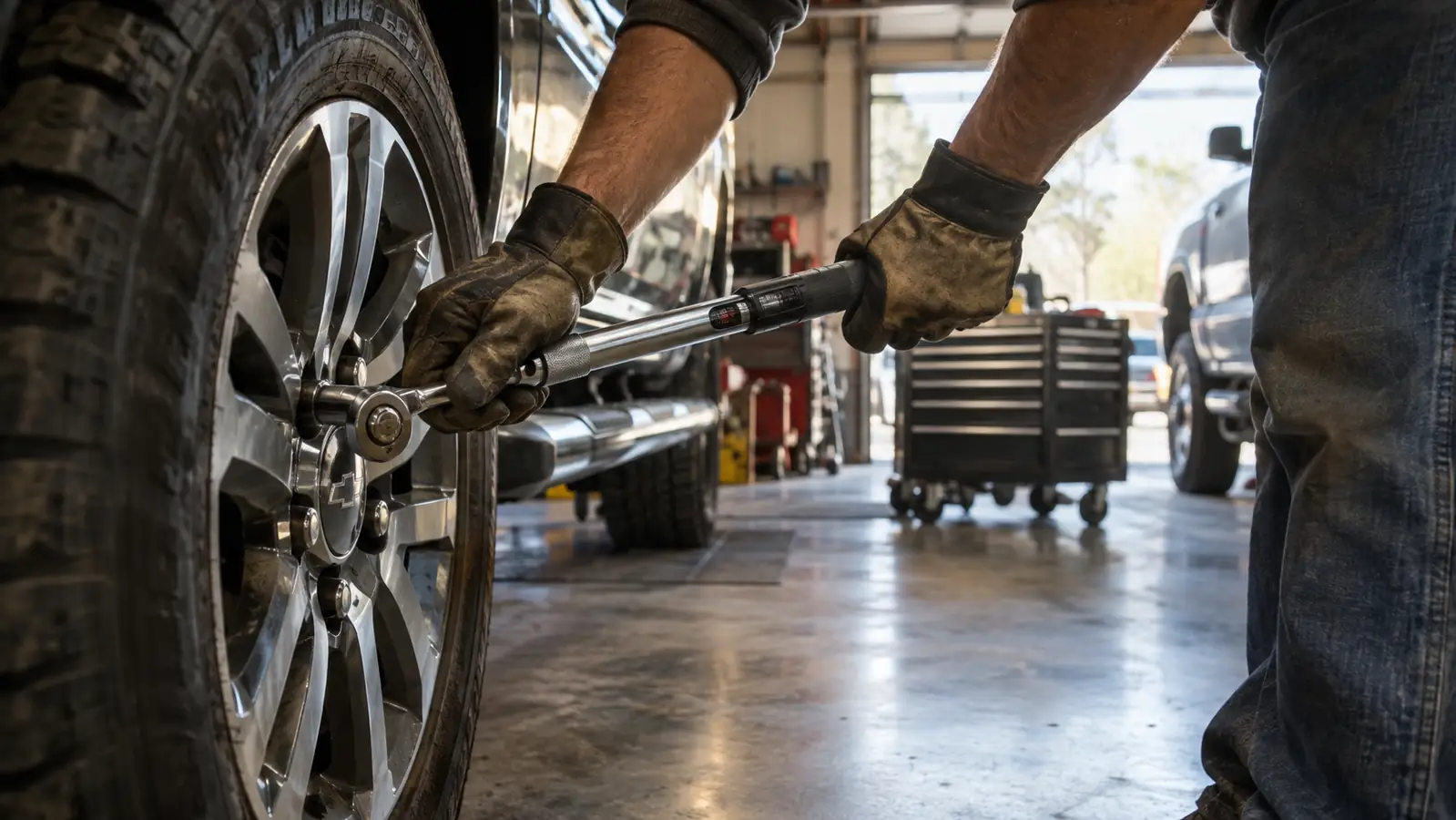
I have a confession to make. For the first fifteen years I worked on my own vehicles, I never owned a torque wrench. I tightened lug nuts by feel, torqued drain plugs by grunt, and told myself that was good enough. Then I snapped a bolt in a brake caliper bracket on my 2014 F-150 and spent a full Saturday drilling it out. That is when I bought the EPAuto 1/2-inch Drive Click Torque Wrench, and two years later it is still the tool I reach for on every job that calls for a specific number.
This is not a lab test. I am a retired factory maintenance tech who does all his own work in a two-car garage outside Dayton, Ohio. The EPAuto has torqued lug nuts on my pickup and my wife Carol's Honda CR-V, set the bolts on two brake jobs, handled oil pan drain plugs more times than I can count, and survived being dropped on a concrete floor at least three times. Here is what two years of real use taught me.
The Quick Verdict
The EPAuto 1/2-inch click torque wrench is the best value in my toolbox. It clicks where it should, holds its setting, and has not drifted in two years of driveway use. The plastic case is cheap and the range tops out at 150 ft-lb, but for a home mechanic it is hard to beat at the price.
Amazon Check Today's Price →Stop Guessing and Start Torquing
If you have ever snapped a bolt or stripped a drain plug by tightening by feel, the EPAuto 1/2-inch click torque wrench is the fix. It covers 10 to 150 ft-lb, which handles lug nuts, brake calipers, and oil pan plugs on most cars and light trucks.
Amazon Check Today's Price on Amazon →How I've Used It
The EPAuto lives in the top drawer of my rolling tool chest, and it comes out at least once a month. The most common job is lug nuts. My F-150 calls for 150 ft-lb on the wheels, which is right at the top of this wrench's range, and Carol's CR-V calls for 80 ft-lb. I have torqued every wheel on both vehicles at least a dozen times over the last two years, and the wrench has never failed to click.
Beyond wheels, I have used it for brake caliper bracket bolts, strut top nuts, control arm bolts, and the drain plug on every oil change. The 1/2-inch drive is the right size for suspension and brake work, and the 10 to 150 ft-lb range covers almost everything on a normal car or light truck. The only jobs it cannot do are the small fasteners that need an inch-pound wrench and the big axle nuts that need more than 150 ft-lb.
One job stands out. In the spring of last year I replaced the front brake pads and rotors on Carol's CR-V. The caliper bracket bolts call for 80 ft-lb. With the old habit of guessing, I probably would have stopped at good and tight, which is how I snapped that caliper bolt on my F-150 years ago. Instead I set the EPAuto to 80, ran each bolt down until it clicked, and then went back and clicked all four again to make sure. The job took an extra three minutes. The car has been on the road ever since with no squeal and no pull.
I also use it for the oil drain plug on every oil change. My F-150's plug is spec'd at 20 ft-lb, which is low enough that a cheater bar or a heavy hand can easily strip the pan threads. I set the EPAuto to 20 and let the click tell me when to stop. In two years I have not stripped a single plug, and I have not had a leak. That alone has made the wrench worth owning.
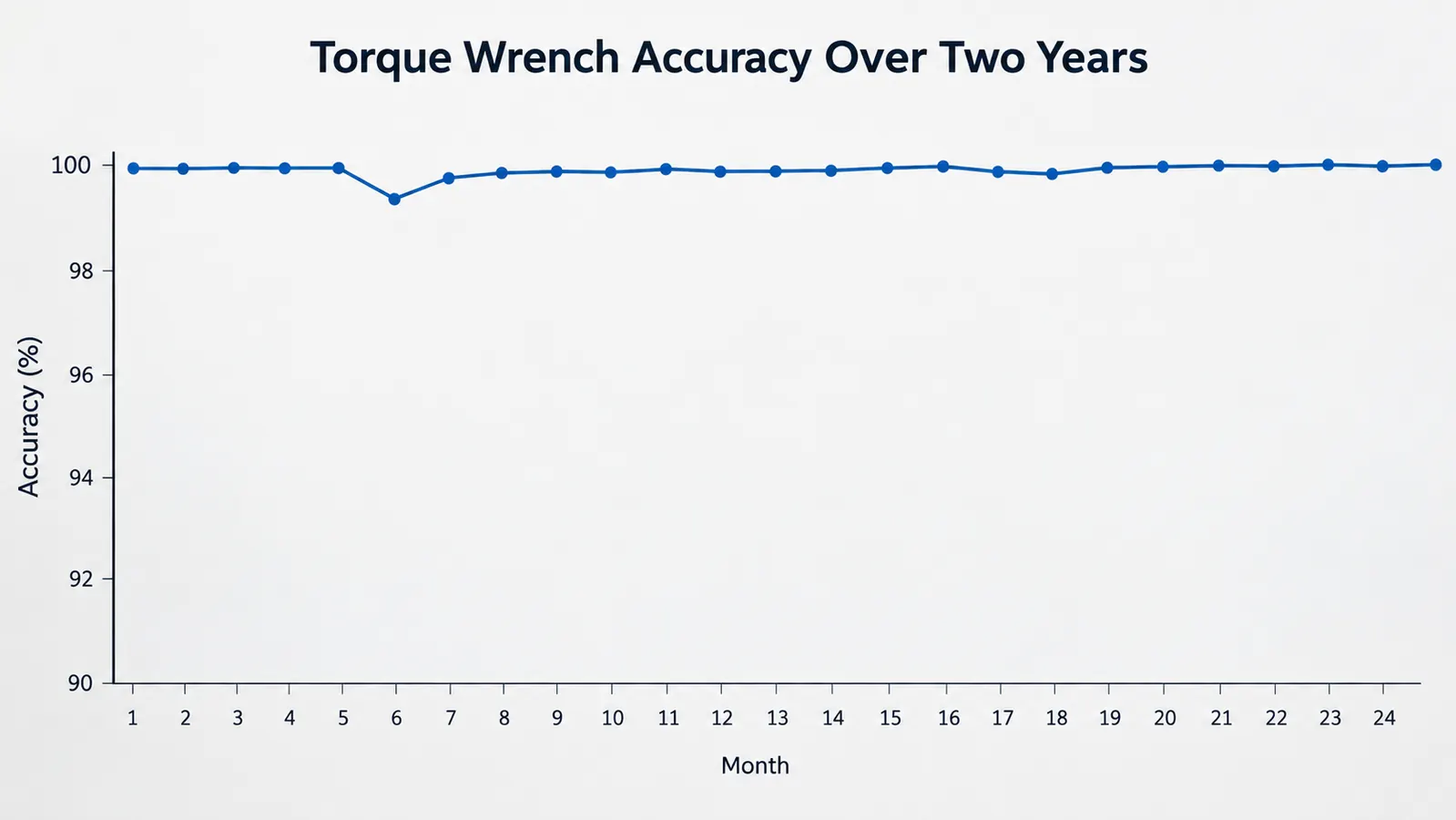
I also tested it against a friend's digital torque adapter on a few bolts. The EPAuto clicked within a pound or two of the digital reading every time. That is not a certified calibration check, but it tells me the wrench has not drifted after two years of regular use.
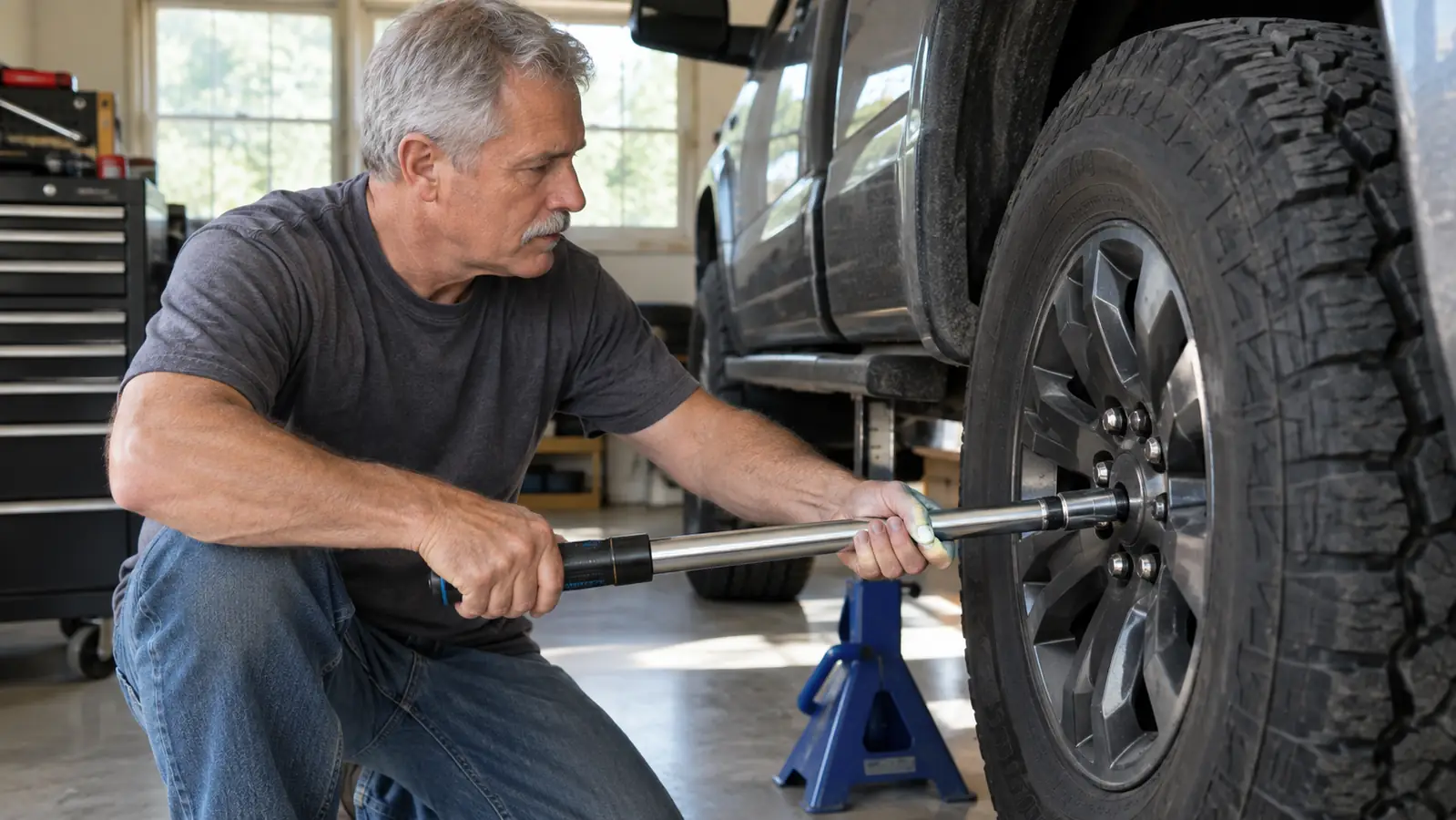
What the Numbers on the Wrench Actually Mean
The EPAuto is a click-style torque wrench, which means you set a number on the handle and the wrench clicks when you reach that torque. The scale reads in both ft-lb and N-m, and the handle locks with a small collar at the base. To set it, you pull the collar down, turn the handle to your number, and let the collar snap back up. It takes about five seconds once you have done it a few times.
Reading the scale takes a second once you know what to look at. The main scale is marked every 5 ft-lb with numbers every 20, and the handle has a row of smaller marks for the in-between values. To set 80, you line the top edge of the handle with the 80 mark on the shaft. My first time, I set it by the bottom edge by mistake and ended up at 75. The wrench still clicked, but I caught it when I checked with the digital adapter later. Now I always double-check which edge I am lining up.
The N-m scale is not just decoration. A lot of newer vehicles list torque specs in N-m in the owner's manual, and it is nice to set the wrench without converting. My CR-V's lug nuts are 108 N-m, which is about 80 ft-lb. I have used the N-m side more than I expected.
The one thing that trips up new owners is the storage setting. You are supposed to back the handle all the way down to the lowest setting before putting the wrench away. That keeps the internal spring from staying compressed and losing its calibration over time. I keep a piece of tape on the case that says 'set to 10 before storage,' and after two years the wrench still clicks where it should.
The locking collar is where a cheap wrench usually fails. On the EPAuto, the collar has a positive snap when it seats, and it has not loosened on its own in two years. I have caught the collar on the edge of a fender a few times and it never released. That matters because a collar that slips while you are torquing will let the setting drift.
The click itself is a solid, audible snap. It is not a subtle feel through the handle like some higher-end wrenches. You hear it and you feel it, which is exactly what you want when you are lying on your back under a vehicle with your arms at a bad angle.
How It Holds Up Over Time
After two years, the EPAuto still looks and works like the day I bought it. The metal finish has a few scuffs from being dropped, but there is no rust and the markings on the handle are still sharp. The ratchet head has not developed any slop, and the direction switch still clicks over cleanly.
Last fall I did a more formal check. A buddy let me borrow his digital torque adapter, and I ran the EPAuto against it at three settings: 20, 80, and 150 ft-lb. At 20 the adapter read 21. At 80 it read 79. At 150 it read 149. That is within the 4 percent EPAuto claims, and it is close enough for lug nuts and brake bolts. I wrote the numbers on a sticky note and taped it inside the drawer so I would have a record.
The ratchet mechanism has also held up. It has a standard two-position switch, and the switch has not gotten stiff or started skipping. The head is compact enough that I can get it on the upper strut nuts on the CR-V without pulling the whole strut tower apart. That is a spot where a bulky head would have made the job miserable. I have also used it on the F-150's lower control arm bolts, which need 148 ft-lb. That is close to the ceiling, and the wrench still clicked cleanly.
The weakest part is the plastic storage case. The latches still work, but the hinge feels flimsy and I would not trust it to survive a fall off a workbench. I replaced the case with a foam-lined drawer insert after about six months, and that has worked out better anyway because the wrench stays in the drawer where I can grab it without opening a case.
I have dropped this wrench on a concrete floor at least three times. Once it landed directly on the ratchet head. I checked it against the digital adapter afterward and it was still reading correctly. That is not a guarantee yours will survive the same abuse, but it tells me the internal mechanism is built better than the price suggests.
After two years and dozens of jobs, the EPAuto still clicks within a pound or two of a digital torque adapter. That is the only proof that matters to me.
Where the EPAuto Falls Short
I am not going to pretend this wrench is perfect. The biggest limitation is the 150 ft-lb ceiling. My F-150's lug nuts are spec'd at 150 ft-lb, which means I am always working at the very top of the range. It works, but I would feel better with a little headroom. If you regularly work on heavy-duty trucks or anything with big axle nuts, you will want a wrench that goes higher.
The 150 ft-lb ceiling bit me once. A neighbor asked me to help with the lug nuts on his 3/4-ton truck, and the spec was 175 ft-lb. I had to borrow his 250 ft-lb wrench to finish the job. That is not a knock on the EPAuto. It is a reminder that this tool is built for cars, crossovers, and half-ton pickups, not for one-ton work. If you ever plan to work on a heavy truck, buy a bigger wrench as well.
The second annoyance is the case, which I already mentioned. It is functional but cheap, and the latch on mine started feeling loose within the first year. The third is the lack of a calibration certificate in the box. EPAuto states the wrench is calibrated to within plus or minus 4 percent, and my informal checks support that, but if you need a documented calibration for professional work, this is not the tool for you.
The fixed head is the last limitation. It does not flex, so on a couple of jobs I had to reach a bolt through a universal joint and a socket where a flex-head wrench would have gone straight in. It only cost me a few extra minutes, but it is worth knowing if you do a lot of work in tight engine bays.
Finally, the handle is smooth metal rather than knurled or rubber-coated. That is fine when your hands are dry, but if you are torquing something with oily hands, you have to grip a little harder. I keep a pair of mechanic's gloves in the drawer and put them on for oily jobs. That fixes the grip problem without spending extra money. It has never caused me to miss a click, but it is worth knowing.
What I Liked
- Clicks accurately and consistently, even after two years of regular use
- Covers 10 to 150 ft-lb, which handles lug nuts, brakes, and drain plugs on most cars and light trucks
- Clear, easy-to-read scale in both ft-lb and N-m
- Solid click you can hear and feel, even under a vehicle
- Survived multiple drops on a concrete floor without losing accuracy
- Hard to beat for the price
Where It Falls Short
- 150 ft-lb top end leaves no headroom for heavy-duty truck work
- Plastic case feels cheap and the hinge is flimsy
- No calibration certificate included
- Smooth metal handle gets slippery with oily hands
Who This Is For
The EPAuto 1/2-inch click torque wrench is for the home mechanic who is tired of guessing. If you change your own oil, rotate your own tires, or do your own brake jobs, this wrench will pay for itself the first time it keeps you from snapping a bolt or stripping a drain plug. It is also a great first torque wrench for a beginner because the click style is simple to understand and the price is low enough that it does not feel like a big commitment.
It is especially good for anyone who works on a mix of vehicles. I use it on my F-150 and Carol's CR-V, and the 10 to 150 ft-lb range covers both without needing a second wrench. If you are maintaining a normal car, a crossover, or a half-ton pickup, this is likely the only torque wrench you need.
Who Should Skip It
Skip the EPAuto if you do professional work and need a documented calibration certificate, or if you regularly torque fasteners above 150 ft-lb. Heavy-duty trucks, large axle nuts, and commercial work need a bigger wrench. You should also skip it if you want a digital readout or a ratcheting flex head, because this is a straightforward fixed-head click wrench and it does not pretend to be anything else.
And if you only work on your car once a year, you might not need a torque wrench at all. But if you are going to own one, the EPAuto is the one I would hand a friend who is just getting started.
Two Years of Proof in One Tool
The EPAuto 1/2-inch click torque wrench has earned its spot in my toolbox. If you do your own maintenance, it will earn a spot in yours. Check the current price on Amazon and see why 23,000-plus owners give it 4.6 stars.
Amazon Check Today's Price on Amazon →