
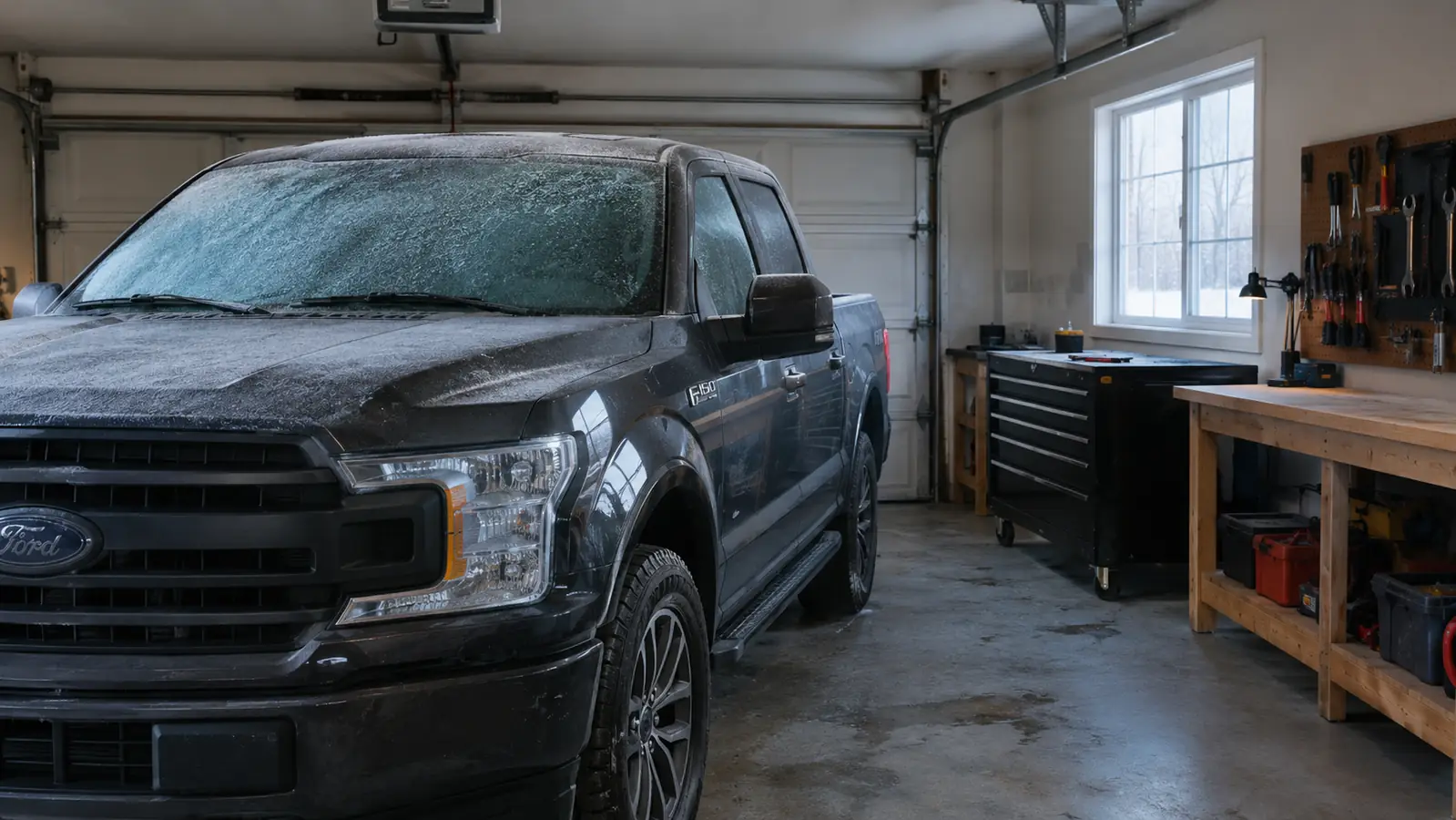
Here's the thing about a truck battery in a Dayton winter: it doesn't die on the cold night. It dies on the one morning you're already running late, because the cold made a weak battery weaker. I learned that the hard way with my 2014 F-150, which has a little over 190,000 miles on it and a battery that was three years old at the time. I spent two winters jumping it, idling it in the driveway, and replacing batteries a year early out of pure frustration. Then I bought a NOCO GENIUS1 smart charger and maintainer, and I stopped thinking about the battery entirely. This is the exact routine I've used for the last two winters, step by step, including the mistakes I made the first few times so you don't have to repeat them.
The problem is never the cold by itself. A healthy battery handles a week of single-digit nights without complaining. The problem is the slow drain that happens when a truck sits for a few days, plus the fact that cold thickens the oil and makes the starter work harder at the exact moment the battery has the least to give. The usual answer is to start the truck and let it idle. That's what I used to do. It wastes gas, it doesn't fully recharge a battery that's been drained, and it does nothing for the next morning. A maintainer is the fix, but only if you use it right. Here's how.
The only charger I trust to stay connected all winter
The NOCO GENIUS1 is a 1-amp smart charger, trickle charger, and maintainer for 6V and 12V batteries. It reads the battery's state, charges it to full, and holds it there without overcharging. It's the last battery tool you'll need to buy. Check today's price on Amazon.
Amazon Check Today's Price on Amazon →Step 1: Know what battery you have before you buy anything
Before you buy any charger, open the hood and read the label on the battery. You're looking for two things: the voltage, which will be 6V or 12V, and the battery type. The NOCO GENIUS1 handles both 6V and 12V batteries, so it covers just about everything on the road, but the type matters because the mode you pick needs to match. My F-150 runs a standard 12V lead-acid battery. Carol's 2017 Honda CR-V runs the same. Yours may be different, so check before you connect anything.
You also want to know the battery's age. Most batteries last three to five years in Ohio, and the date code is stamped right on the case. If yours is over four years old, the maintainer will slow down the decline, but it won't undo years of heat and vibration. I found this out the hard way. The first battery I hooked the GENIUS1 to was already five years old, and I expected a second life out of it. What I got was a battery that held a charge all winter and still gave up the next fall. The charger did its job. The battery was simply done.
So the honest rule is this: if the battery is under four years old and holds a charge, a maintainer will stretch it. If it's older and already struggling, replace it first, then maintain the new one. That order has kept me from buying a battery every single winter, and it's the difference between maintaining a battery and babysitting a dead one.
Step 2: Set up safely before you touch a terminal
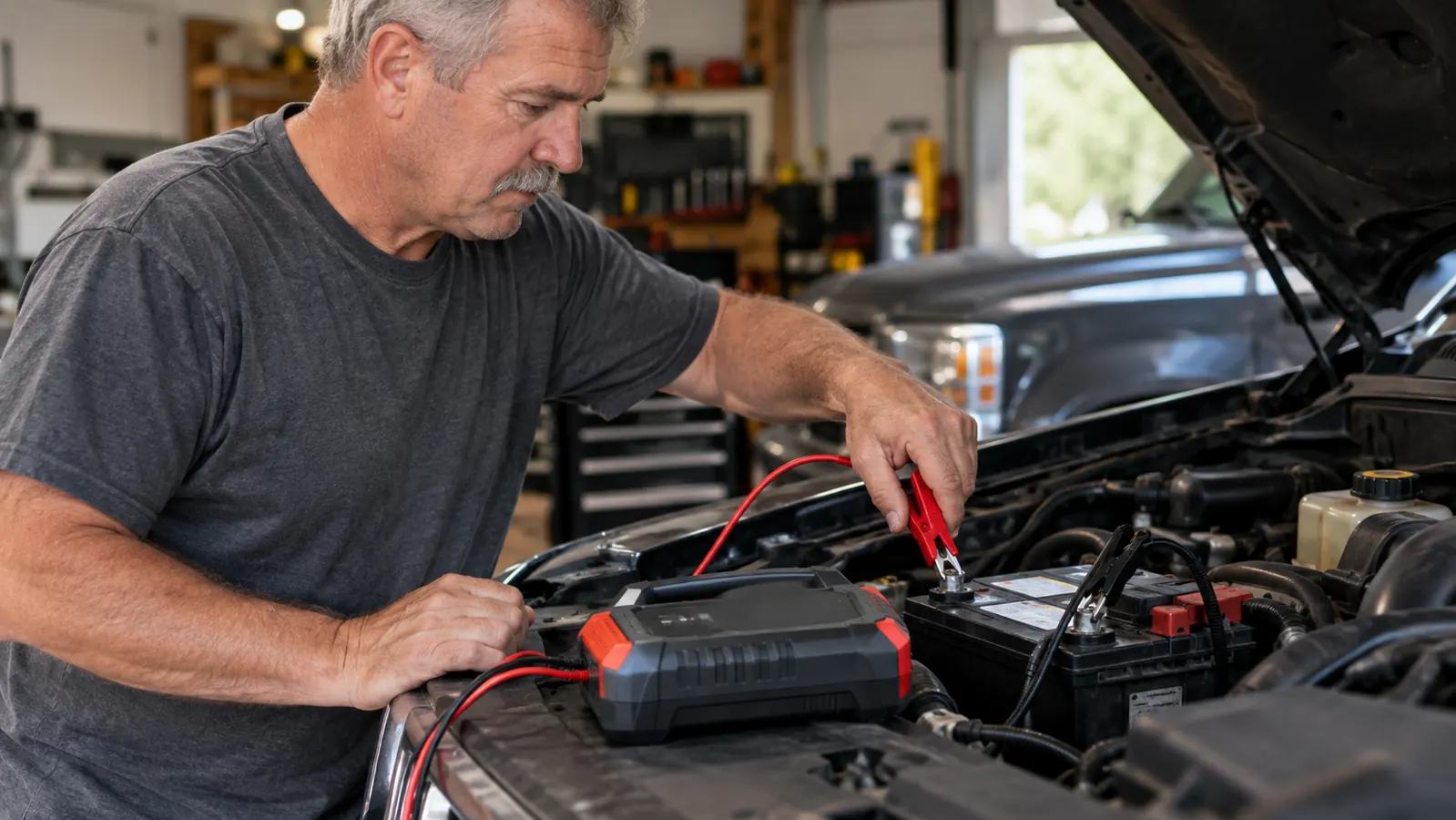
Batteries deserve more respect than most of us give them. They're full of acid and they can put out hundreds of amps. Before I touch anything, I park the truck in the garage, shut it off, and take the keys out of the ignition. Then I put on safety glasses and a pair of work gloves. It takes twenty seconds, and it's the difference between a routine job and an emergency room visit.
Give the battery a once-over before you connect anything. I'm looking for cracked cases, bulging sides, and corrosion around the terminals. That white crust on the posts is normal wear, and it should be cleaned off before you attach clamps. A terminal brush takes two minutes. Corrosion creates resistance, and resistance is what makes a charger think a battery is full when it isn't, or makes it charge unevenly. The worst case I've seen was Carol's CR-V. The terminals had a thick layer of crust, and the car cranked slow every cold morning. A load test said the battery was fine. I cleaned the terminals with a brush, and the slow cranking disappeared. That's the kind of fix that costs nothing and saves you a battery.
The other thing I do is work in a ventilated space. The garage door stays cracked open while the charger runs. Batteries can give off hydrogen gas while charging, and while a modern smart charger produces far less of it than the old chargers did, I don't see any reason to test that with the door sealed. This is the kind of detail the instructions mention and people skip. Don't skip it.
Step 3: Connect the clamps in the right order
The order matters, and it's the opposite of what a lot of people expect. Red clamp first, to the positive terminal. That's the one with the plus sign and usually the red cap, though I've seen plenty of aftermarket batteries where the colors have faded. If the terminal is marked, trust the marking over the color. On my F-150 the positive terminal has a plastic cover, and I flip it back before I clamp on. If your truck has side terminals instead of top posts, the same order applies, just with a different clamp angle.
Then the black clamp. The NOCO GENIUS1 has reverse polarity protection built in, which means it won't spark or blow a fuse if you mix the clamps up, and that's a real comfort on a cold morning. But you still want to do it right. On most modern vehicles, the manual says to connect the black clamp to bare metal on the engine block or the frame rather than directly to the negative terminal. I use a clean bolt on the fender well. It's the same connection electrically, and it keeps the clamp away from the battery itself.
The clamps themselves are worth mentioning. The GENIUS1 comes with clamps that grip well and don't feel flimsy. I've used cheap chargers where the clamp barely holds onto the terminal, and the charger keeps dropping in and out. That constant reconnecting is hard on a battery and confusing to read. A clamp that stays put means the charger does its job without you standing there holding it.
Step 4: Plug it in and let the smart charger do the thinking
Once the clamps are on, plug the charger into a 120V outlet and walk away. That's the whole trick. The NOCO GENIUS1 is smart about how it charges, which means it measures the battery's state and adjusts the charge rate instead of blindly pushing current the way the old chargers did. You don't pick a time and you don't watch a gauge. It goes into maintain mode on its own once the battery is full.
The honest tradeoff is speed. This is a 1-amp charger, and 1 amp is slow. If your battery is at 12.4 volts instead of 12.7, it will be topped off in a few hours. If the battery is deeply drained, below 12 volts, it can take a day or more to bring it back. That's fine for a maintainer, and it's exactly why this charger is the wrong tool if you need a jump in the next twenty minutes. For that, you still want a jump pack or a second vehicle. The GENIUS1 is for the night before, not the morning of.
My routine is Sunday night. I plug the truck in on Sunday evening, and by Monday morning the battery is full and the charger is holding it there. Carol's 2017 CR-V gets the same treatment, but on its own schedule. It doesn't sit as often, so it only gets plugged in during the worst cold snaps or after a week of short errands. The same charger handles both vehicles, which is part of why the 1-amp rating is enough for me. A bigger charger would do the same job faster, but I don't need faster. I need dependable. I've checked the voltage with a multimeter after a full cycle, and it sits right where it should. Last February, during the cold snap that kept us below ten degrees for nearly a week, the F-150 sat for four straight days and still cranked like it was July. That's the entire point. The charger does the worrying so you don't have to.
Step 5: Disconnect in reverse, then make it a habit
When it's time to drive, I disconnect in the reverse order: black clamp off first, then red. The charger switches to standby on its own, so there's no arcing and no drama. I hang the clamps on the charger so they don't touch anything, and I coil the cord loosely. A cord that gets stepped on all winter is a cord that eventually fails at the worst time.
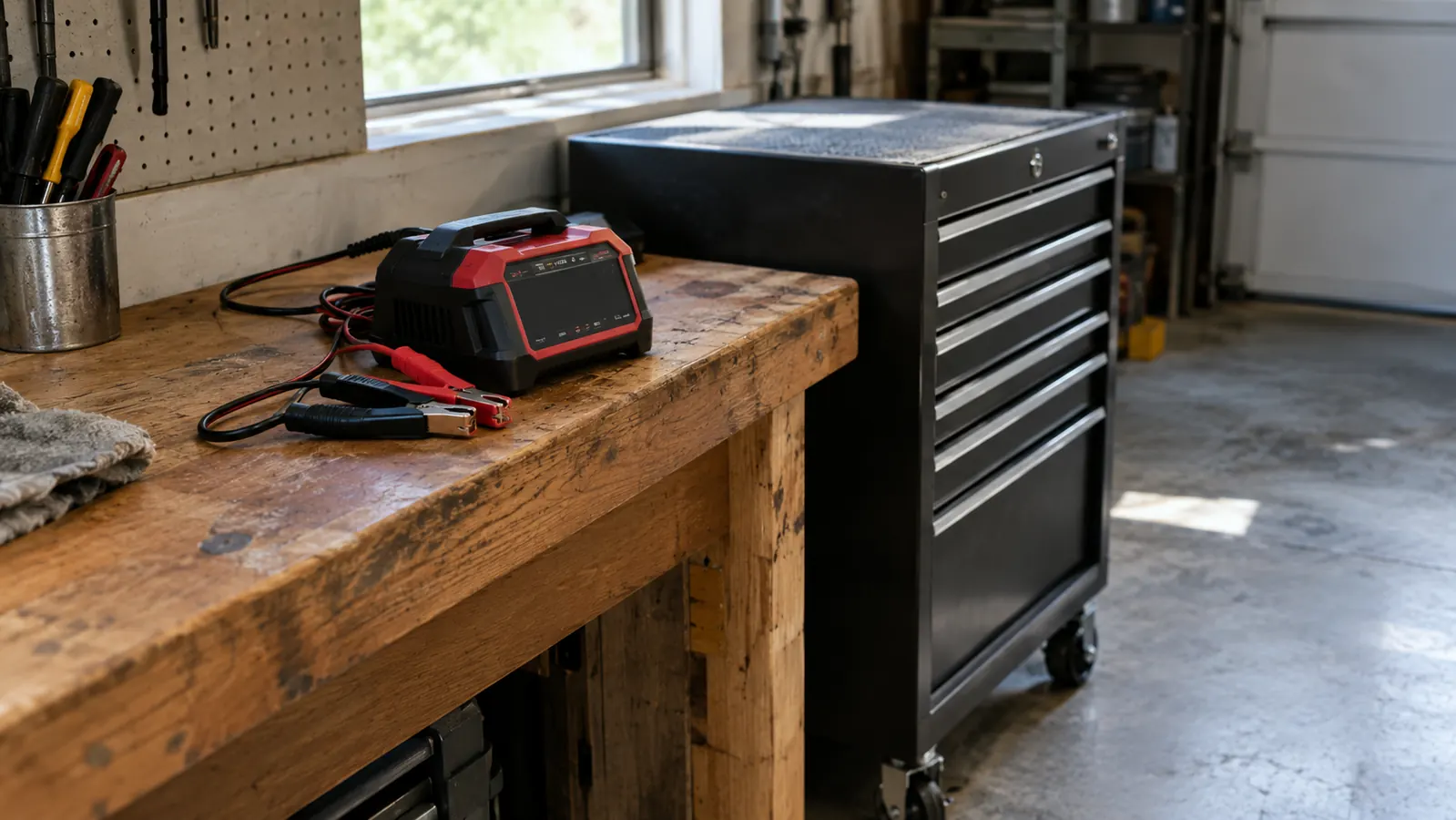
Then the charger goes back on the workbench. The GENIUS1 is small, about the size of a thick paperback, and it takes up almost no room in the rolling tool chest. I keep it in the same drawer every time, because the one time I left it in the truck, I spent a week looking for it. Find one home for it and put it back there every time.
The habit part is what actually saves the battery. A maintainer only works if it gets plugged in before the battery is in trouble, not after. I set a simple rule: any time the temperature is going to drop below freezing and the truck is going to sit for more than a day, it gets plugged in. That's maybe twenty nights a winter. Twenty nights of plugging in a charger costs less than a single tow, and it means the battery starts every single morning.
What Else Helps
The GENIUS1 does the heavy lifting, but a few other things have made a real difference in my driveway. First, clean terminals. I take a terminal brush to the posts and the inside of the clamps every fall, before the cold arrives. I use the same brush on the clamps themselves, because the inside of a corroded clamp can't make good contact no matter how clean the post is. A clean connection carries current the way it's supposed to, and it takes ten minutes.
Second, think about your drives. A five-minute trip to the store in January takes more out of the battery than the alternator puts back. The truck's electronics, the heated seats, the defroster, they all draw plenty. If I know the truck is going to sit after a short trip, that's exactly the night it gets plugged in.
Third, use the garage if you have one. My F-150 lives in the attached garage, and even an unheated garage runs ten to fifteen degrees warmer than outside on the coldest nights. That's enough to make a difference. If you park outside, the maintainer matters even more, because the battery is working against colder temperatures all night.
Fourth, test the battery in the fall, before you need it. A load test at a parts store takes ten minutes and tells you whether the battery is going to make it through January. I do this every October. If it fails, I replace it then, on my schedule, instead of on a single-digit morning while I'm already late.
Last February, the F-150 sat for four straight days in a cold snap and still cranked like it was July. That's the whole point of a maintainer.
Plug it in tonight, not after the first dead morning
The NOCO GENIUS1 does one job and does it well: it keeps your battery full all winter. It's the last battery tool you'll need to buy for a long time. Check today's price on Amazon.
Amazon Check Today's Price on Amazon →