

The first thing nobody tells you about the NOCO GENIUS1 is that it is not the charger you think it is. I found that out on a cold January morning in Dayton, Ohio, when my F-150 cranked slow after sitting for four days. I grabbed the GENIUS1 off the garage workbench, hooked the clamps on, and waited for the quick fix. What I got instead was a lesson in what one amp actually means. This is the honest version of that story, the one I wish somebody had handed me before I ordered.
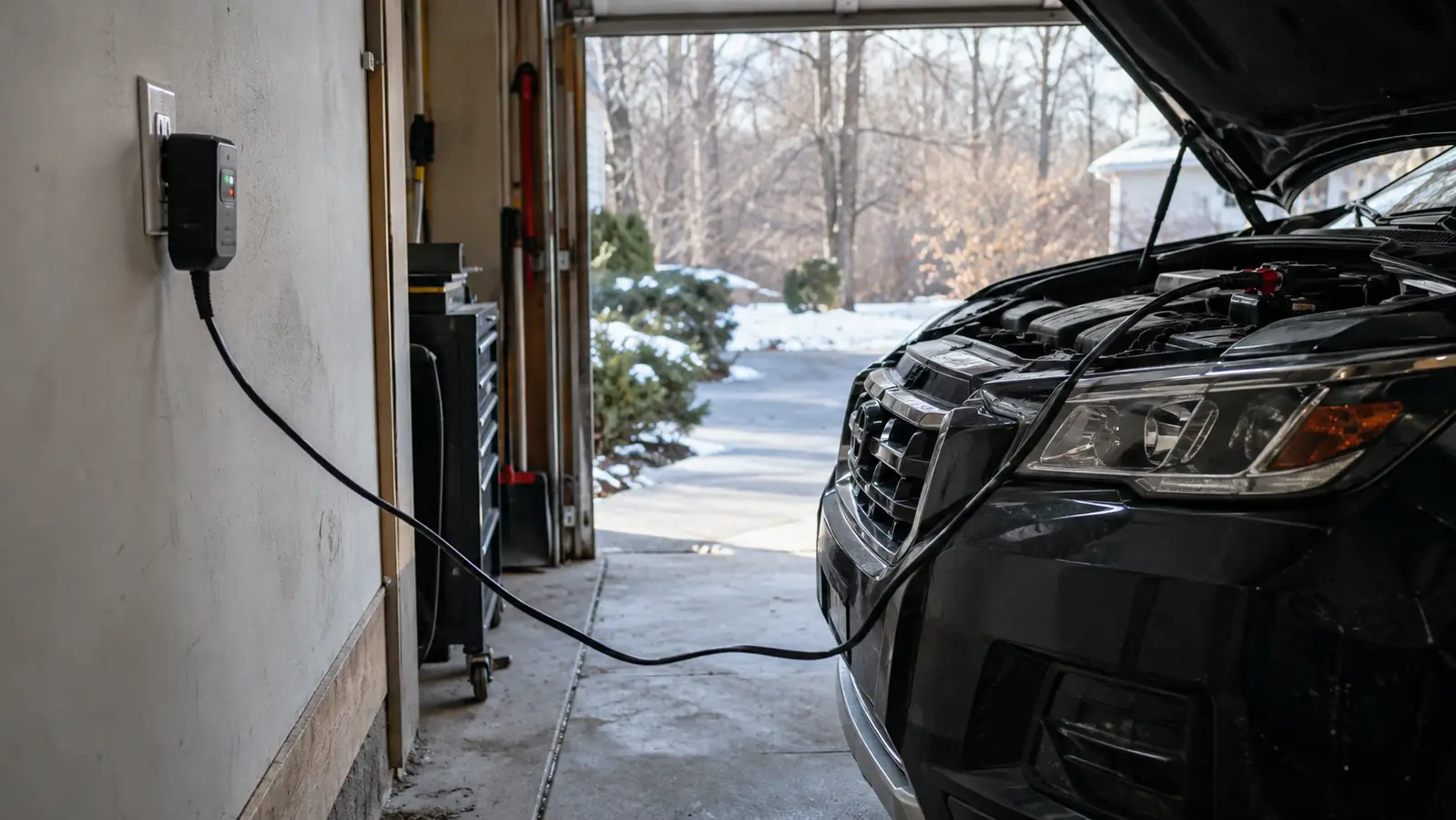
Let me set the scene so you know where this opinion comes from. I am Walt, a retired factory maintenance tech, and I have done my own vehicle work for thirty years to keep money in my pocket. My 2014 F-150 has a little over 190,000 miles on it, and my wife Carol's 2017 CR-V is the second vehicle I keep running. The garage is a standard two-car attached setup with a concrete floor, a rolling tool chest, and a workbench along the back wall. I bought the GENIUS1 because Ohio winters are hard on batteries and I wanted something smart enough to leave connected without worrying about overcharging overnight. It does that job very well. The trouble is everything it cannot do, because none of that is printed on the front of the box.
The Quick Verdict
A genuine quality maintainer that keeps a healthy battery topped off for months, but the 1-amp rate makes it the wrong tool for reviving a dead one. Buy it for maintenance, not rescue.
Amazon Check Today's Price →If your battery spends most of its life full, the GENIUS1 earns its spot on the shelf.
It is small, smart, and safe to leave connected for weeks at a time. See what it costs today and whether it fits the way you park your vehicles.
Amazon Check Today's Price on Amazon →How I've Used It
My setup is simple. The F-150 is my daily driver, but daily in my world means a few short trips a week, and short trips in winter never give the battery back what it spends at startup. The truck is also old enough that I do not trust the charging system to do all the work in January. So I run the GENIUS1 overnight a couple of times a month, and I leave it connected to the CR-V whenever Carol's SUV sits for more than a week. Both are conventional lead-acid batteries, and the charger handles them without me touching a single setting. It reads the voltage, picks the right program, and gets on with the job. That is exactly what I wanted from a smart charger.
The way I actually use it most is with the eyelet leads, not the clamps. You screw the eyelets onto the battery terminals once, route the little cable out of the battery box, and from then on you just plug the charger into that lead the same way you plug in a lamp. That setup takes about ten minutes the first time, and it turns a twice-a-month chore into a thirty second job. For a battery that sits, this is the correct way to use the GENIUS1, and I cannot overstate how much easier it makes the whole routine.
I have also used it the wrong way, which is how I found the limit. Carol's CR-V sat for three weeks during a stretch of single-digit nights, and the battery was too weak to turn the engine over. It clicked once and gave up, the way a tired battery does when it is cold. I hooked up the GENIUS1 at eight in the morning, assuming it would be ready by lunch. It was not ready by lunch. It was not ready by dinner. It took the better part of two days to get that battery back to a confident start. That is not a defect in the unit. That is what one amp means, and it is the single most important thing to understand before you order one.

The 1-Amp Reality: What Nobody Tells You
Here is the math nobody puts on the box. A 1-amp charger delivers roughly one amp-hour to the battery for every hour it runs, and real-world charging is less efficient than that because the battery spends time in the absorption phase near the end and because a cold battery accepts less current. My truck's battery is rated around 70 amp-hours. If it is half empty, that is about 35 amp-hours to replace. At 1 amp, that is 35 hours before the battery is genuinely full, and longer in January temperatures. To put that in human terms, plug it in Monday morning and it finishes sometime Tuesday night, assuming the battery was only half down.
For comparison, a 5-amp charger does that same job overnight, and a 10-amp charger does it in a few hours. The GENIUS1 is not built for that. It is built to sit on a battery that is already mostly full and hold it there. That is a great job, and it is the job the smart circuitry does beautifully. It is just not the job most buyers think they are getting when they type battery charger into the search bar and pick the first small unit. The box says maintainer in the fine print, but the word charger is bigger, and that is where the confusion starts.
The other thing nobody tells you is that a truly dead battery, one reading near zero volts at the terminals, may not even register with the charger at first. NOCO built a manual override into the GENIUS1 for exactly that case, and you reach it by holding the button down for a few seconds. But you have to know it exists, and the quick start card does a thin job of explaining it. I only found it because I read the full manual out of habit from my maintenance days. Plenty of owners never do, and they send the unit back thinking it is broken. It is not broken. It is waiting for a button press the manual never made obvious.
Let me give you the full timeline so you understand what slow really means. The CR-V's battery was not stone dead, it was just too weak to crank. At 1 amp, the charger spent the first hours bringing the voltage up, then most of the first day in the bulk phase, then a long stretch in absorption as the battery filled near the end. I checked it constantly that first day, expecting the light to turn green. It finally did, but it was the next afternoon. If that battery had been completely drained, I would have been looking at three days or more. That is the honest truth about a 1-amp charger, and it is the reason this review exists.
Build Quality: The Clamps, the Cables, the Interface
The unit itself is small and light, about the size of a thick paperback, and it feels solid enough for garage life. The cables are a different story. Both the AC cord and the DC leads are shorter than I would like, so in my garage I run an extension cord from the outlet to reach the battery. The clamps work, but they are small and they feel light in the hand, and on a truck battery with tight access you will fight them a little. None of this is a deal breaker. It is just the kind of corner a manufacturer cuts to keep the cost down, and you should know about it before you plan where the unit will live.
The eyelet kit fixes most of that. You attach the two ring terminals to the battery posts, tuck the quick-connect plug somewhere it will not bounce against the hood, and from then on the clamps never matter again. I installed the kit on the CR-V in about ten minutes with a 10-millimeter socket, and it has not come loose in months of driving. If you buy the GENIUS1, do this on day one. It turns the weakest part of the package into a nonissue and makes the whole routine as close to effortless as battery care gets.
The interface is where I have my biggest small complaint. There is a single status light and one button, and the light changes color and blinks in patterns that the manual explains in about three sentences. I have been doing this for thirty years and I still second-guess whether it is charging or maintaining or complaining. I once unplugged it thinking it was done when it was actually telling me something was wrong. A small digital readout would have made this unit nearly perfect, and the next model up has one. On the GENIUS1, you get a light, and you will learn to read it, but you will not enjoy the learning.
Where It Earns Its Keep
Once you accept the 1-amp reality, the GENIUS1 is genuinely good at what it is. The smart charging is the whole point. It charges in stages, it stops when the battery is full, and it drops into a float mode that holds the battery at the right voltage without cooking it. That float mode is the difference between this unit and the cheap trickle chargers that keep pumping current into a full battery until something gives. I have owned both kinds over the years, and I will not go back to the dumb ones. The difference shows up in battery life, and it shows up in your electric bill only in pennies.
I left the GENIUS1 connected to the CR-V for two weeks straight and the battery stayed cool to the touch the entire time. I checked the electrolyte level on the truck's flooded battery afterward and it had not lost measurable water. That matches what NOCO claims about the charging profile, and in my experience the claim holds. A dumb charger would have been working that battery hard by day three. This one was barely idling, holding it at float and waiting. My routine now is to hook the truck up in late fall and leave the charger on through the worst of winter, checking it once a week. That single habit has ended the slow-crank mornings completely.
The safety features are also the real thing. I clipped the clamps together once by accident while repositioning them, and the unit shut itself down before anything happened. No spark, no heat, no drama, just a reset. For a guy who has seen what a shorted battery cable can do, that is worth real money. The unit also handles 6-volt batteries and 12-volt lithium batteries, which I have not needed to test on my own vehicles, but it is nice to know the capability is there if I ever take on a project with an older electrical system.
What I'd Do Differently
If I were buying again knowing what I know now, I would still buy a NOCO, but I might buy a different amp rating. If the battery in front of you spends most of its life full, the GENIUS1 is plenty and the 1-amp rate is exactly what you want. If you are the kind of person who lets batteries go dead and then needs them back fast, step up to the 5-amp model and save yourself the two-day wait. The extra money buys you a charger and a maintainer in one box, and it will not leave you standing in a cold garage wondering why the light is still red.
I looked hard at the Battery Tender Junior before I settled on this one, and the NOCO's safety electronics and multi-stage charging won me over. I would make that same call again. I would also install the eyelet leads on day one instead of living with the clamps for the first month, because the clamps are the weakest part of the package and the eyelet kit completely sidesteps them. Those two changes would have saved me a few headaches and a few choice words in the garage, and they cost nothing extra.
What I Liked
- True smart charging with a float mode that can stay connected for months without cooking the battery
- Spark-proof and reverse polarity protected, which cheap maintainers are not
- Handles 6-volt and 12-volt lead-acid batteries plus 12-volt lithium
- Eyelet leads in the box make permanent installation a ten minute job
- Small, light, and quiet, easy to keep on a garage shelf
Where It Falls Short
- 1-amp rate is very slow for a deeply discharged battery, expect days, not hours
- Both cables are short, so plan on an extension cord in most garages
- The clamps feel light and are best replaced by the eyelet kit for regular use
- The single status light and the thin manual make it easy to misread what the charger is doing
- Not enough power to rescue a fully dead truck battery on your schedule
It took the better part of two days to get that battery back to a confident start. That is not a defect in the unit. That is what one amp means.
Who This Is For
The GENIUS1 is for the person with a vehicle that sits. A pickup that gets driven three times a week. An SUV that stays in the garage while the other car does the daily miles. A battery that is healthy but slowly loses ground through the winter. If that is your situation, this charger will likely outlast your current battery and your next one. It is also a fine first maintainer for a beginner, because the safety electronics forgive the mistakes you are going to make while you learn. You can leave it connected, walk away, and not think about it again, which is exactly what a maintainer should be.
Who Should Skip It
Skip it if you are buying a charger to bring a dead battery back to life, because for that job you want more amps and you want them before you find yourself waiting two days in January. Skip it if your vehicle has a parasitic drain that kills the battery every week, because a maintainer is a band-aid on that problem and you should find the drain instead. And skip it if you expect a big truck battery to go from empty to full overnight. The GENIUS1 will get it there. It just will not do it on your schedule, and no amount of wishing will make one amp move faster.
Buy the GENIUS1 for the job it actually does, and you will be happy with it.
It is a quality maintainer with honest limits, and for a battery that sits, that is exactly the tool you want. Check today's price and see if it belongs in your garage.
Amazon Check Today's Price on Amazon →