
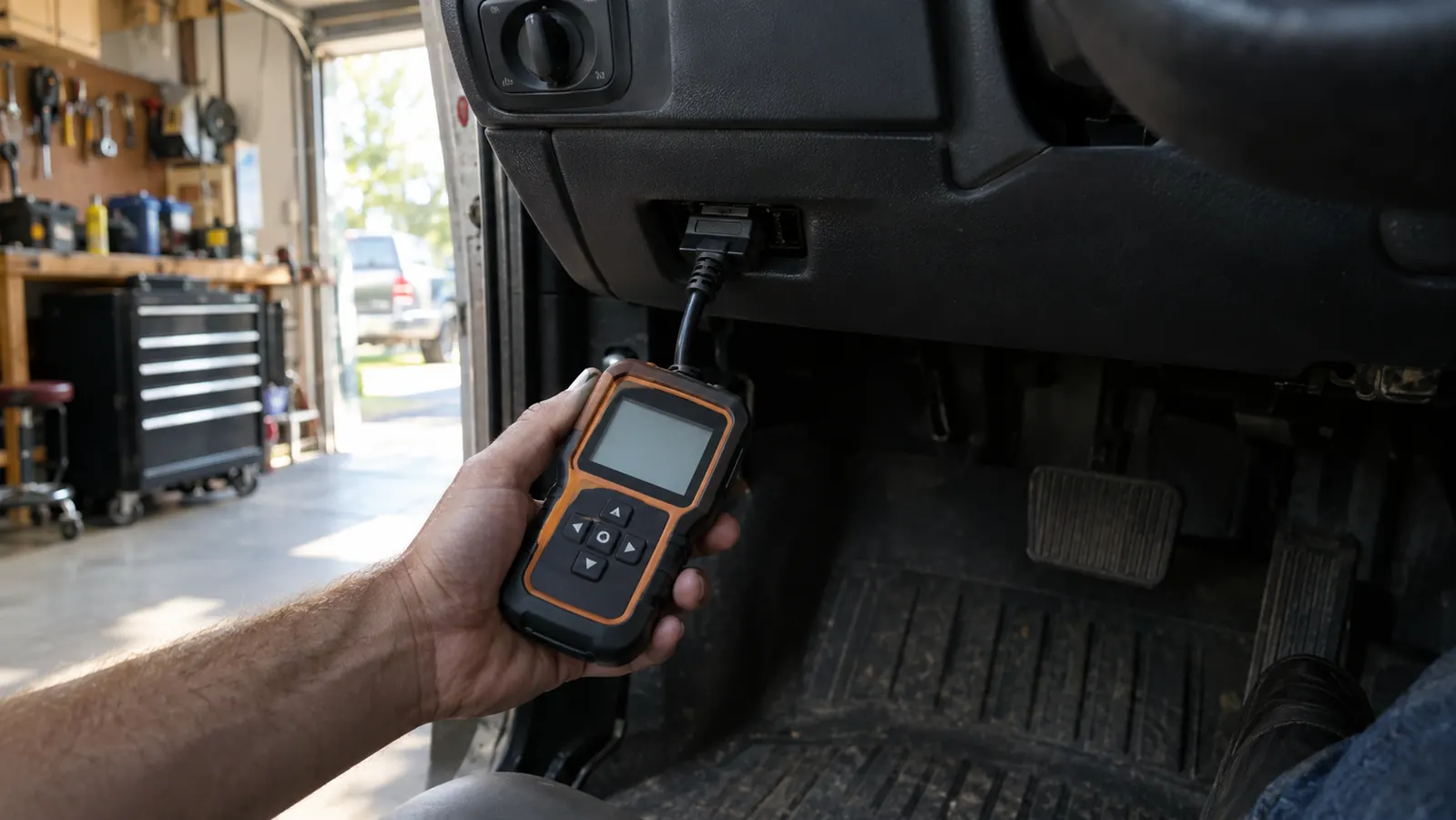
I have been turning wrenches in my own garage for thirty years, and I will tell you straight: the ANCEL AD310 is the first code reader I have ever recommended to a neighbor without crossing my fingers. It is cheap, it is simple, and it does the one job most people actually need done. But it is not a magic box, and if you buy it expecting a full diagnostic workstation, you will be disappointed. This review is the honest version, the one that tells you where it stops.
My daily driver is a 2014 Ford F-150 with a little over 190,000 miles on it, and my wife Carol drives a 2017 Honda CR-V. Both of them have thrown codes at me in the past year, and the AD310 has been the tool I reached for every time. It has paid for itself more times than I can count, but it has also left me standing in the driveway with a code I could not fully decode. That is the part most reviews leave out.
The Quick Verdict
The ANCEL AD310 is the best code reader I have used at its price for reading and clearing engine codes on 1996 and newer vehicles. It will not do ABS, airbag, or transmission diagnostics, and it will not give you live data graphs. If you just want to know why the check engine light is on and whether you can clear it, this is the one.
Amazon Check Today's Price →Why the check engine light is on, in under a minute
The ANCEL AD310 plugs into the port under your dash, reads the code, and tells you what it means in plain English. No app, no pairing, no monthly subscription. If you have a 1996 or newer car or light truck, this is the cheapest way to stop guessing.
Amazon Check Today's Price on Amazon →How I've Used It
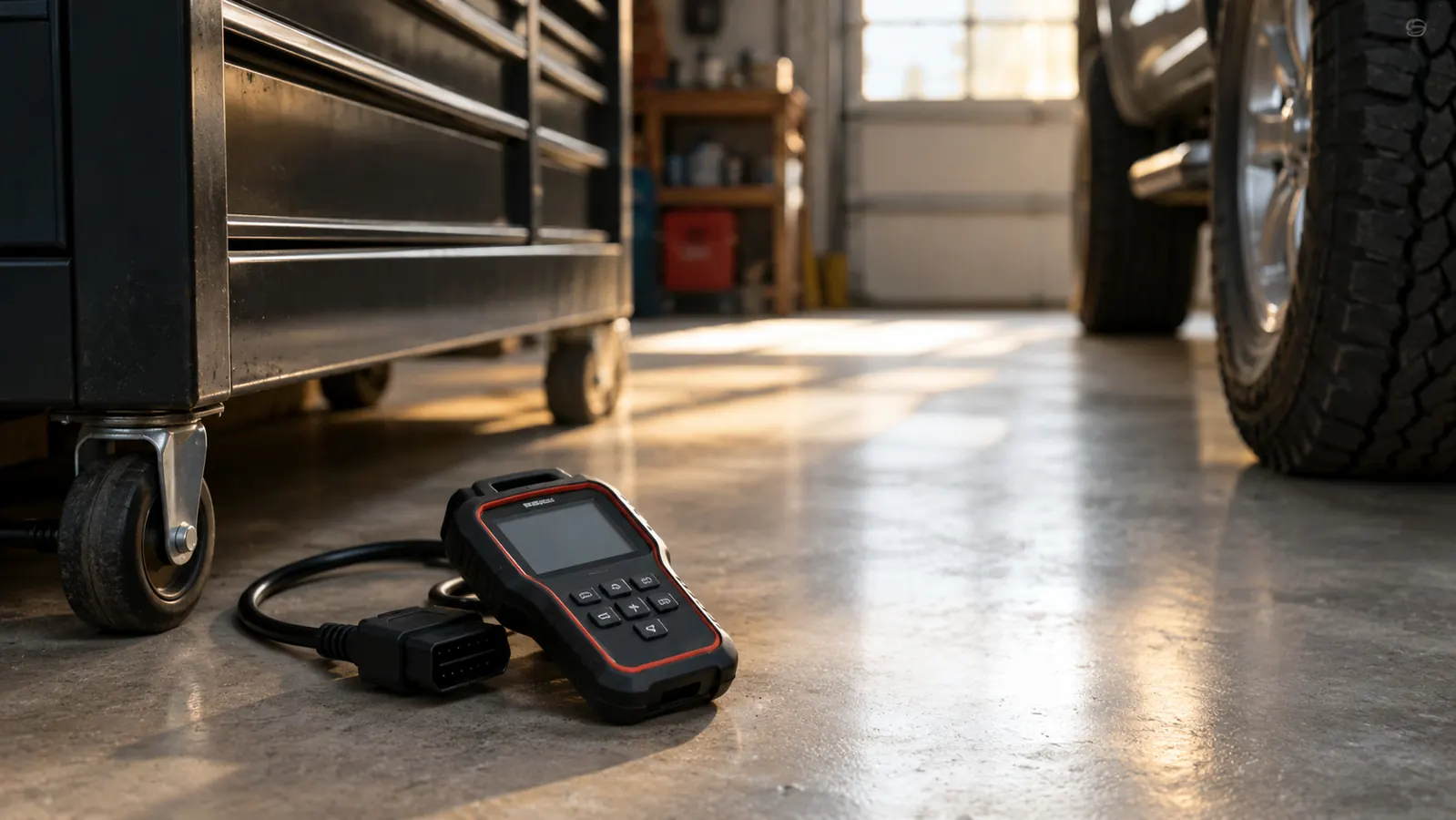
I have had the AD310 for about fourteen months now. It lives in the top drawer of my rolling tool chest, wrapped in the same microfiber cloth I use for the windshield. It has been dropped once, on the concrete floor of the garage, and it still works fine. The cable is about two feet long, which is enough to reach the diagnostic port on both of our vehicles without contorting myself under the dash.
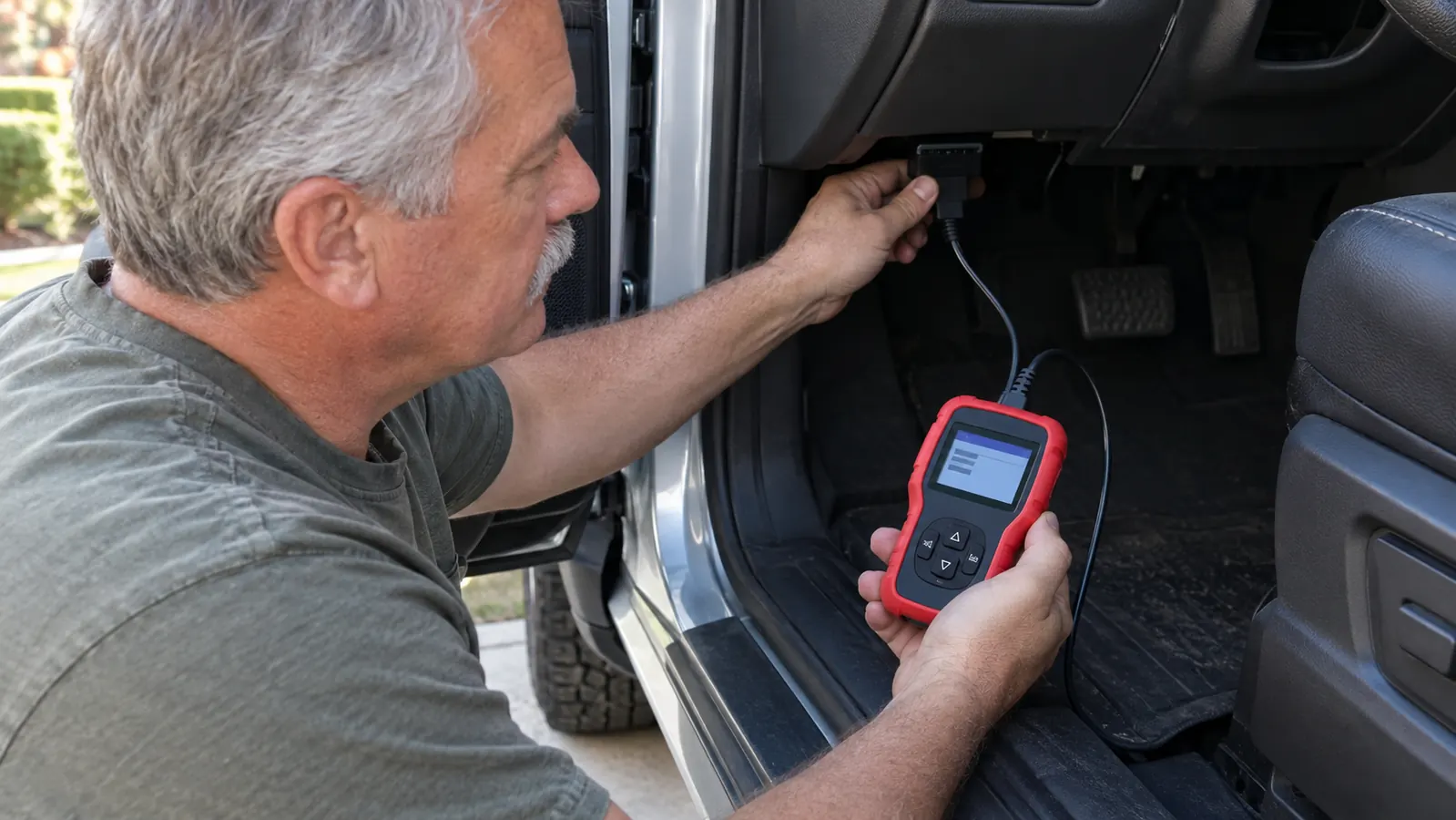
The first real test came on a Tuesday in March. Carol's CR-V started idling rough at a stoplight, and the check engine light came on steady, not blinking. I plugged the AD310 in, turned the key to the on position without starting the engine, and within about ten seconds it showed P0301, cylinder 1 misfire. The screen also displayed a short description, which is something I did not expect at this price. I swapped the coil pack from cylinder 1 to cylinder 2, cleared the code, and drove it for a week. When P0302 showed up, I knew the coil was bad, not the plug. A coil pack later, the misfire was gone and the code has not come back in nine months.
The second test was my F-150. I had a P0456, which is a small evaporative emissions leak. The AD310 told me exactly that, but it did not tell me where the leak was. I spent a Saturday morning checking the gas cap, the hoses around the charcoal canister, and the purge valve. It turned out to be a cracked hose near the canister, a small part that cost me less than a tank of gas. The scanner did its job, which was to point me in the right direction. It was not going to hold my hand and find the leak for me.
What the ANCEL AD310 Actually Does
The AD310 is an OBD2 code reader, not a full diagnostic scan tool. That distinction matters more than any spec sheet. It reads and clears generic powertrain codes, which are the ones that trigger the check engine light on 1996 and newer vehicles. It also reads some manufacturer-specific codes, but not all of them, and it does not read ABS, airbag, or transmission codes at all. If your airbag light is on, this scanner will not tell you why.
What it does, it does well. The screen is a two-line monochrome display, which sounds dated until you realize it is actually a feature. It is readable in direct sunlight, which is more than I can say for the phone apps I have tried. The buttons are big enough to press with work gloves on, and the whole thing runs on power from the diagnostic port, so there are no batteries to charge. You plug it in, it turns on, and it works.
The built-in code library is the part that surprised me. It does not just show you P0301. It shows you a short description, like cylinder 1 misfire, right on the screen. That saves you from having to look up the code on your phone, which is the single biggest convenience this thing offers. For a beginner, that is the difference between a tool that helps and a tool that confuses.
One small detail I have come to appreciate is the readiness check. Before an emissions test, or before I hand a vehicle back to someone after a repair, I pull up the readiness monitors on the ANCEL AD310 to see whether the computer has finished its self-tests. If a code was just cleared, several monitors will read incomplete until the vehicle has been driven through a few warm-up cycles. Knowing that has kept me from taking a vehicle in for inspection too early and getting turned away.
Where the ANCEL AD310 Stops
Here is the honest part. The AD310 has three real limits, and you should know all of them before you order. First, it does not do live data. You cannot watch the coolant temperature climb in real time, you cannot graph the oxygen sensor voltage, and you cannot see the fuel trims while the engine is running. For a shade-tree mechanic like me, live data is often the difference between guessing and knowing. The AD310 will not give it to you.
Second, it does not read ABS or airbag codes. I found this out the hard way when the ABS light came on in Carol's CR-V last fall. I plugged in the AD310, it showed no codes, and I spent twenty minutes wondering if the scanner was broken. It was not broken. It just does not talk to the ABS module. I ended up borrowing a friend's higher-end scanner to confirm it was a wheel speed sensor, a part that took me about an hour to replace. The AD310 saved me nothing that day, and I want you to know that before you buy.
Third, the manufacturer-specific coverage is hit or miss. On my F-150, it reads the generic powertrain codes fine, but it will not read the body control module or the transmission codes. On the CR-V, it reads Honda-specific codes better than I expected, but it still will not touch the airbag system. If you drive an older European car, you may find that the AD310 reads even fewer manufacturer codes. It is a universal tool, and universal tools are never the best at any one thing.
The AD310 saved me a diagnostic fee the first week I owned it. It also left me standing in the driveway with an ABS light and no answer. Both of those things are true, and both of them are part of an honest review.
The Pros and Cons, Laid Out Plain
What I Liked
- Reads and clears engine codes on any 1996 or newer vehicle, which covers the vast majority of cars and light trucks on the road
- Shows a plain-English description on the screen, so you do not need a code book or a phone to understand what P0301 means
- No app, no Bluetooth pairing, no subscription, no account. It just works, which is rarer than it should be
- Runs off the diagnostic port, so there are no batteries to charge and nothing to forget to turn off
- Small enough to keep in the glove box, and tough enough to survive a drop onto a concrete garage floor
- At its price, it pays for itself the first time it saves you a trip to the shop
Where It Falls Short
- No live data, so you cannot watch sensor readings in real time while the engine runs
- Does not read ABS, airbag, or transmission codes, which is the limit that surprises most people
- Manufacturer-specific coverage is incomplete, especially on European vehicles
- The two-line screen shows only one code at a time, so you have to scroll through multiple codes one by one
- No freeze frame data, which means you cannot see the engine conditions at the moment the code was set
What Nobody Tells You About the ANCEL AD310
The first thing nobody tells you is that the AD310 will not work on every port you find. I tried it on a neighbor's 1998 BMW and it read the engine codes fine, but it would not communicate with the transmission module. The neighbor was disappointed, and I had to explain that the AD310 is an engine code reader, not a full system scanner. If you buy this for a European car, set your expectations accordingly.
The second thing nobody tells you is that clearing a code is not the same as fixing the problem. I have seen people clear a misfire code, drive for a day, and then get mad when the light comes back. The AD310 will clear the code, but if the underlying problem is still there, the light will come back. That is not a flaw in the scanner. That is the scanner telling you the truth.
The third thing nobody tells you is that the cable is short. Two feet sounds like plenty until you are lying on your back with your head under the dash, trying to reach a port that is tucked up behind a fuse panel. On my F-150, the port is easy to reach. On Carol's CR-V, it is a little more awkward. On some vehicles, you will want a short extension cable, which costs about eight bucks and makes the whole experience much easier.
The fourth thing nobody tells you is that the AD310 does not come with a case. It comes in a blister pack, and once you open it, you are on your own. I keep mine in a microfiber cloth in the tool chest, but if you plan to keep it in the glove box, buy a small zippered pouch. It is a minor thing, but it is the kind of detail that separates a tool that lasts from a tool that gets scratched up and tossed in a drawer.
None of those are reasons to skip it. They are just the things I wish someone had mentioned before I bought mine, so I would have ordered a small zip pouch at the same time and kept the AD310 out of the loose bits at the bottom of the drawer.
Who This Is For
The ANCEL AD310 is for the person who wants to know why the check engine light is on without paying a shop to tell them. It is for the person who does their own oil changes, their own brake pads, and their own coil packs, and who wants a simple tool that reads and clears engine codes. It is for the person who has a 1996 or newer car or light truck and wants to stop guessing.
It is also for the beginner. The AD310 is about as close to foolproof as a code reader gets. You plug it in, you read the code, you look at the description, and you decide whether it is something you can fix. If it is not, you walk into the shop with more information than you had before, which means you are less likely to get talked into unnecessary work. That alone is worth the price.
Who Should Skip It
Skip the AD310 if you need to diagnose ABS or airbag issues. Skip it if you want to watch live sensor data while the engine runs. Skip it if you drive a European vehicle and expect full manufacturer-specific coverage. And skip it if you are a professional mechanic who needs a tool that can do bidirectional controls, because this is not that tool.
If you fall into any of those groups, you should be looking at a higher-end scanner, and you should expect to pay more. The AD310 is not a bad tool because it lacks those features. It is a good tool that knows its limits, and the sooner you know them too, the happier you will be with it.
How It Compares to the Alternatives I Tried
Before I settled on the AD310, I tried a couple of other options. The first was a cheap Bluetooth adapter that paired with a phone app. The app was free, but it was full of ads, it required an account, and it drained my phone battery while I was trying to diagnose a car. The adapter itself worked, but the experience was clunky enough that I stopped using it after a month.
The second was a more expensive scanner that a friend lent me. It did live data, it read ABS codes, and it cost about six times as much as the AD310. It was a great tool, but I did not need it often enough to justify the price. The AD310 covers the 90 percent case, which is reading and clearing engine codes, and it does that for a fraction of the cost.
There is also the option of just taking the car to a parts store and asking them to read the code for free. I have done that, and it works, but it means driving to the store, waiting for a clerk, and hoping the code is still stored by the time you get there. The AD310 costs about the same as one trip to the shop, and it is always in my garage when I need it.
The parts store route works, and I have used it in a pinch. The catch is that you have to drive the vehicle there with the light on, wait your turn, and then make decisions standing at the counter next to someone with a reason to sell you a part. With the ANCEL AD310 in the glove box, I read the code at home, look it up on my own time, and decide calmly whether it is a loose gas cap, a sensor, or something I should hand off to a mechanic.
The Bottom Line
The ANCEL AD310 is the tool I reach for first, and it is the tool I recommend to anyone who asks. It is not the most capable scanner on the market, and it does not pretend to be. It reads and clears engine codes, it tells you what they mean, and it does it without an app, a subscription, or a learning curve. For the price, that is a fair trade.
If you are on the fence, ask yourself one question: do you want to know why the check engine light is on, or do you want to diagnose every system in the car? If the answer is the first one, the AD310 is the honest choice. If the answer is the second, keep looking. Either way, you will know more than you did before you read this review.
The honest tool for the honest job
The ANCEL AD310 will not diagnose your airbags, and it will not graph your oxygen sensors. What it will do is tell you why the check engine light is on, in plain English, in under a minute. If that is the job you need done, this is the tool.
Amazon Check Today's Price on Amazon →