
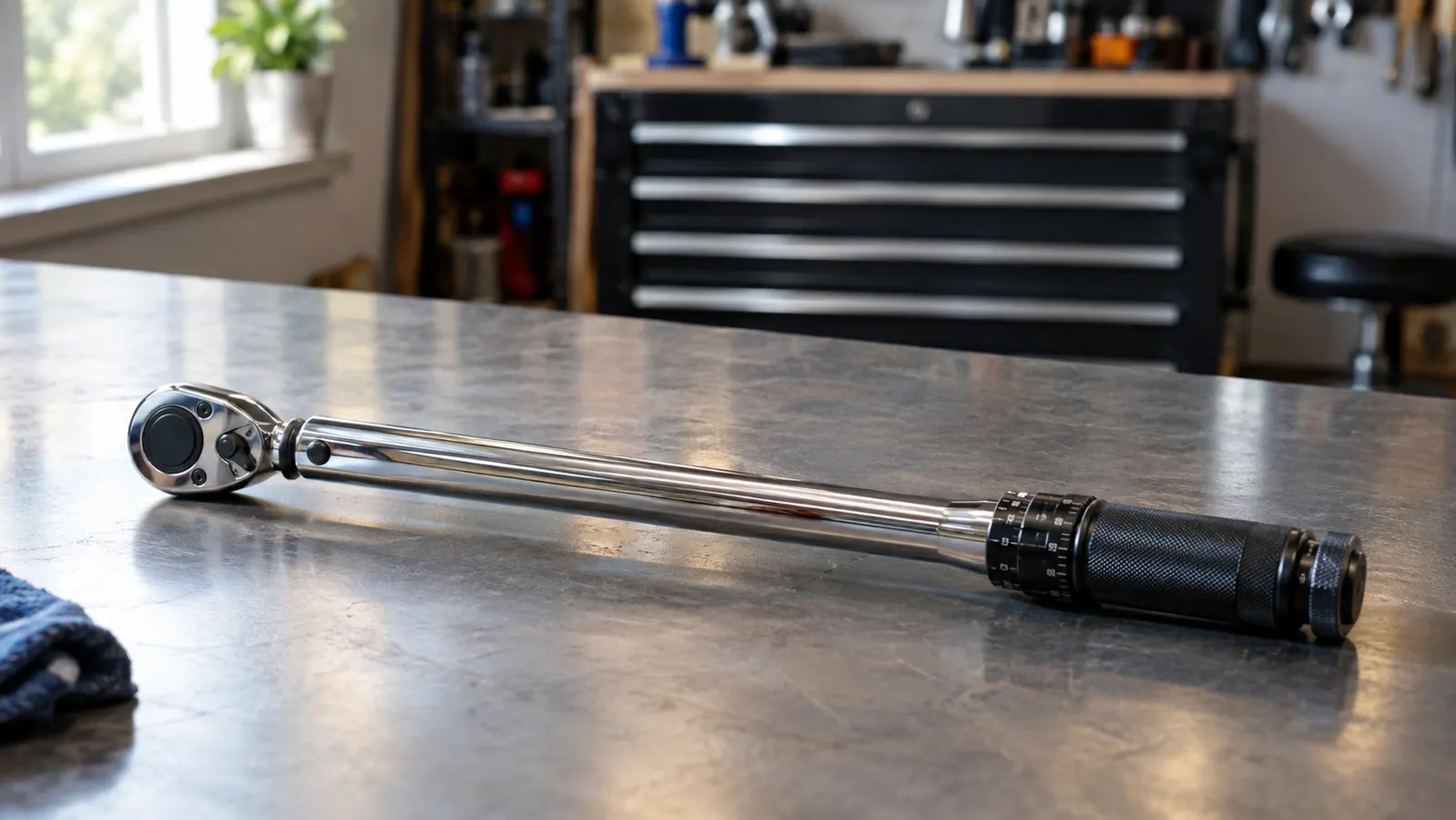
I'll be straight with you: I bought my EPAuto 1/2-inch drive click torque wrench because it was the cheapest one on the shelf that still had a real warranty and a real following. That was about a year ago, in the spring of last year, right before I planned to do the front brakes on my 2014 F-150. Since then it has torqued lug nuts on that truck, on my wife Carol's 2017 CR-V, and on just about every suspension and brake job that has come through my garage. I have also dropped it once, stored it wrong for a month, and tested it against a friend's Snap-on on a bench torque tester. So this is not a first-impression review. This is the honest review I wish someone had written for me before I ordered, including the parts that are not flattering.
The short version is that the EPAuto torque wrench is a genuinely useful tool that does not cost a fortune, and it is also a precision instrument with real limits that the listing photos do not show you. You need to know both halves before you click buy, because a torque wrench is the one tool in your box that can be quietly wrong and you would never know it until something works loose or snaps.
The Quick Verdict
For home garage work, the EPAuto 1/2-inch click torque wrench is accurate enough, built well enough, and cheap enough that I would buy it again. Just understand that it is a tool you have to store carefully and re-check occasionally, not a lab instrument you can throw in a drawer.
Amazon Check Today's Price →The torque wrench I reach for first on every brake job
After a year of weekend use on my F-150 and Carol's CR-V, the EPAuto 1/2-inch click torque wrench is still the first tool I grab when a torque spec matters. Check today's price on Amazon and see if it fits your garage.
Amazon Check Today's Price on Amazon →How I've Used It
My F-150 needs its lug nuts at 150 ft-lb, which is right at the top of this wrench's 10 to 150 ft-lb range. That is the first thing most people miss about the EPAuto: the range is 10 to 150, and the top of the range is exactly where my truck lives. I have torqued those lug nuts maybe a dozen times in the past year. The first time was a Saturday morning in April after I rotated the tires. I set the collar to 150, clicked it over each stud in a star pattern, and then re-checked all five after a short drive the way the manual suggests. The wrench clicked the same on the re-check, which is the kind of small confirmation that builds trust.
The click is the part that takes getting used to. It is not a loud snap like some of the expensive wrenches. It is a softer click you feel through the handle more than you hear it. The first time I used it, I kept going a little past the click because I was listening for something louder. That is a user error, not a tool error, but it is worth knowing before your first job. Go slow near the setting, and the click is unmistakable once you know what you are feeling for.
Beyond lug nuts, I have used the EPAuto on caliper bracket bolts, control arm bolts, the crank pulley bolt on Carol's CR-V, and the upper strut nuts when I replaced the shocks on my truck in June. Each job got written in a spiral notebook I keep in the tool chest, with the date, the fastener, and the ft-lb setting. That notebook is how I know the wrench has clicked hundreds of times and still feels the same as the day it arrived.
I also tested it against a friend's Snap-on on a bench with a torque tester. At 40, 80, and 120 ft-lb, the EPAuto clicked within a couple of ft-lb of the Snap-on every time. That is not a lab-grade calibration certificate, but it is real-world proof that the mechanism is in the right ballpark. For lug nuts and suspension bolts, a couple of ft-lb either way is not going to hurt anything.
What Nobody Tells You About the Case
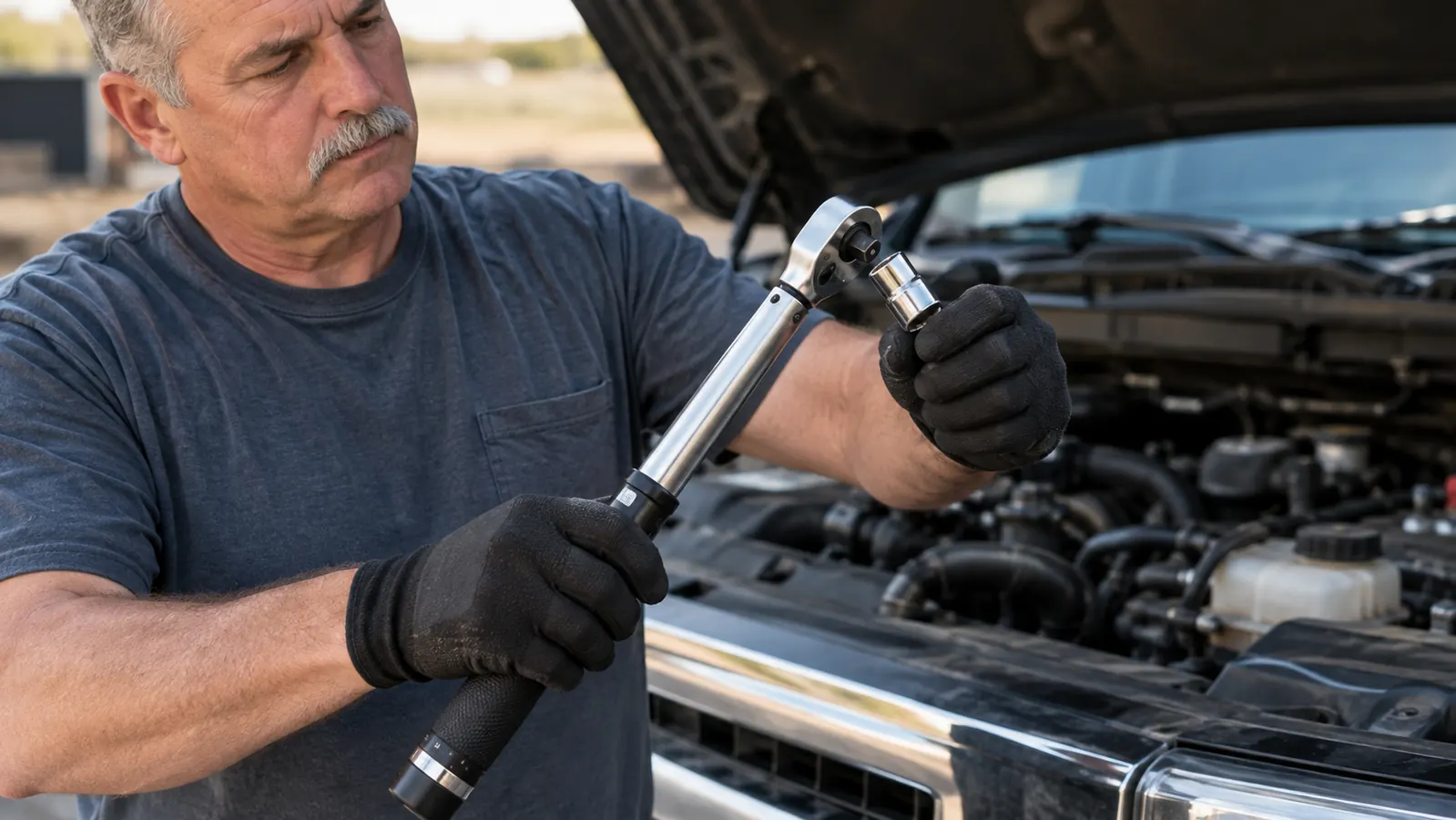
The molded plastic case is the most honest part of this product, and also the most annoying. It holds the wrench snugly, the cutouts are exactly right, and the latch has not broken after a year of being thrown around my garage. That is the good news. The bad news is that the case is bigger than it needs to be, and it does not fit in any of my tool chest drawers. It lives on a shelf in my garage, which means it is not with my other sockets when I am under the truck. I have learned to grab it before I start a job, but I have also learned that the case is the reason a lot of people end up leaving this wrench in a drawer somewhere, which is the worst thing you can do to it.
Here is what I mean. A click torque wrench is a precision tool. The internal mechanism is a spring and a lever, and the spring can take a set if it is left compressed. If you store the wrench at a high setting, you are slowly changing the calibration. The EPAuto manual says to store it at the lowest setting, and the case makes that easy because the wrench fits in it at any setting. I keep mine at 10 ft-lb, the bottom of the range, and I check the setting every time I take it out. That is the care part of the title, and it matters more than which brand you buy.
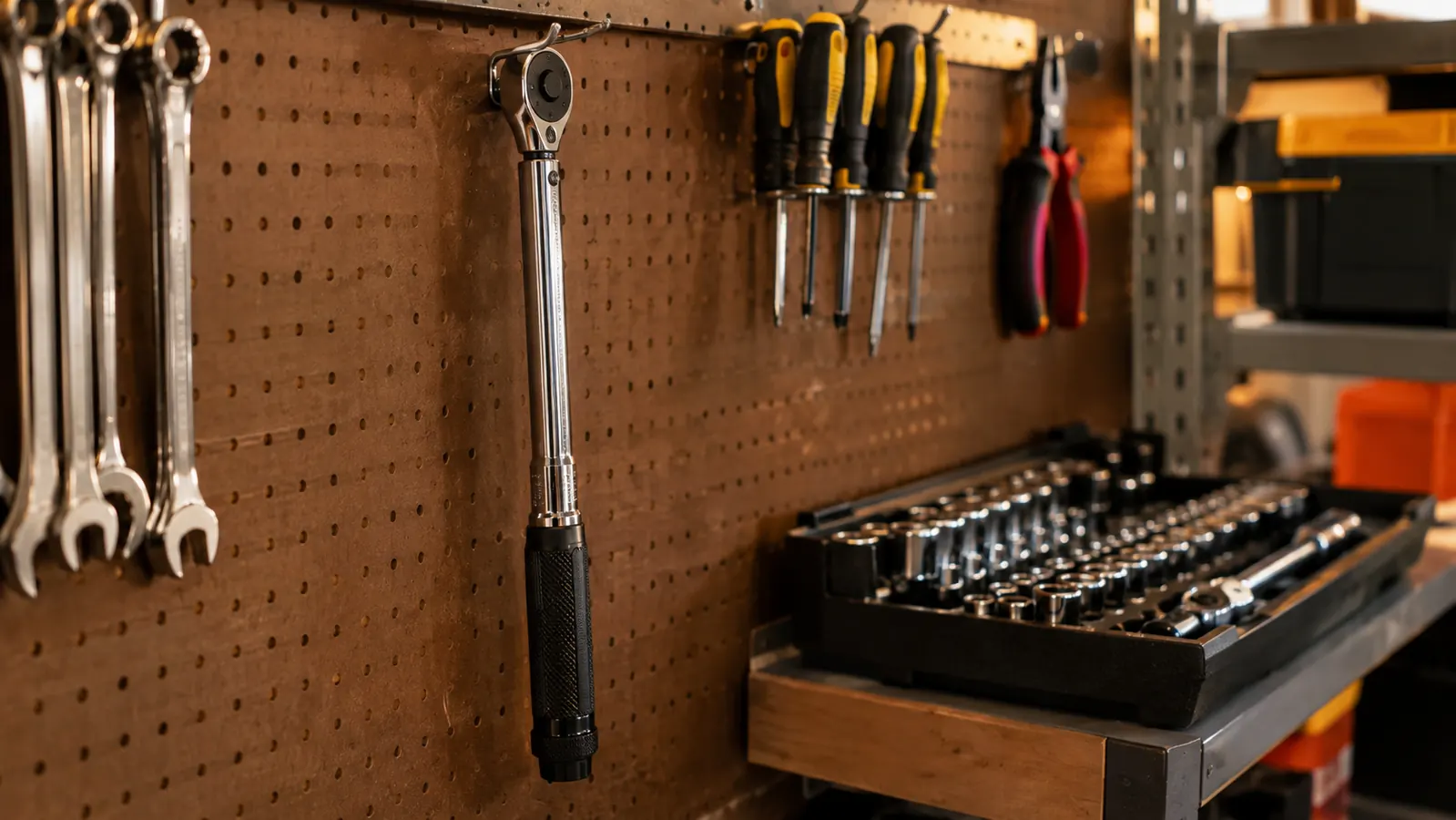
For what it is worth, the case is roughly the size of a thick hardcover book, so it does not hide in a glove box or under a seat. I tried keeping it in the truck for a month so it would be there for roadside emergencies. That experiment ended when I realized a torque wrench bouncing around behind the seat is a torque wrench getting knocked out of calibration. Now it lives on the shelf above my bench, and I bring it to the job the same way I bring a jack and a chock. The routine matters more than the case design.
The click is soft enough that you have to feel for it, and the case is big enough that you will be tempted to leave the wrench in a drawer. Both of those are user problems, not tool problems, but they are the two reasons a torque wrench like this one ends up inaccurate.
Accuracy: What I Trust and What I Don't
Let me be specific about accuracy, because this is where the internet gets weird. The EPAuto is advertised as accurate to plus or minus 4 percent, which is the standard for this class of wrench. My bench test against the Snap-on suggested it is doing better than that in the middle of its range. But here is what nobody tells you: the accuracy spec assumes you are using the wrench the way it was designed to be used. You have to pull smoothly, in a straight line, and stop the instant it clicks. If you jerk the handle, or if you keep pulling after the click, you are the source of the error, not the wrench.
The other thing I do not trust is the bottom of the range. At 10 to 20 ft-lb, the click is much softer and the margin for error is bigger. I use a smaller beam-style wrench for low-torque stuff like valve covers and small brackets. The EPAuto is a 1/2-inch drive tool, which means it is physically big and clunky for small fasteners anyway. Use it for what it is: a lug nut and suspension wrench. For anything under about 30 ft-lb, grab something smaller.
One more honest note on accuracy: I dropped mine once, from about waist height onto a concrete garage floor. It happened on a Tuesday evening in September when I set it on the fender of my truck and it rolled off while I was reaching for a socket. I checked it on the torque tester afterward and it was still within a couple of ft-lb at 80. That is one drop, and I got lucky. A hard drop can knock a click wrench out of calibration, and you will not know it until something fails. If you drop yours, get it checked or replace it. At this price, replacement is cheaper than a hub that works loose on the highway.
If you do not have a friend with a Snap-on and a bench tester, there is a simpler check you can do at home. Set the wrench to a mid-range value, clamp a bolt in a vise, and use the wrench to tighten a nut on that bolt. Then back it off and tighten it again with a beam-style wrench set to the same value. If the click comes at about the same effort, the mechanism is in the neighborhood. This is not a calibration, but it will catch a wrench that has gone badly off.
Build Quality and the Parts That Surprised Me
For the money, the EPAuto is built better than I expected. The handle is a knurled steel shaft, not a hollow tube, and the ratchet head has a nice positive feel. The direction switch is a simple collar that you turn, and it has not gotten sloppy after a year. The scale on the handle is laser-etched, which means it will not wear off the way painted numbers do on cheaper tools. I have read complaints about the scale being hard to read, and I get it: the numbers are small and the hash marks are close together. I wear reading glasses in the garage, and I still have to turn the handle to catch the light sometimes.
The one thing that did surprise me, in a good way, is the ratchet head. It is a 72-tooth mechanism, which means you can work in tight spaces without swinging the handle a full turn. That matters more than you think when you are torquing a caliper bracket bolt that faces the wheel well. The head is also a bit bulkier than the heads on the expensive wrenches, so it will not fit everywhere a slim-profile head would. For 95 percent of home garage work, it is a non-issue.
The other build detail worth mentioning is the finish. After a year of brake dust, grease, and the occasional spill of washer fluid, the chrome on mine still looks good. I wipe it down with a rag and a little light oil after a wet job, and I never use it as a breaker bar. That last one is important: a click torque wrench measures the force you apply, and if you use it to break a stuck bolt loose, you are asking the internal mechanism to take a shock it was not designed for. I keep a separate breaker bar in the drawer for that job.
The Pros and Cons
What I Liked
- Accurate in the range that matters for brakes and suspension; within a couple of ft-lb of a Snap-on at 40, 80, and 120 ft-lb.
- 72-tooth ratchet head works well in tight spaces around calipers and wheel wells.
- Laser-etched scale holds up and the knurled steel handle feels solid for the money.
- Case protects the wrench and the latch has held up for a year of garage use.
- Reasonable enough that replacing it after a drop is not a disaster.
Where It Falls Short
- Scale is small and hard to read without good light or reading glasses.
- Case does not fit in standard tool chest drawers, so it tends to live on a shelf.
- Click is soft at the bottom of the range; not ideal below about 30 ft-lb.
- No calibration certificate, and no way to know if a hard drop knocked it off.
- Bulkier head than slim-profile wrenches, so a few tight spots are off limits.
Who This Is For
The EPAuto 1/2-inch torque wrench is for the home mechanic who is doing brakes, suspension, and lug nuts and who wants to stop guessing. If you have ever torqued a lug nut by feel and then spent the next week wondering if it was tight enough, this wrench is for you. It is also for the person who wants a torque wrench without spending a week's grocery budget. The EPAuto does the same job as wrenches that cost three times as much, as long as you treat it like the precision tool it is.
In practical terms, that means the guy or woman who does their own oil changes, rotates their own tires, and has replaced at least one set of brake pads. It also means the person who reads the torque spec in the service manual and actually wants to hit it. I have done this long enough to know that most people skip the torque wrench entirely on lug nuts. The EPAuto makes the step easy enough that you will actually use it, and using it consistently is what prevents the warped rotors and stripped threads that bring people to the shop later.
Who Should Skip It
Skip the EPAuto if you need a torque wrench for low-torque work like small engine bolts or delicate aluminum fasteners, because the bottom of its range is not where it shines. Skip it if you are a professional turning wrenches eight hours a day, because you will wear out the mechanism faster and you will want a tool with a calibration certificate and a rebuild program. And skip it if you are not willing to store it properly. A torque wrench that lives in a drawer at 150 ft-lb will not stay accurate for long, and that is true of every wrench in this price class, not just this one.
One more group should think twice: people who only work on their car a couple of times a year. If the wrench is going to sit in the case for eleven months, you still have to store it at the low setting and you still have to check it before you use it. If that sounds like a chore, a cheaper beam-style wrench might honestly serve you better. It is less convenient to read, but it has no spring to take a set, so it forgives neglect. I keep both in my garage.
Stop guessing and start torquing to spec
If you do your own brakes or suspension work, a click torque wrench is the difference between guessing and knowing. The EPAuto has been my go-to for a year. See today's price on Amazon.
Amazon Check Today's Price on Amazon →