
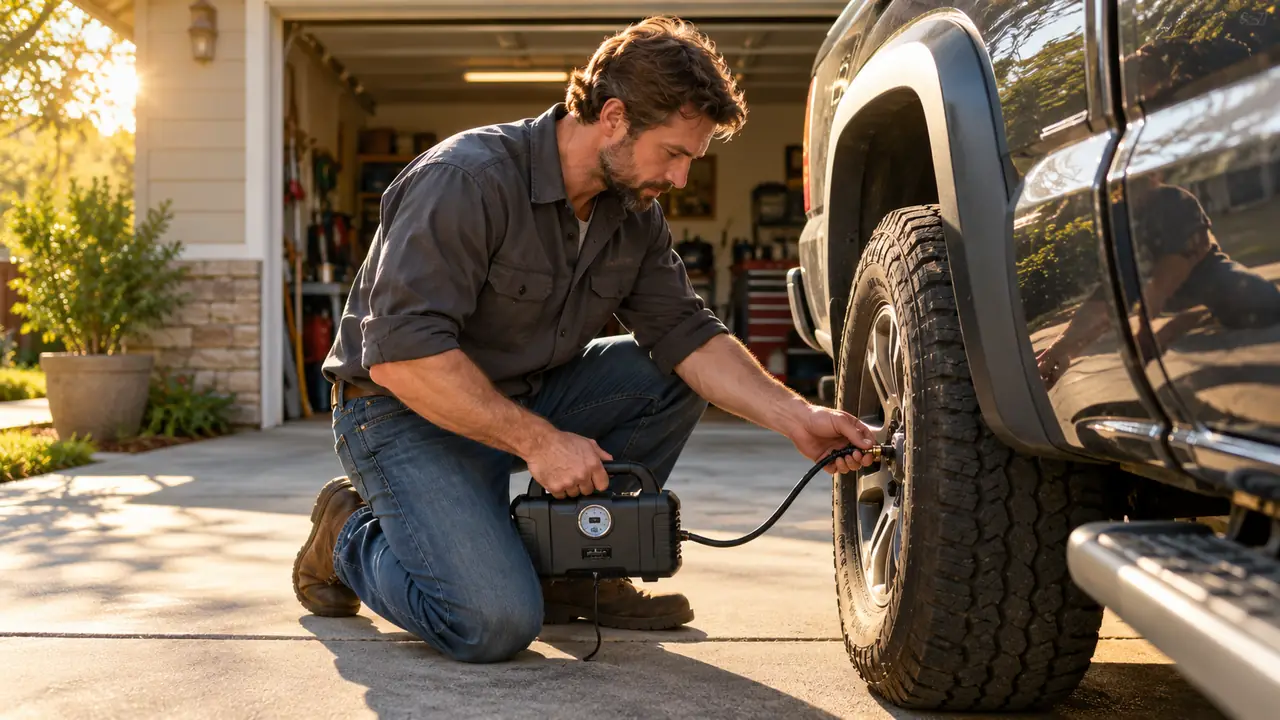
A tire that is ten PSI low does not look flat. It looks fine. It rolls down the road fine. It only starts talking to you in the form of a wandering steering wheel, a hotter than normal sidewall, and a fuel bill that creeps up a couple of dollars a week. I have been doing my own vehicle work for thirty years, and I still catch myself running tires low longer than I should. The fix is a ten minute habit, and the tool that made it painless for me is the AstroAI AIRUN H portable air compressor.
This guide walks through the whole job the way I do it in my own garage outside Dayton: finding the right pressure for your vehicle, checking it cold, setting the AstroAI AIRUN H, filling each tire, and checking again. I will also cover the mistakes I have made so you do not have to repeat them.
The inflator that makes the ten minute tire check actually take ten minutes
Set the target pressure, press the chuck on the valve, and the AstroAI AIRUN H shuts itself off when the tire hits the number. No guessing, no gauge math, no overfilling.
Amazon Check Today's Price on Amazon →Step 1: Find the right pressure for your vehicle
The right pressure for your vehicle is not on the tire sidewall. The number molded into the tire is the maximum pressure that tire can carry, not what your vehicle needs. The number you want is on a sticker in the driver's door jamb, or inside the fuel door, or in the owner's manual. On my 2014 Ford F-150 the door sticker calls for 35 PSI front and rear for normal loads. My wife Carol's 2017 Honda CR-V calls for 30 PSI. Those are the numbers I set on the inflator.
If you carry heavy loads or tow, the sticker usually lists a higher pressure for that situation. Do not guess. The sticker is the result of the engineers testing that exact vehicle with those exact tires. I keep a photo of the door sticker on my phone so I do not have to open the door every time. That photo has saved me more than once, especially on a cold morning when I am in a hurry and my memory of the number is fuzzy.
One more thing: check all four tires, including the spare if your vehicle has one and you can reach it. A spare that is twenty PSI low is a common find in my neighborhood, and it is always discovered at the worst possible moment. Last fall I helped a neighbor who had a flat on the interstate, and his spare was at 18 PSI. We filled it with the AstroAI AIRUN H and got him home, but it was a close thing.
Step 2: Check the pressure cold
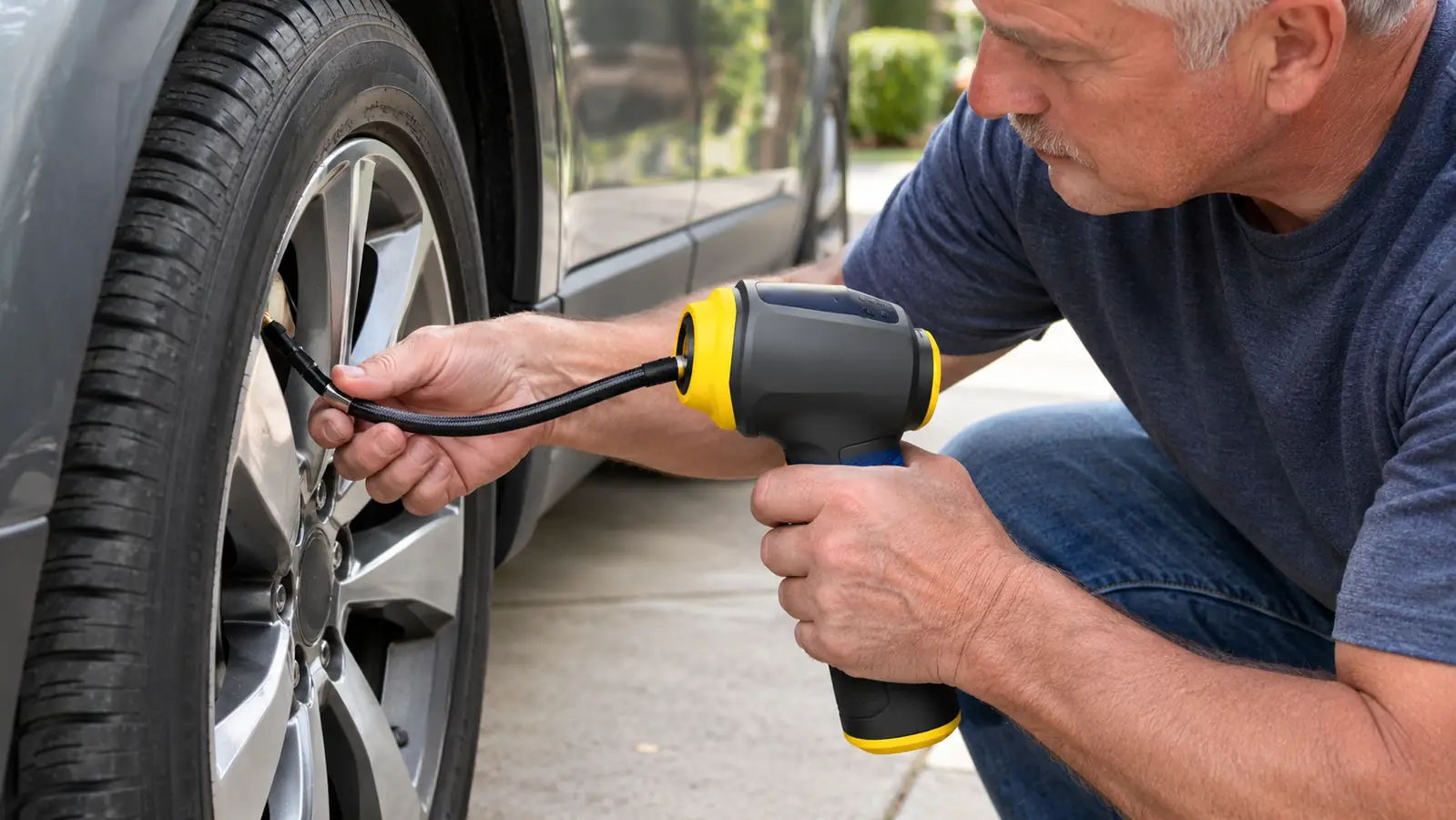
Tire pressure is measured cold, which means the vehicle has not been driven for at least three hours, or has been driven less than a mile at moderate speed. Heat from driving raises the pressure inside the tire, sometimes by four to six PSI on a summer highway run. If you check a hot tire and set it to the door sticker number, you will actually be underfilling it by the time it cools down.
The best time is first thing in the morning before the day's driving. That is when I do it. I pull the AstroAI AIRUN H out of the garage, set the target pressure, and work my way around the pickup. The 9.8 foot cord reaches all four tires without me moving the truck, which is one of the reasons I keep this inflator instead of the old plug-in unit I used to drag around. That old unit had a cord half as long, and I spent more time moving it from wheel to wheel than actually filling tires.
If you are checking in the middle of a trip and the tires are warm, add a couple of PSI to the door sticker number as a rough adjustment, then recheck cold the next morning. It is not a perfect method, but it beats filling to the sticker number on a hot tire. I have done this on road trips with the pickup, and it keeps the handling predictable until I can do a proper cold check.
Step 3: Set the target pressure on the AstroAI AIRUN H
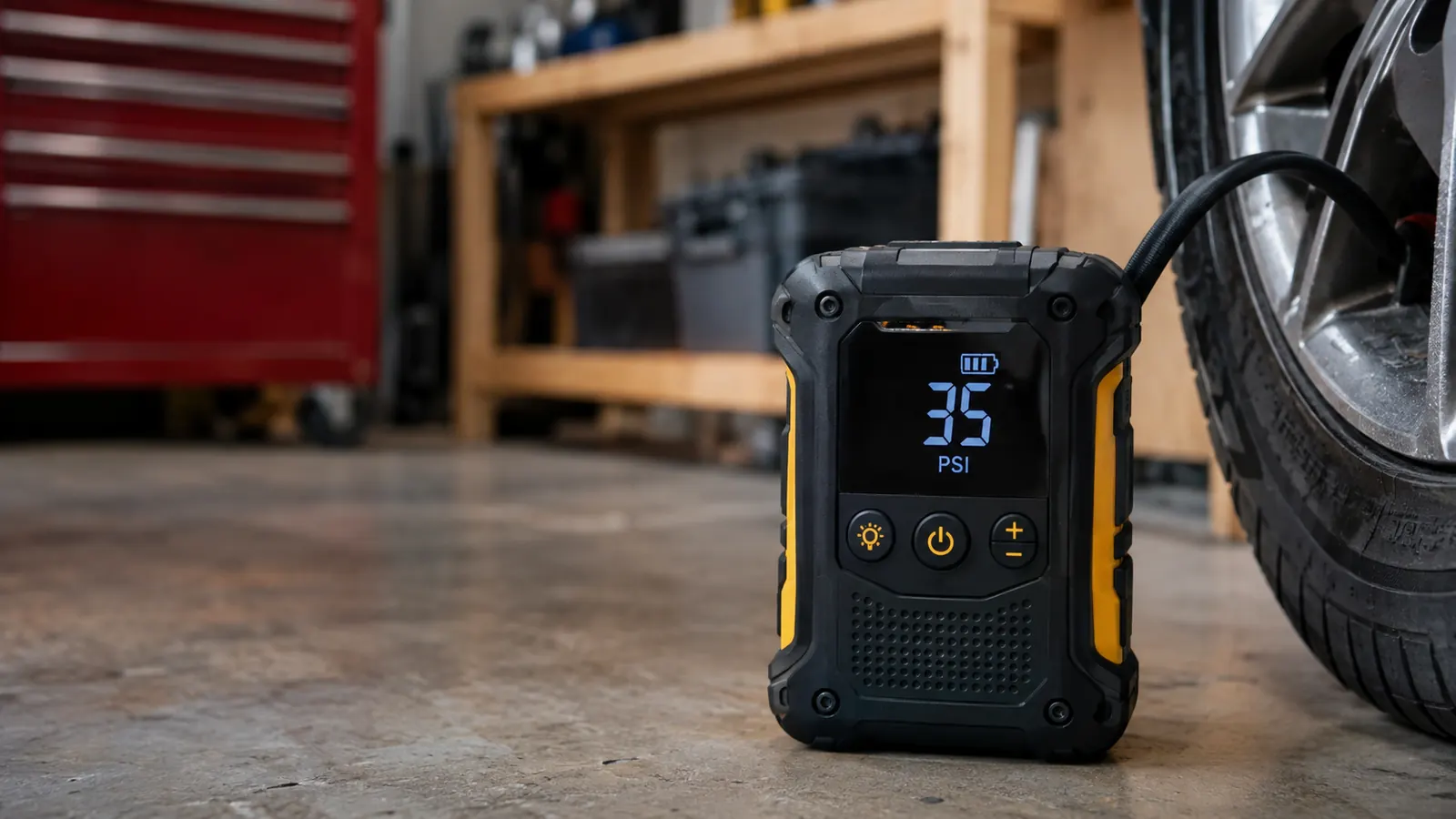
The AstroAI AIRUN H has a digital display and buttons to set your target pressure. Press the plus and minus buttons until the display shows the number from your door sticker. On my F-150 that is 35 PSI. The unit remembers the setting, so the next time I use it, it still shows 35 and I only have to adjust if I am filling the CR-V at 30. That memory feature is a small thing, but it means I am not re-entering the number every single time.
Plug the power cord into the 12V accessory socket in your vehicle and start the engine, or at least leave the ignition in the accessory position. The inflator draws a fair amount of current, and running it with the engine off can drain the battery if you are filling more than one tire. I learned that lesson years ago with an older compressor, and I have not repeated it. It happened on a Sunday morning, the battery was too weak to crank the engine, and I had to walk to the gas station for a jump. Once was enough.
The unit also has an LED light built in. If you are doing this at night or in a dim garage, the light is genuinely useful for seeing the valve stem and the pressure reading. It is a small thing, but it is the difference between a two minute job and a ten minute fumble. I have used it more than once when Carol asked me to top off the CR-V before an early flight, and the driveway was still dark.
Step 4: Fill each tire to the set pressure
Remove the valve cap and press the chuck firmly onto the valve stem. You want to hear a small hiss of air as the chuck seats, then no hiss. If air is leaking around the chuck, the reading on the display will climb slowly or not at all, and the inflator will run longer than it should. Press harder and at a slight angle until the seal is solid. The first time I used the AstroAI AIRUN H, I did not press hard enough, and I stood there for a full minute wondering why the pressure was not moving.
Press the power button. The AstroAI AIRUN H starts filling and the display shows the live pressure as it climbs. When the tire reaches the target you set, the unit shuts off automatically. That auto shut-off is the feature that makes this tool worth owning. You do not have to stand there watching the gauge and yank the hose at the exact right moment. You can walk around to the next tire while it finishes. On a cold morning, that means I am not kneeling on wet concrete longer than I have to.
When the unit stops, pull the chuck off, check that the valve stem is not leaking by putting a drop of spit or soapy water on it, and put the cap back on. Move to the next tire. I do the two front tires, then the two rear, and I keep the door sticker number in my head so I can tell at a glance if the display is behaving. If a tire is more than five PSI low, I take a closer look at the sidewall and tread before I fill it, because a nail or a cut needs attention before the tire goes back on the road.
Step 5: Recheck and record
After all four tires are filled, go back around with the inflator and check each one again. The AstroAI AIRUN H shows the current pressure when you press the chuck on, so you can use it as a plain gauge. This second pass catches the tire that lost a couple of PSI while you were filling the others, and it confirms the auto shut-off actually hit the number. On the pickup, the rear tires usually settle a half PSI lower after the first fill, so the second pass is not optional for me.
I keep a small notebook in the garage and write the date and the pressures down. It sounds old fashioned, but it is how I noticed that the front passenger tire on the pickup loses about two PSI a week. That told me there was a slow leak before it became a flat on the highway. A slow leak is a cheap fix at a tire shop. A blowout is not. The notebook also tells me when the seasons are pulling the pressure down, so I am not surprised in November when every tire reads low.
If a tire keeps losing pressure after you fill it, check the valve core first. A valve core tool and a small pack of cores can fix a leak that would otherwise cost you a trip to the shop. I keep both in the rolling tool chest in the garage. If the tire still loses pressure, it is time to have it inspected for a puncture or a bead leak. That is the point where I stop guessing and let a shop with a proper tire machine take a look.
What Else Helps
A good tire pressure gauge is still worth having. The AstroAI AIRUN H has a digital gauge built in, and I trust it, but a separate pencil gauge in the glove box is handy for a quick check at a gas station or before a long trip. Keep the valve caps on all four tires. They are the first line of defense against dirt and moisture getting into the valve stem. I also keep a small bottle of soapy water in the garage for finding slow leaks around the bead or the valve.
Check pressure at least once a month, and more often when the seasons change. A ten degree drop in temperature can lower tire pressure by one to two PSI. That is why tires always seem low in November. If you do nothing else, do the monthly check and keep the tires at the door sticker number. It is the cheapest maintenance you can do for your vehicle, and it pays off in tire life, fuel economy, and handling. On the pickup, I have seen the front tires wear evenly across the tread since I started keeping them at 35 PSI, and the steering feels steadier on the highway.
The auto shut-off is the feature that makes this tool worth owning. You do not have to stand there watching the gauge and yank the hose at the exact right moment.
Set it, press it on, walk away
The AstroAI AIRUN H does the watching for you. If you have been putting off the monthly tire check because it is a hassle, this is the tool that ends the hassle.
Amazon Check Today's Price on Amazon →