
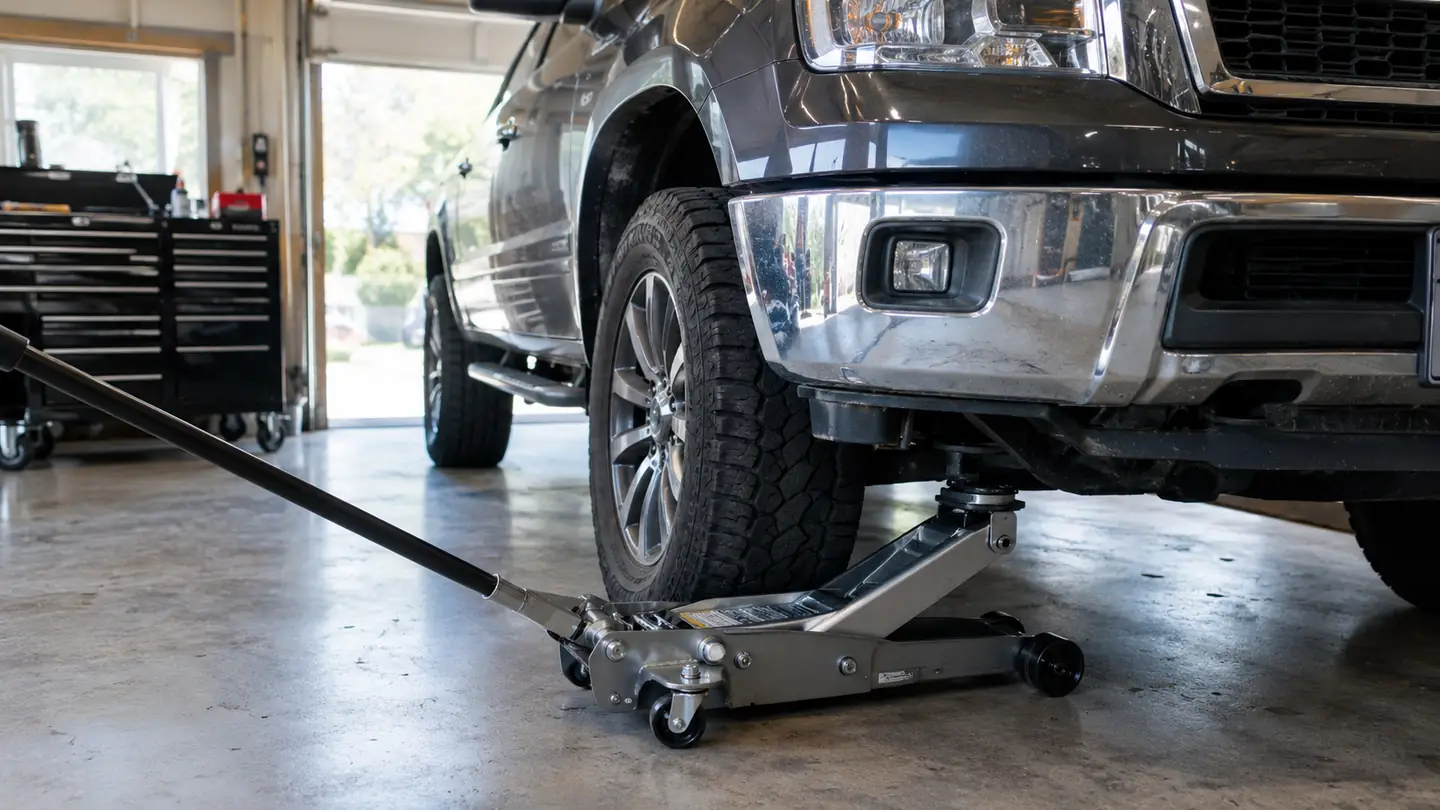
I have been doing my own vehicle work for thirty years, and I still remember the first time I crawled under a car that was only held up by a jack. I was nineteen, I did not know any better, and I got lucky. These days I use a Jack Boss 3 Ton Low Profile Floor Jack, and I use it the way the manual says, with jack stands under the frame before I go underneath. This guide walks through the exact steps I follow in my own garage, plus the mistakes I have made so you do not have to make them.
The Jack Boss floor jack is the one I reach for first on my 2014 Ford F-150. It has a low profile that slides under the front crossmember without me having to drive the truck up on boards, and the dual piston quick lift pump gets the saddle to the frame in a few strokes. But a good jack only does its job when you use it correctly. Here is the whole process, start to finish.
Start every job with a jack that lifts the whole truck
The Jack Boss 3 Ton Low Profile Floor Jack handles my F-150 and my wife's CR-V with room to spare. Check today's price on Amazon and keep it in the garage before your next oil change.
Amazon Check Today's Price on Amazon →Step 1: Park on level ground and set the brakes
Level ground is not a suggestion, it is the whole ballgame. A jack that rolls on a slope turns a simple oil change into a runaway truck. I park the F-150 on the flattest part of my garage floor, put the transmission in Park, and set the parking brake hard. For extra insurance I chock the rear wheels on both sides, not just one.
If you are working on a driveway that slopes, do not try to level it with a board under one wheel. Find a flat spot, or wait until you can get the vehicle somewhere level. The Jack Boss has a wide base and casters that roll smoothly, but no jack in the world is safe on a hill.
One more thing before you lift: clear the area. I move the rolling tool chest out of the way, push the trash can aside, and make sure the garage door is closed so nobody wanders in while I am under the truck. And check your slope before you trust it. My garage floor drops a quarter of an inch over ten feet toward the door, enough for water to drain but also enough for a truck to creep if the brake is not set hard. I learned that on a Tuesday morning a couple of years ago when I skipped the chocks for a quick brake inspection. The truck started to creep toward the door, and I jammed a chock under the rear tire before it got far. That was the last time I skipped a step. Now the chocks live on top of the tool chest.
Step 2: Find the factory lift points
Every vehicle has designated lift points, and they are there for a reason. On my F-150, the front lift points are on the frame rails behind the front wheels, and the rear points are on the axle or the frame ahead of the rear wheels. The owner's manual shows them clearly, and I still check it when I am working on Carol's CR-V because the points are different.
Do not lift on the floor pan, the oil pan, the transmission pan, or the radiator support. I bent a floor pan on an old car in the early nineties by getting lazy with the saddle placement. I set the saddle on the pinch weld because it was right there and it looked plenty strong, and it folded like a soda can about halfway up. It cost me a full Saturday of hammering from underneath with a block of wood and a ball peen hammer, and the carpet never sat flat again after that. The Jack Boss saddle is wide enough to spread the load, but it still needs to sit on a structural point, and I learned that lesson the hard way so you do not have to.
If you are not sure where the lift points are, look at the owner's manual before you start. It takes two minutes and it saves you from a repair bill that makes the jack look cheap.
Step 3: Position the jack and raise the saddle
Before I bought the Jack Boss, I used the factory scissor jack that came with the F-150, and it was a workout every single time. The handle flexed with every crank, and it took the better part of forty turns to get the tire off the ground. That is why I bought a low profile floor jack in the first place. The Jack Boss saddle starts at about three and fifteen sixteenths inches, so it slides under the F-150's front crossmember without me having to drive the truck up on ramps first. I roll the jack into position so the saddle sits directly under the lift point, then I close the release valve by turning the handle clockwise until it stops.
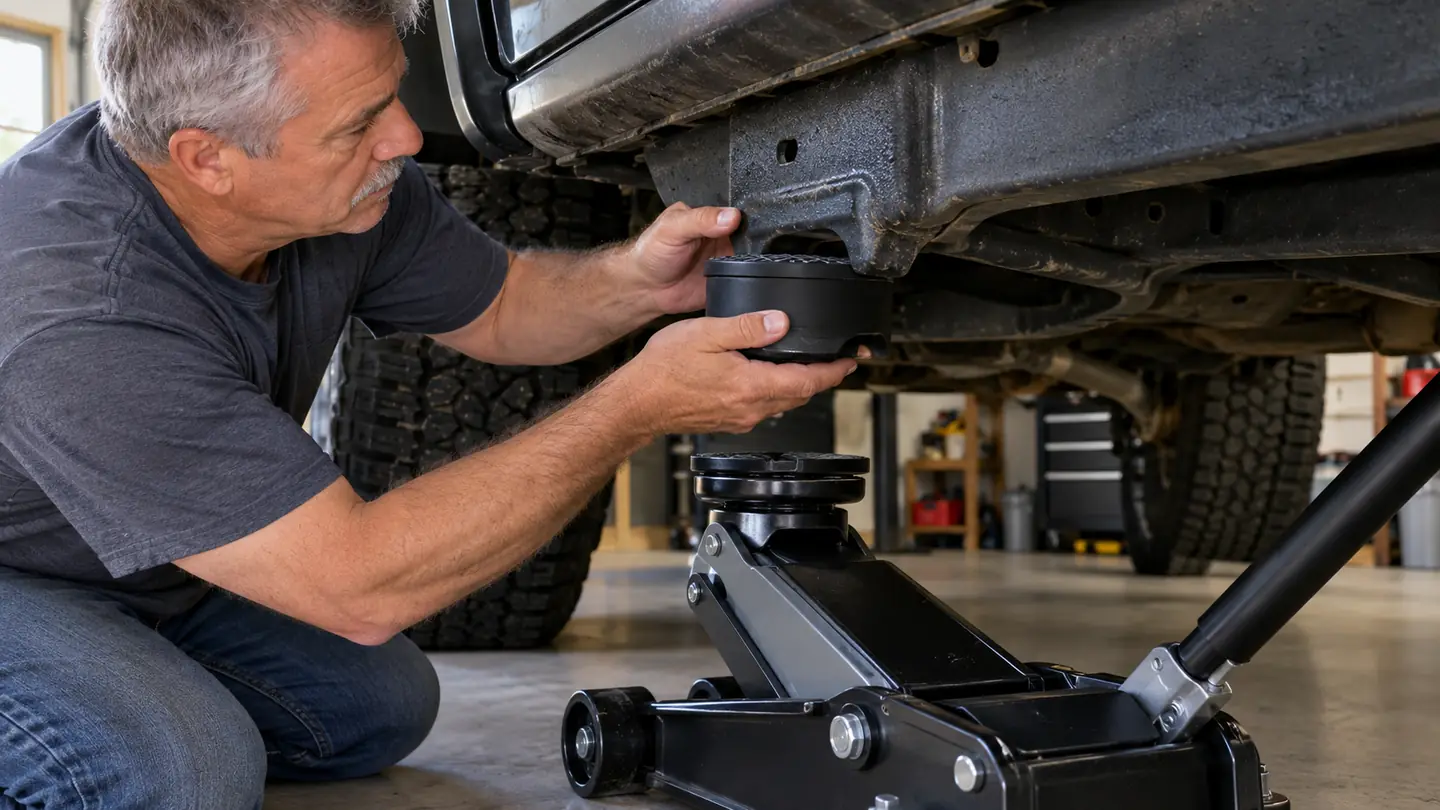
Use the quick lift pump to bring the saddle up to the frame. The dual piston design means the saddle rises fast on the first few strokes, then the main pump takes over. I pump until the saddle just touches the frame, then I stop and double check that the saddle is centered on the lift point. If it is off by even an inch, I lower it and reposition.
A rubber jack pad helps here. I keep one on the saddle so the metal does not dig into the frame, and it also gives the saddle a little grip so the truck does not shift as it rises.
Step 4: Lift, then set the jack stands
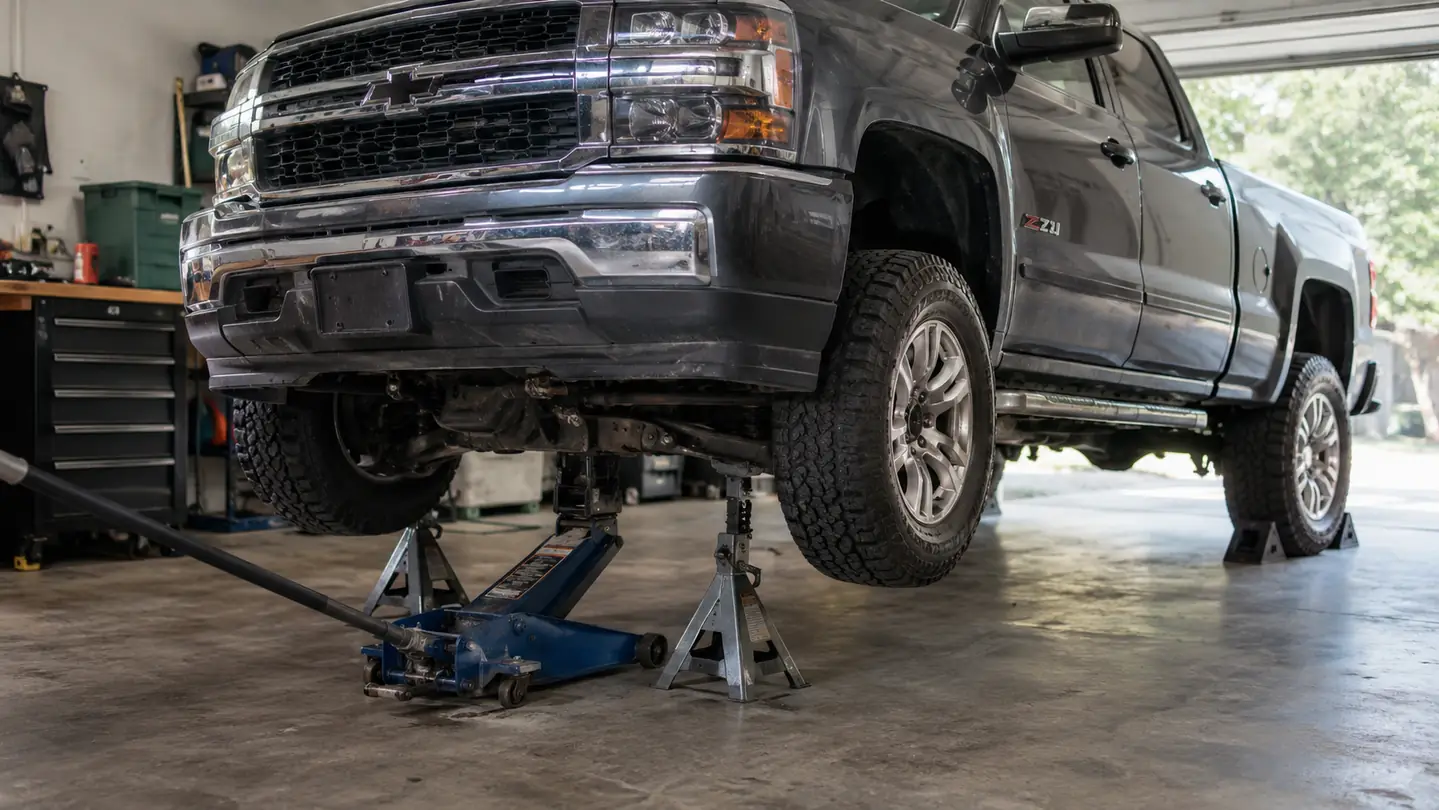
This is the step where I see the most DIYers cut corners, and it is the step that scares me the most. The Jack Boss is rated for three tons, which is more than enough for my F-150, but a floor jack is a lifting tool, not a holding tool. The hydraulic seals can leak, the handle can get bumped, and the truck can come down. That is why jack stands exist.
I pump the handle until the truck is high enough to slide a jack stand under the frame, then I set the stand on its base, extend the pawl to the frame, and make sure it locks into place. I do this on both sides before I even think about crawling underneath. The jack stays in place as a backup, but the stands are what hold the weight. I watched a floor jack fail once, years ago, on a car that had been up for maybe ten minutes while the owner went inside for a wrench. The seal let go without any warning, and the car came down onto the jack stands with a bang that echoed through the garage. The stands held, which is exactly what they are for, but the bang is something I have never forgotten. I give each stand a firm push after I set it to make sure the pawl is locked and the base is flat on the concrete.
How high should you lift? Just high enough to do the job. If you are changing oil, you do not need the tires off the ground. If you are rotating tires, you need enough clearance to get the tire off and the spare on. Lifting higher than necessary just gives the truck more distance to fall.
Step 5: Lower it slowly and never rush the release
When the job is done, I raise the jack just enough to take the weight off the stands, pull the stands out, and then lower the truck slowly by turning the release valve counterclockwise a quarter turn at a time. The Jack Boss has a controlled descent, but only if you open the valve gradually. Crack it too far and the truck drops hard enough to bounce the suspension and scare the daylights out of you.
Lower the truck until the tires touch the ground, then give the release valve one more small turn so the saddle drops free of the frame. Roll the jack out from under the truck, and you are done. I always do a final walk around to make sure nothing is left under the vehicle and the chocks are still in place before I drive away.
What Else Helps
A floor jack is one piece of a safe lifting setup. Jack stands are non-negotiable, and I use a pair of six-ton stands, which is more than the F-150 weighs with a full tank and the toolbox in the bed. Wheel chocks, a rubber jack pad, and a good work light round out the kit. I also keep a small piece of plywood under the jack when I work on gravel, though I prefer concrete. The plywood spreads the load so the jack does not sink, and I learned that trick after watching a jack sink two inches into soft ground the first time I tried to use it outside.
The Jack Boss floor jack has a lifting range that goes from about three and fifteen sixteenths inches up to eighteen and five sixteenths inches, which covers my F-150 and Carol's CR-V without any adapters. The dual piston quick lift pump is the feature I did not know I needed until I used it. The saddle comes up fast, and the overload tested rating gives me confidence when the truck is in the air.
A floor jack is a lifting tool, not a holding tool. The jack stands are what keep the truck up while you are underneath it.
The Mistakes I Made So You Do Not Have To
I have lifted a lot of vehicles over the years, and I have made most of the mistakes you can make. I have lifted on the wrong point and bent a floor pan. I have forgotten to chock the wheels and watched a car roll backward off a jack. I have even crawled under a truck with no stands at all, back when I was young and stupid. The Jack Boss is a good jack, but it will not save you from a bad procedure.
The most common mistake I see in forums is people using the jack to hold the vehicle while they work. The second most common is lifting on something that looks strong but is not, like a suspension arm or a tie rod. The third is rushing the release valve and letting the vehicle drop. All three are easy to avoid if you follow the steps above.
Who This Is For
This guide is for anyone who does their own oil changes, brake jobs, or tire rotations and wants to do them without a trip to the shop. The Jack Boss 3 Ton Low Profile Floor Jack is a good fit for pickup trucks, SUVs, and crossovers like Carol's CR-V. If you have a lowered car or a truck with a low front bumper, the low profile design is the reason to pick this one over a standard jack.
Who Should Skip It
If you only work on a small sedan and never plan to lift anything heavier, a two ton jack might be enough and you can save a few dollars. If you are not willing to use jack stands, no jack is safe for you, and I would rather you skip the whole project than work under a vehicle held up by hydraulics alone. The Jack Boss is a tool, and like any tool it only works when the person using it does the job right.
Keep the Jack Boss in your garage before your next oil change
The Jack Boss 3 Ton Low Profile Floor Jack lifts my F-150 and Carol's CR-V with room to spare. Check today's price on Amazon and add a pair of jack stands to the order while you are at it.
Amazon Check Today's Price on Amazon →