
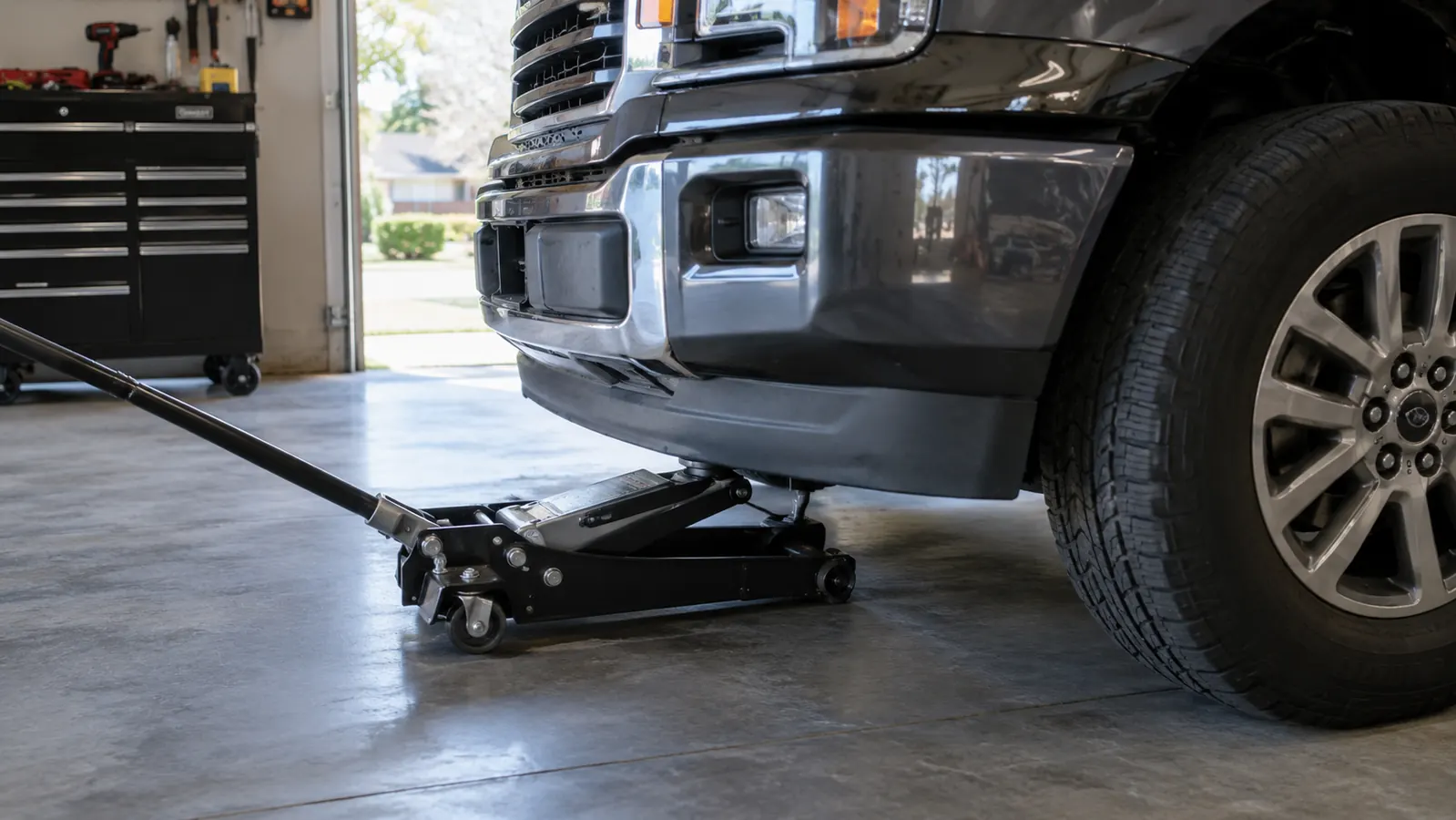
I will start with the part most reviews skip: this jack is heavy. The Jack Boss 3 Ton Low Profile Floor Jack weighs right around 80 pounds, and if you are 58 years old with a lower back that complains after a long day, you will feel every one of those pounds the first time you haul it out to the driveway. I am Walt Kessler, and I have done my own vehicle maintenance for thirty years in a two-car garage outside Dayton, Ohio. My daily driver is a 2014 Ford F-150 with a little over 190,000 miles on it, and my wife Carol's 2017 Honda CR-V gets the same treatment. I bought this Jack Boss in early April, and after six months of oil changes, brake jobs, a transmission drain and fill, and one very stubborn exhaust hanger, I have a clear picture of what it does well and where it falls short.
The headline numbers are honest, and I checked them with a tape measure. The lift range is 3-15/16 inches at the lowest setting to 18-5/16 inches at full height. That clears my F-150's front crossmember without a block of wood, and it still reaches the frame rails on the lower-sitting CR-V. The 3 ton rating is not marketing fluff. The frame is aluminum and steel, the dual piston quick lift pump gets the saddle to the frame in two or three strokes, and the whole thing feels solid under a load. But there are things the product photos do not tell you, and I want to walk you through them before you spend your money.
The Quick Verdict
A genuinely capable low profile jack that lifts my F-150 and my wife's CR-V with room to spare, held back by a heavy frame, a handle that rattles, and a release valve that needs a light touch.
Amazon Check Today's Price →The low profile jack that actually clears my F-150's crossmember
After six months of weekend maintenance, the Jack Boss 3 Ton is the jack I reach for first. It lifts my pickup and my wife's SUV without a block of wood, and the dual piston pump gets the saddle up fast. Check today's price on Amazon and see if it fits your garage.
Amazon Check Today's Price on Amazon →How I've Used It
I bought the Jack Boss in early April, and it has been under a vehicle at least once a month since. The list of jobs is six oil changes, two full brake jobs, a transmission fluid drain and fill on the F-150 in September, and one afternoon in October replacing a rusted exhaust hanger. That is the kind of schedule a home mechanic actually has, and it is why I wanted a jack I did not have to think about.
The exhaust hanger job is the one that sold me. It was a Saturday in mid-October, and the hanger was rusted through where it met the frame, which meant the tailpipe was hanging about two inches low and banging on a heat shield. I sprayed the bolts with penetrating oil Friday night, and Saturday morning I slid the Jack Boss under the front of the F-150, pumped it to full height, and set two 6-ton jack stands under the frame. With the truck up that high, I could get under it on a creeper and reach the hanger with a ratchet from the side. My shoulders never touched the frame, and the job took about an hour instead of the whole afternoon I had budgeted.
The dual piston quick lift pump is the feature I did not expect to care about. On my old floor jack, I would pump the handle eight or nine times just to get the saddle to the frame. The Jack Boss does it in two or three, and then the main pump takes over. The first time I used it, the saddle was already touching the crossmember by the third stroke, which threw me off because I was expecting to pump six more times. When you are lying on the garage floor with a drip pan under the truck, every saved stroke matters.
I have also used it on Carol's CR-V, which sits lower than the pickup. The low profile saddle slides under the front subframe without me having to drive the car up onto a board first. That alone is worth a lot on a Sunday afternoon oil change. It is the difference between a 40 minute job and an hour job, and it is the reason the jack has earned a permanent spot next to the rolling tool chest instead of living in a corner.
The Weight Nobody Warns You About
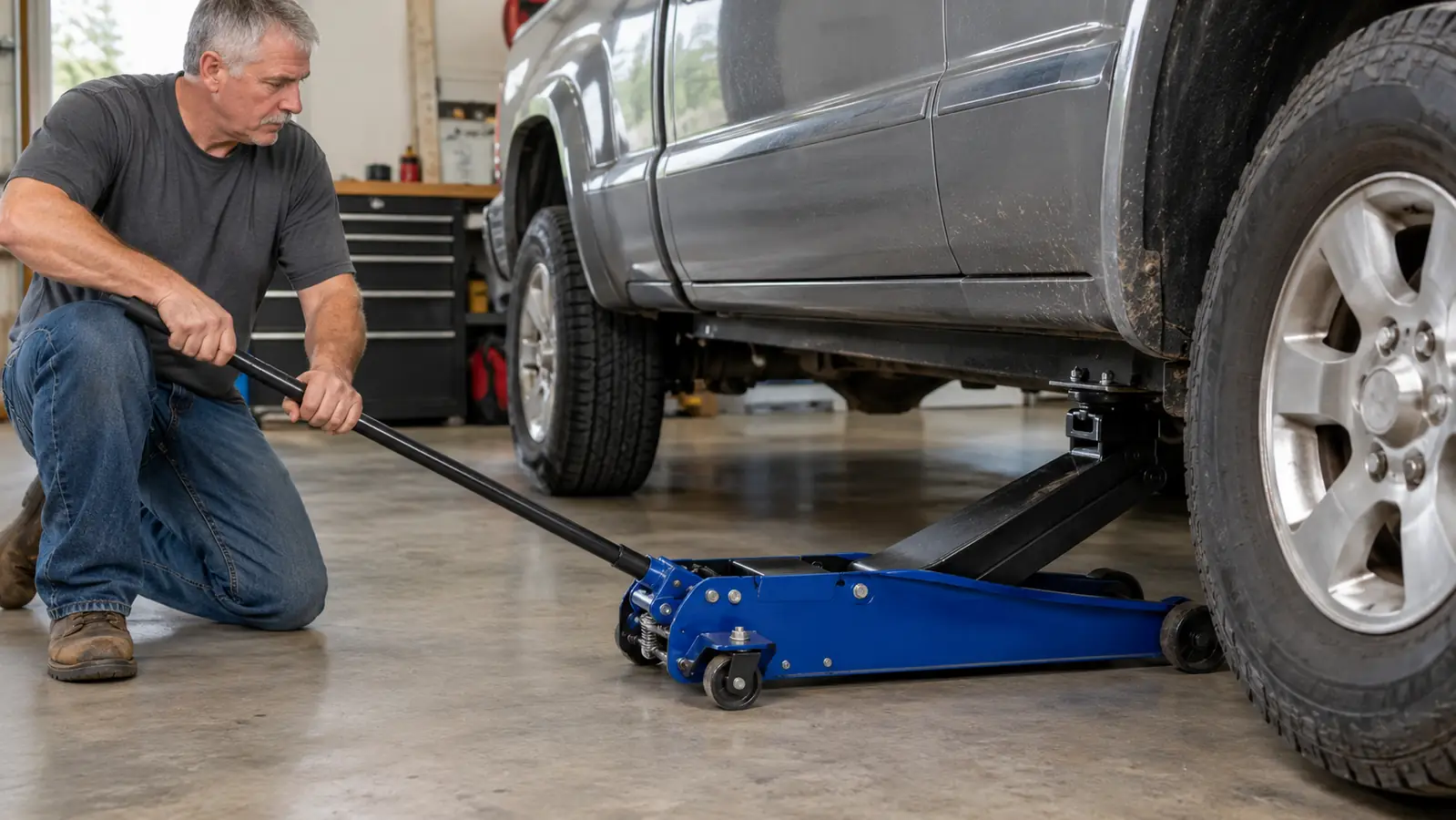
Here is the honest part. The Jack Boss weighs roughly 80 pounds. I put it on the bathroom scale one afternoon to confirm, and it read 79. The handle does not lock into place for carrying, so you lift it by the frame and the handle swings free. The first time I loaded it into the back of the F-150 to help a neighbor with his trailer bearings, the handle swung sideways, threw off my grip, and I nearly dropped the whole thing on my foot. I caught it with my knee, which I do not recommend. If you plan to keep this jack in a garage and roll it a few feet to the car, the weight is a non-issue. If you plan to haul it to the track or to a friend's house, plan your lifting strategy before you pick it up.
After that first near-miss, I worked out a better way to carry it. I grab the rear of the frame with one hand and the front of the frame with the other, and I walk it like a wheelbarrow, with the front wheels on the ground. That keeps the handle out of the way and puts most of the weight on the wheels instead of my back. It is still not something I want to carry up a flight of stairs, but it is manageable on flat ground.
The weight is also the reason the wheels matter, and the wheels on this jack are decent but not great. The two rear casters roll smoothly on clean concrete, and the front wheels are wide enough that they do not sink into the gaps between garage floor panels. On gravel or cracked asphalt, the jack is a handful. I rolled it across the driveway to do the CR-V brakes in July, and the front wheels caught in every expansion crack. Keep it on concrete and you will be happy.
At 18-5/16 inches, I can get the F-150 high enough to slide a creeper under it and still have a few inches of travel left in the jack.
Lift Range: What the Spec Sheet Doesn't Tell You
The spec sheet says 3-15/16 inches minimum to 18-5/16 inches maximum, and those numbers are accurate. What the spec sheet does not tell you is that the minimum height is measured at the saddle, not at the frame rail. I measured the front crossmember on my F-150 with a tape measure one afternoon, and it sits about eight inches off the ground with the tires at normal pressure. The saddle at its lowest point is under four inches, so it slides under with room to spare, and the saddle rises to meet the frame in a couple of pumps. On a lowered car, you might still need a small piece of 2x6 to get the saddle under the pinch weld. That is not a flaw in this jack. It is the reality of any low profile jack, and it is worth knowing before you order.
The maximum height is the number that surprised me. At 18-5/16 inches, I can get the F-150 high enough to slide a creeper under it and still have a few inches of travel left in the jack. My old jack topped out around 16 inches, which meant the front of the truck was just high enough to get a stand under the frame, but not high enough to work comfortably. The transmission drain and fill in September was the job that showed me the difference. I lifted the front to full height, set the stands, and the pan was at a comfortable working height with the truck level. On the old jack, I would have had to crib the front end with 2x6s to get the same working space.
That extra headroom is what makes this jack useful for transmission work and exhaust work, not just tire rotations. If you only need to swap wheels, you will never use the full range, but it is nice to have when you do. I looked at a couple of 2 ton jacks before I bought this one, and the shorter lift range was the reason I passed on them. A 2 ton jack will get a wheel off the ground, but it will not get you under the truck, and under the truck is where the real work happens.
The Release Valve and the Handle Rattle
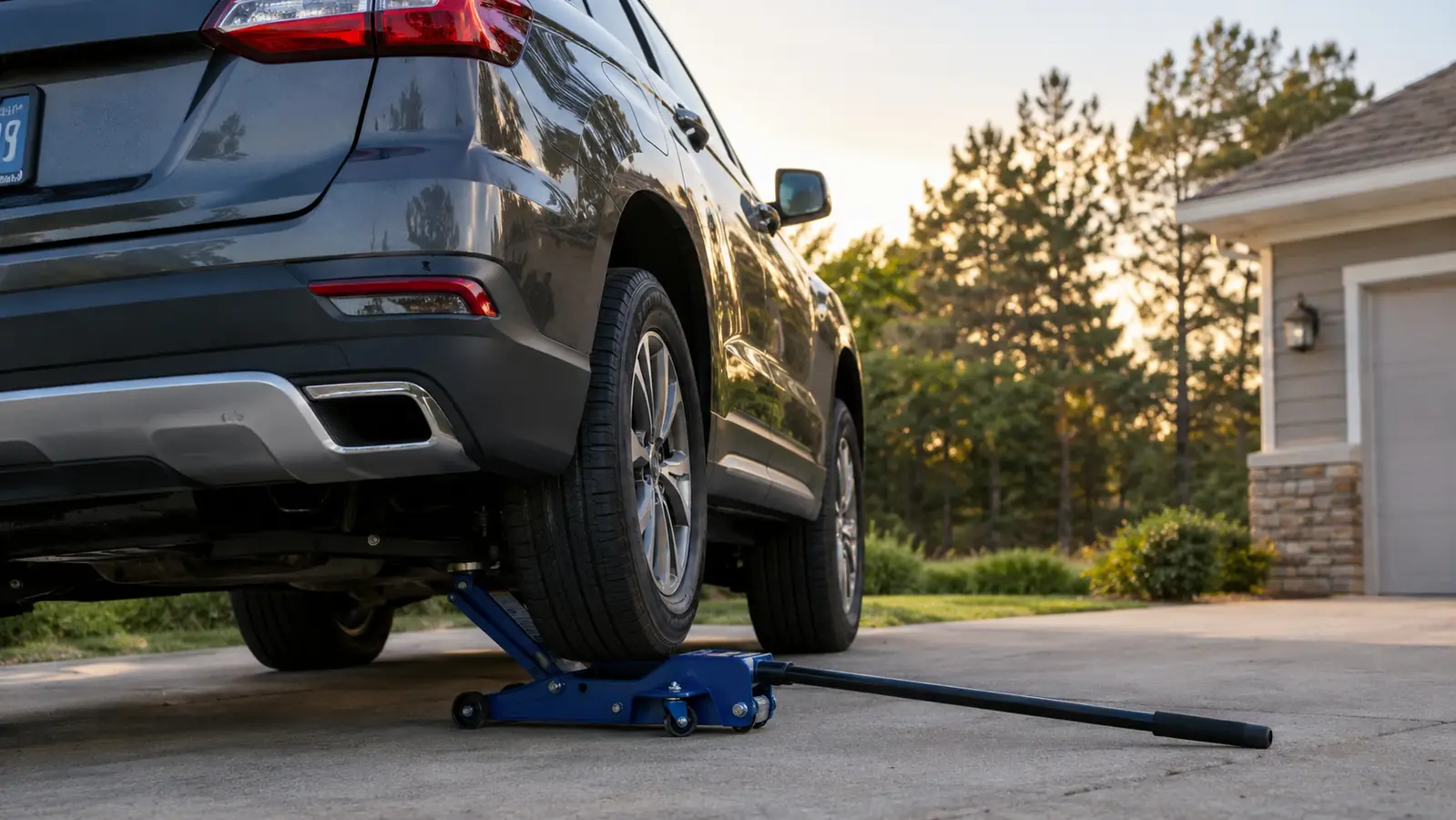
Now the flaws. The release valve is sensitive. The first time I lowered the F-150, I turned the valve a quarter turn and the front end dropped a good two inches before I caught it. The jack did not slam down, but it came down faster than I wanted, and the whole truck rocked on the jack stands. I have learned to crack the valve open just a hair and let the load settle, and now it comes down so slowly you can watch the saddle separate from the frame. That is a learning curve, not a deal breaker, but it is the kind of thing a review should tell you before you put your hand on the valve.
It took me three or four lowering cycles to get the feel. The valve has almost no dead zone between closed and open. A hair is a lot, and a quarter turn is a lot more. My old jack was the opposite, you could turn the valve a full turn before anything happened, so my instincts were exactly wrong for this one. The manual warns about this, and the manual is right. If you buy this jack, spend the first five minutes lowering an empty jack a few times before you put a vehicle on it.
The handle also rattles. It is a two-piece design that locks together with a pin, and the joint has a little play in it. When you are pumping, you feel a slight clunk at the top of each stroke. It does not affect the lift, and it has not gotten worse in six months, but it is there, and it is the kind of thing you notice when you are working in a quiet garage at 7 AM on a Saturday. If you are the kind of person who notices a rattle in the cab of a 190,000 mile truck, you will notice this.
One thing I have not had to do is add fluid. The jack arrived with the reservoir full and the release valve closed, and it has not needed a drop since. The frame is rated to 1.5 times its 3 ton capacity in the overload test, and I have not felt any flex in the aluminum and steel frame under anything I have put on it. For a home mechanic, that is the kind of margin that makes you trust the tool.
What I Liked
- Low profile saddle slides under a full-size pickup and a low SUV without a board
- Dual piston quick lift pump saves strokes on every single raise
- 18-5/16 inch max height is enough for creeper work under a full-size truck
- Aluminum and steel frame rated to 1.5x its capacity in the overload test
- Has not lost fluid or lift in six months of monthly use
Where It Falls Short
- Roughly 80 pounds, and the handle does not lock for carrying
- Release valve is sensitive, a quarter turn drops the load fast
- Handle joint rattles with a clunk at the top of each stroke
- Wheels are only happy on clean concrete
Who This Is For
This jack is for the home mechanic who works on a concrete floor, wants one jack that handles both a pickup and a low SUV, and does not mind a little weight in exchange for a solid frame. If you do your own oil changes, brake jobs, and the occasional suspension job, the Jack Boss 3 Ton will do everything you ask of it. The low profile saddle and the 18 inch lift range mean you will not outgrow it quickly.
It is also for the person who keeps a floor jack for years instead of replacing it every couple of seasons. I have had cheap jacks that leaked fluid and lost lift within a year. This one has not done either in six months, and the construction suggests it will not start. I plan to have this jack in my garage for the rest of the time I am wrenching on the F-150, which at the rate I am going is a long time.
Who Should Skip It
Skip this jack if you need something you can carry to the track in a trunk every weekend. At roughly 80 pounds, it is a garage tool, not a travel tool. Skip it if you work on gravel or dirt, because the wheels are not built for soft ground. And if you are a beginner who has never used a floor jack before, the sensitive release valve means you should practice lowering an empty jack a few times before you put a car on it. The Jack Boss is a capable tool, but it demands a little respect.
If you only work on one low car that never leaves the pavement, a smaller 2 ton jack will do the same job at half the weight. The Jack Boss is built for a household with a full-size pickup and an SUV, which is exactly what it is in mine. That is not a knock on the jack. It is a warning about matching the tool to the job, which is the same advice I would give anyone standing in the aisle wondering which one to buy.
Still deciding? This is the jack I keep reaching for
Six months in, the Jack Boss 3 Ton has earned its spot in my garage. It lifts my F-150 and my wife's CR-V, the low profile saddle slides under both, and the dual piston pump makes the work faster. Check today's price on Amazon and see if it fits your garage.
Amazon Check Today's Price on Amazon →